
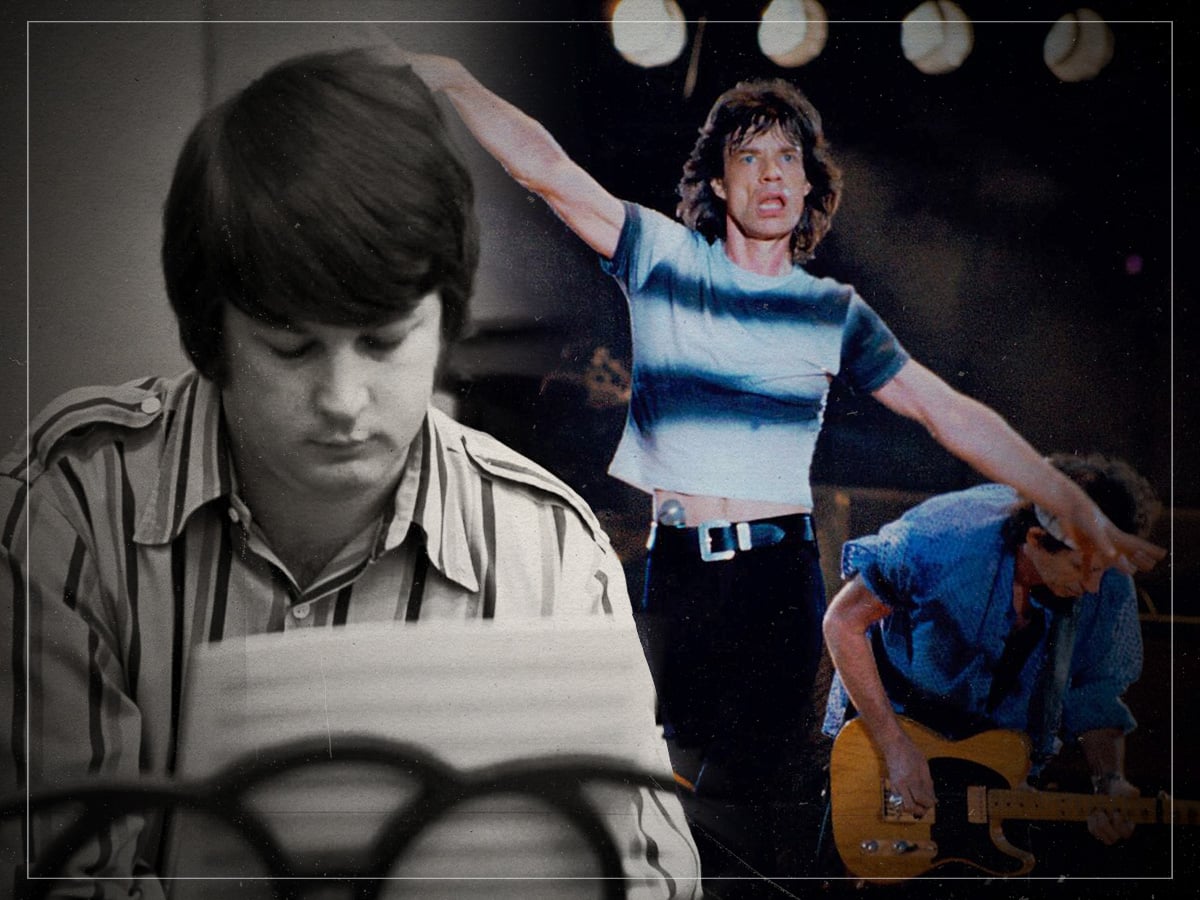
(Credits: Far Out / Brian Wilson / Alamy)
Thu 15 January 2026 20:30, UK
Brian Wilson was never in the business of creating mere background music or advertising jingles.
Throughout his illustrious career, the Beach Boys songwriter seemed to speak directly to the souls of his legions of listeners, and even now, his material seems to have a unique power of finding you when you need it most. For Wilson himself, though, it was The Rolling Stones who served that purpose.
Despite the band’s sparkly, sun-soaked image, typified by surfboards and matching shirts, The Beach Boys was rarely a harmonious band to be in. During their early years, for example, the group was overshadowed by the abusive tendencies of Wilson’s father, and The Beach Boys’ manager, Murry Wilson. Even when they had rid themselves of his grasp, though, the band was still plagued by vicious infighting and longstanding feuds stretching across multiple decades.
What’s more, Wilson quickly found that the intense pressure of being in a touring group was too much to handle, and his decision to become a studio-only member of the band from 1964 onwards caused a pretty unavoidable chasm between the songwriter and the rest of the band. To top it all off, Wilson’s studio experiments were spurred on by LSD, a drug which he claimed caused permanent damage to his mental health.
That brief encounter with LSD also seemed to predict his later struggles with drug addiction, used to self-medicate his mental health struggles and deal with the unbearable pressure of being a Beach Boy. By the mid-1970s, then, Wilson was in an incredibly tough spot, becoming a borderline recluse following the death of his father in 1973, neglecting both his musical career and his personal relationships – namely, his then-wife, Marilyn Rovell.
Music has a way of soundtracking your struggles, but it was one often underappreciated effort by the kings of anarchic rock and roll rebellion, The Rolling Stones, that snapped Wilson out of that slump.
“I was just drinking a lot of liquor, a lot of booze. I was really laying in the gutter,” the songwriter recalled of that period in his life. “I was on the street without a house because my wife and I had a big argument. And I went out and would bum cigarettes off people, I would drink here, and I would get drunk maybe later that night.”
“Then,” he recalled, “I heard ‘Fool to Cry’ on a jukebox in San Diego. I started crying and said, ‘That’s what I needed.’” During his darkest hour, it was one of Mick Jagger’s few ballads that dragged him out of the gutter. “I just needed that. They saved me. They saved my very brain.” He concluded, “I’ll never forget that, you know. I’ll always remember that.”
If you look at the timeline of Wilson’s career, 1976 – the year that The Stones unveiled the Black and Blue track for the first time – does seem to coincide with a renewed creative drive, along with an effort to kick his debilitating drug addiction.
Sonically, ‘Fool to Cry’ was a huge departure from The Stones’ typical sound, which is perhaps why it is rarely considered among their greatest efforts. Regardless of the public reception to it, though, without that album, it sounds as though the world might never have heard from Brian Wilson ever again.
Related Topics