
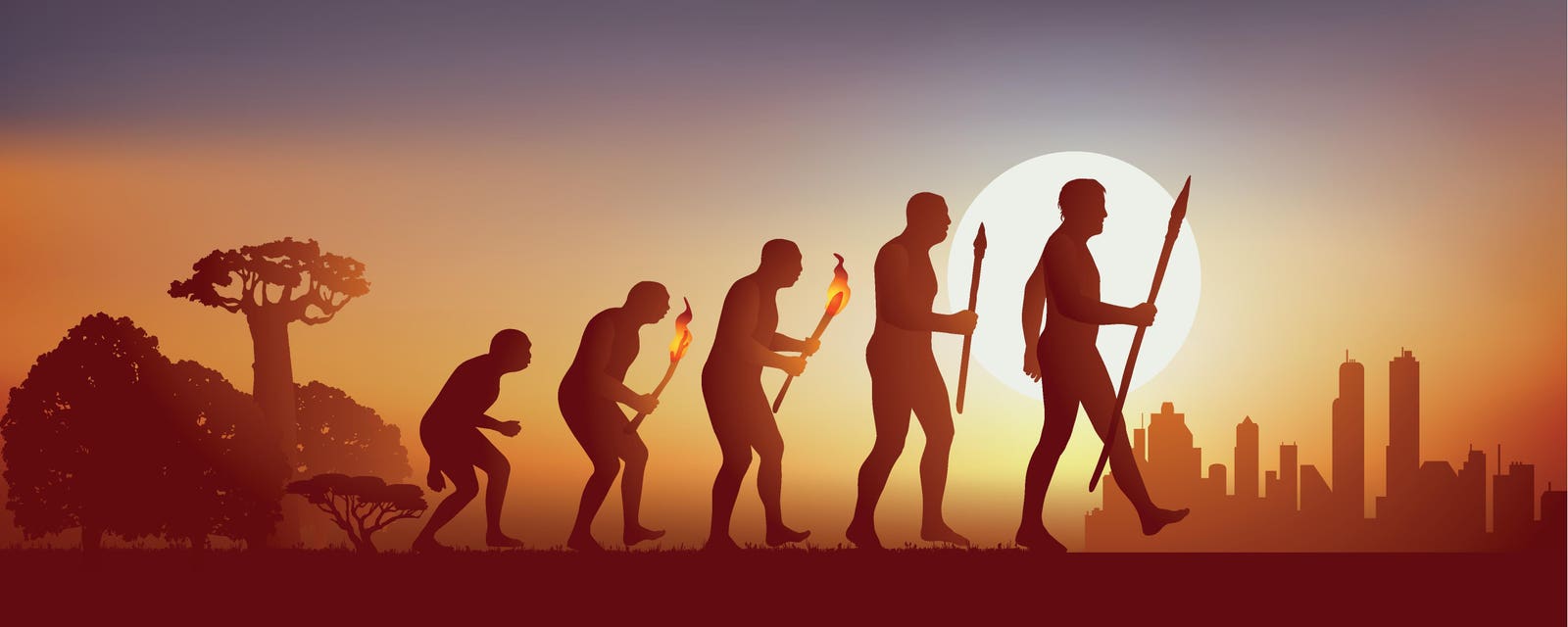
Humans are the only primates that run nearly naked under the sun. Here’s how this biological tradeoff reshaped how our ancestors hunted, cooled themselves and survived.
getty
Losing body hair is usually a liability for most animals. Fur is what protects many creatures against the cold, ultraviolet radiation, parasites and water loss. Yet we humans, unlike any other primate on the planet, are largely hairless. Instead, we rely almost entirely on an extensive system of sweat glands to regulate our body temperature.
Few evolutionary exceptions are accidental, and this one is no different. According to biologists, our lack of fur is among the most consequential tradeoffs ever made in human evolution. Here’s why, according to research.
Why Humans Started With Fur
Fur is the norm among mammals. Its primary purpose is to trap air close to the skin in order to create an insulating layer that stabilizes body temperature, and most mammals rely on this insulation. Species that do will primarily regulate their heat through panting, behavioral cooling or localized sweat glands.
Primates are no exception to this tendency. Chimpanzees, gorillas and macaques all have relatively dense body hair, and are paired with minimal eccrine sweat glands. Typically, their thermoregulatory strategies will involve finding shaded areas, reducing activity during peak heat and modest sweating on hands and feet.
However, as research from the Journal of Human Evolution explains, despite being part of the primate family, humans reversed this pattern. Compared to other primates, we have far less visible body hair, yet we also have dramatically more eccrine sweat glands — between two and four million across the body. These glands secrete watery sweat directly onto the skin surface, enabling efficient evaporative cooling.
Of course, this change didn’t happen magically overnight. There’s ample fossil and genetic evidence that suggests it occurred gradually during the time that early members of the genus Homo needed to start adapting to hotter, more open environments.
Why Humans Lost Their Fur
One of the strongest hypotheses that explains this hair loss, as 2015 research from Comprehensive Physiology explains, centers on heat stress. Around two million years ago, early humans began spending significantly more time in open savanna environments, rather than shaded forests.
These landscapes exposed our ancestors to intense solar radiation and higher ambient temperatures. At the same time, archaeological and anatomical evidence indicates that they also increasingly relied on long-distance walking and running. Naturally, moving long distances in the heat generates substantial metabolic heat. But without a way to dissipate it, body temperature can rise to dangerous, if not lethal, levels.
So, although fur is an excellent source of insulation, it became a risky liability under sustained heat production. Specifically, it can significantly hinder the process of heat loss by trapping air and reducing evaporation at the skin surface.
In time, humans evolved to reduce body hair and increase sweating to solve this problem. Sweating, in particular, is uniquely effective due to how well it exploits evaporation, as it removes heat efficiently by turning liquid water into vapor. In turn, each gram of evaporated sweat will carry away a significant amount of thermal energy.
Why Humans Chose Sweating Instead
As research from the International Journal of Biometeorology explains, humans excel at sweating. This is because we evolved to have eccrine sweat glands densely distributed across the body. This, in turn, enables us to produce large volumes of dilute sweat. And unlike panting, sweating allows cooling without facing any disruptions in breathing or feeding.
Notably, this is a system that works especially well during endurance activities, such as long-distance walking and running. Compared to other mammals, we can sustain moderate-intensity activity in heat for significantly longer periods of time, and without the risk of overheating. This ability most probably played a defining role in persistence hunting: a strategy in which early humans tracked prey over long distances, until the animals overheated and collapsed.
However, many may still wonder: If hair loss works so well for cooling, then why did we retain our dense scalp hair? The answer appears to be solar protection. That is, the hair on our heads shields our scalps from direct sunburn, while simultaneously protecting the brain and mitigating heat gain.
Scalp hair (especially tightly curled hair) can significantly reduce heat load from sunlight, while still allowing sweat to evaporate. This combination made it possible for early humans to run and walk in the sunlight without cooking their brains, which is a critical advantage in equatorial environments.
The Costs And Benefits Of Humans’ Hairlessness
It’s also worth noting that losing our fur came with serious costs. Specifically, without fur, humans became highly vulnerable to three key threats:
Cold stressUltraviolet radiationSkin injury
These risks are likely what drove the evolution of many of our behavioral adaptations, such as making clothing and garments, constructing shelter and utilizing fire.
In other words, hair loss locked humans into a cultural evolutionary path. As soon as we lost our fur, our survival strategies increasingly started to depend on tools, cooperation and technology. This feedback loop between biology and culture is one of the defining features of human evolution.
While they may seem like trivial facts of life today, the loss of fur and the rise of sweating is a switch that fundamentally changed human ecology. It allowed our ancestors to:
Forage during the hottest parts of the dayTravel farther than competitorsExploit new food sourcesLearn the value of cooperation, innovation and cultural transmission in managing the downsides of exposure
In evolutionary terms, this change was a highly risky bet — but, ultimately, it has clearly paid off. Humans became endurance specialists in a world dominated by heat. Our hairlessness may seem ineffective, and our sweatiness may seem unbecoming, but neither is a sign of weakness. Both are evidence of a lineage that chose mobility and persistence over insulation and retreat.
How connected is your human mind to the natural world? Take this science-backed test to find out: Connectedness to Nature Scale
Which animal reflects your most protective human instincts? Take this fun, science-inspired test to get an instant answer: Guardian Animal Test