
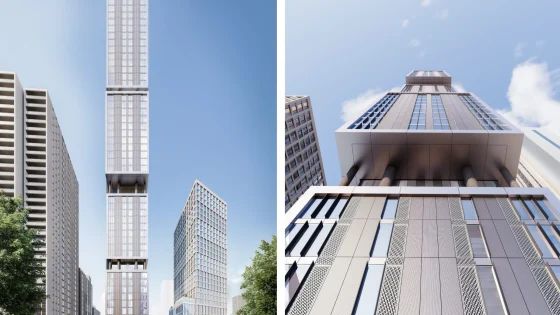
A decision on the 752-apartment development had been delayed twice, including to allow councillors to visit the site, which is covered by the Manchester Piccadilly Strategic Regeneration Framework.
But yesterday (15 January) the planning committee voted unanimously to reject the application, citing concerns about scale, right-to-light, deliverability and a lack of affordable housing.
This was despite the planning officer recommending the scheme’s approval. The application is expected to come back to the committee a final time to sign off on the reasons for its refusal.
The buildings were proposed for 140 Great Ancoats Road, a 1ha site in the east of Manchester’s city centre, currently home to a furniture showroom and parking facilities. The scheme is backed by Liquid Business (Manchester).
The taller tower would have contained 558 flats, amenity space and a café, while the shorter tower would have contained 3,700m2 of co-working space over the first four floors, with around 200 homes and amenity spaces above.
The application received 133 objections, including from residents in the neighbouring 5plus Architects-designed Oxygen Towers (completed in 2021).
A right to light report submitted by AKT Surveyors argued that as many as 80 per cent of rooms assessed within Oxygen Towers north elevation would have their light ‘decimated’ by the new towers.
The committee also heard concerns raised over the scheme’s lack of affordable housing. Councillor Richard Kilpatrick pointed out the contrast between the provision of ‘lounges, coworking facilities, podcast and meeting rooms, a gym, spa and game rooms, and a bar’ to the claim that the project could not afford to supply any affordable homes, or ‘even any one-bedroom properties’.
Although Kilpatrick admitted that a site visit had allayed some of his concerns about the impact on rights to light, he said that this viability and affordable homes issue was what ‘really frustrates me’, amounting to an ‘absolute red line’ that he could not support.
It was also noted that the proposal did not conform to the strategic regeneration framework, which stated that the upper limit for developments on that site should not exceed 45 storeys and that any new building should be integrated into the surrounding area.
Another councillor, Sam Wheeler, argued that the SimpsonHaugh towers would create an ‘impressive canyon effect’ that would increase pollution at street level.
Based on these concerns, councillor Paul Andrew decided to go against the officer’s recommendation and propose a ‘minded to refuse’ motion, which was then backed by the rest of the committee.
The 50-storey tower is designed to be made up of four segments, increasing in size going upwards, with the segments broken up by inset double-height amenity and duplex levels.
The 25-storey tower, meanwhile, has a trapezium plan, with the four office storeys extended outwards from the rest of the mass.
SimpsonHaugh described this tower as ‘a strong form emphasised by its corner location and reinforced by a supergrid composed of light coloured concrete with infill lightweight glazing and aluminium.
‘The office component will create a focal point for the new park and will be dressed in a lightweight glass façade with rhythmic vertical fins.’
The practice has been contacted by the AJ for comment on the scheme’s refusal.
The proposal is the latest of several Manchester skyscraper schemes by SimpsonHaugh. Last April it won planning approval for a 76-storey tower, which would be the largest in the UK outside of London.
Last summer, it won approval for five towers of between 47 and 71 storeys, while it has also delivered a pair of 52-storey towers and a pair of 51-storey towers at the Deansgate cluster.
Existing site view: