
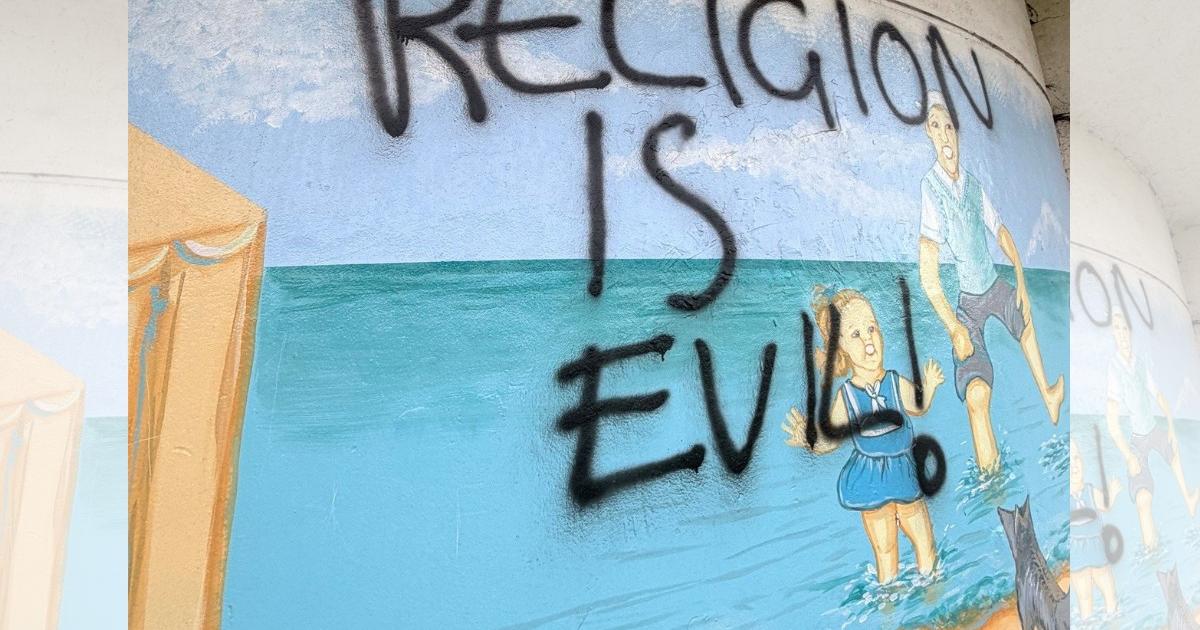
New Brighton Creative Futures CIC reaffirmed its support for ‘lawful creative expression in public spaces’, noting that freedom of expression is protected under the Human Rights Act 1998.
However, it stressed that spraying “religion is evil” tagging over existing murals and defacing buildings is vandalism.
The affected paintings were delivered through the Momentary Art Project CIC around 2013, with Nicola of TAGarts, involving Mount Primary School and United Utilities as the building owner, with Alison Bailey Smith among those involved.
Responding to the repeated “religion is evil” tagging, the CIC described the message as “naïve and misguided” and emphasised New Brighton’s inclusive civic identity as “a town of many faiths and none”.
Rory Wilmer, on behalf of New Brighton Creative Futures CIC, said: “New Brighton is big enough for protest, art, faith and disagreement — but it is not a free-for-all.
“Freedom of expression isn’t a permission slip to destroy other people’s work.
“If you’ve got something to say, we’ll always encourage lawful, constructive routes that don’t leave permanent damage in their wake.”
The CIC is urging anyone with information to report vandalism through the proper channels, including the police via non-emergency reporting (101) or online reporting routes.
Mr Wilmer’s statement continued: “It hurts to see public art in New Brighton vandalised like this.
“Spraying over existing murals, defacing buildings, and repeatedly tagging areas of the promenade and storm channel is not “street art” in any meaningful sense — it is vandalism. Graffiti without the owner’s consent is widely treated as criminal damage.
“We also want to clearly acknowledge the people and organisations who did the work properly in the first place.
“The original paintings were created through the Momentary Art Project CIC (around 2013) with Nicola of TAGarts, and involved Mount Primary School, working with United Utilities as the building owner. Alison Bailey Smith was part of that effort, which was built on permission, partnership, and care for place.
“That point matters, because our approach is the same: we work with permission.
“We seek consent from property owners and partners, and we take extra care where buildings have heritage value.
“This is not bureaucracy for its own sake — it is respect for the town, and for the artists, schools, volunteers, and funders who put time, money, and pride into making New Brighton better.
“We also want to be clear about the message being written. The statement “religion is evil” is naive and misguided. Religion itself is not inherently evil; rather, throughout history, bad people have committed harmful acts in the name of religion.
“New Brighton is a town of many faiths and none, and we welcome people of all beliefs — religious, non-religious, and everything in between.
“You do not have to be religious to appreciate the presence, architecture, and community value of New Brighton’s places of worship.
“Equally, you do not have to share anyone’s beliefs to respect their right to hold them.
“If you are the person doing this: if you have something you want to say, there are better ways to say it. Graffiti has a long history of “speaking truth to power”, but destroying other people’s artwork and damaging buildings is the wrong route.
“We are open to helping people find lawful, constructive options — including temporary formats that don’t cause lasting damage — provided they are agreed with the people responsible for the spaces being used.
“If you witness vandalism, or have information that could help stop it, please report it through the proper channels (including the police via non-emergency reporting) and/or to the relevant property owner.”
The statement concluded: “New Brighton has already lost far too much of its historic character through decades of neglect and poor decision-making.
“We will not normalise another cycle of decline — especially when so many people are working hard to make the town cleaner, kinder, and more beautiful.”