

At a contentious, hours-long public hearing last month over a proposed giant data centre in Chandler, Arizona, Christine Ellis captured Big Tech’s big problem with a simple question.
“What’s in it for Chandler?” asked Ellis, vice-mayor of a city of 275,000 people in the desert southeast of Phoenix. “If you can’t show me what’s in it for Chandler, then we are not having a conversation.”
The builder, Active Infrastructure, apparently could not come up with a satisfactory answer. The city council rejected its bid. The proposed data centre is, for now, on ice.
This was not an isolated incident. From Oregon to Indiana, Missouri to Virginia, American communities are revolting against the great data centre buildout — a $5 trillion (£3.75 trillion) race to frantically erect the infrastructure to power the artificial intelligence boom.
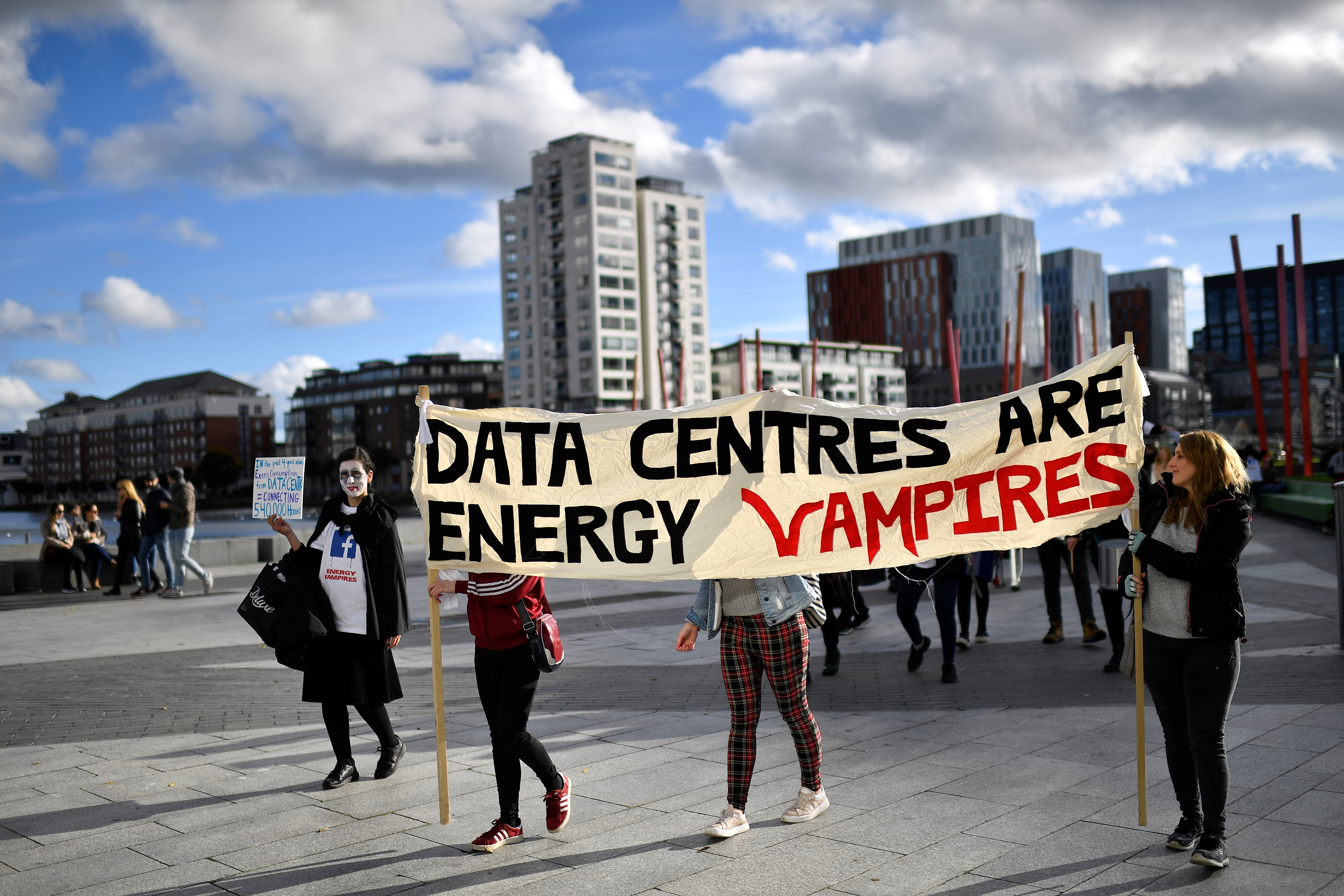
Demonstrators outside Meta’s European headquarters in Dublin. The unrest over data centres is spreading
CLODAGH KILCOYNE/REUTERS

According to Heatmap, a specialist journal, 99 data centre projects — out of the 770 that have been proposed but are yet to begin construction in the US — are being opposed by local communities. Last year, 25 were cancelled, up from just six in 2024.
Silicon Valley has promised a fantastical AI future where cancer is cured, climate change solved and every child is given their own digital tutor. The surge of investment into developing these artificial intelligence systems, and the data centres that underpin them, has fuelled a soaring stock market and become a pillar of the economy. Strip out AI investment from America’s economy, where gross domestic product (GDP) grew at an annualised rate of 4.3 per cent in the third quarter of 2025, and growth would be stagnant.
And yet, the revolution has begun to wobble as communities revolt against power-hungry facilities out of fear that they will drive up energy bills, sap water resources and speed the arrival of an army of bots that might take their jobs.
Sensing the danger, President Trump last week said that tech companies must fund their own energy infrastructure and “pay their own way”. He added: “I never want Americans to pay higher electricity bills because of data centres.”
• Katy Balls: Trump’s big problem is not Epstein — it’s the AI bubble

Donald Trump, with secretary of state Marco Rubio, left, and defence secretary Pete Hegseth, announced in August that Meta was going to spend $50bn on its Hyperion data centre in Louisiana. He is now less bullish on AI
JONATHAN ERNST/REUTERS
Microsoft, one of the world’s largest data centre operators, has also sought to head off the revolt. Last week, it unveiled a five-point plan for what it called “Community-first AI infrastructure”. The scheme includes training programmes for local workers; replenishing water that the company uses to cool data centres; rejecting tax breaks to ensure that local communities reap the benefits from higher property taxes; and paying above-market rates for power to make sure facilities do not push up household prices.
Mitch Jones, head of litigation and policy at Food & Water Watch, a Washington-based non-governmental organisation, dismissed Microsoft’s plan. “Every time a destructive, extractive industry comes into communities that aren’t used to having these giant industrial facilities, they make those same promises,” he said. “And time and time again, we see that despite those promises, the local community suffers.
“This is Microsoft responding to what they rightly recognise as a PR disaster.”
Food & Water Watch last month led 230 organisations in signing a letter calling for a data centre moratorium, echoing a call from the independent, left-wing senator Bernie Sanders, who warned: “This process is moving very, very quickly, and we need to slow it down.”
• A Sputnik moment, but has China really outsmarted the US on AI?

The power needs of data centres are expected to surge
JASON ALDEN/GETTY IMAGES
The stakes are immense. The International Energy Agency expects the power needs of US data centres to more than triple by 2035, from 200 terawatt hours to 640. The White House sees the race to beat China to AI supremacy as a national security imperative. And the action on the ground is frenetic. No fewer than 2,788 data centres are planned or under construction in America — amounting, on completion, to a 67 per cent increase on the 4,149 operating today — according to the American Edge Project. In Britain, at least 100 new data centres are planned, a one-fifth rise from the 477 now in operation.
In virtually every case, however, developers need a sign-off from local authorities, which are increasingly looking askance at Silicon Valley’s gauzy promises and instead focusing on the very real impacts on their communities. Cities near data centres have, over the past five years, endured a 267 per cent rise in energy bills, according to Bloomberg analysis. Locals have also complained that the facilities, which rely on vast quantities of water to cool their server racks, have dried up wells and contaminated groundwater.
“Whether it was canals, railroads, the electrical grid or the interstate highway system, each era produced its own conflicts over who bore the burdens of progress,” said Brad Smith, Microsoft’s president. “One enduring lesson is that successful infrastructure build-outs will only progress when communities feel that the gains outweigh the costs.”
On that score, the industry is falling short.
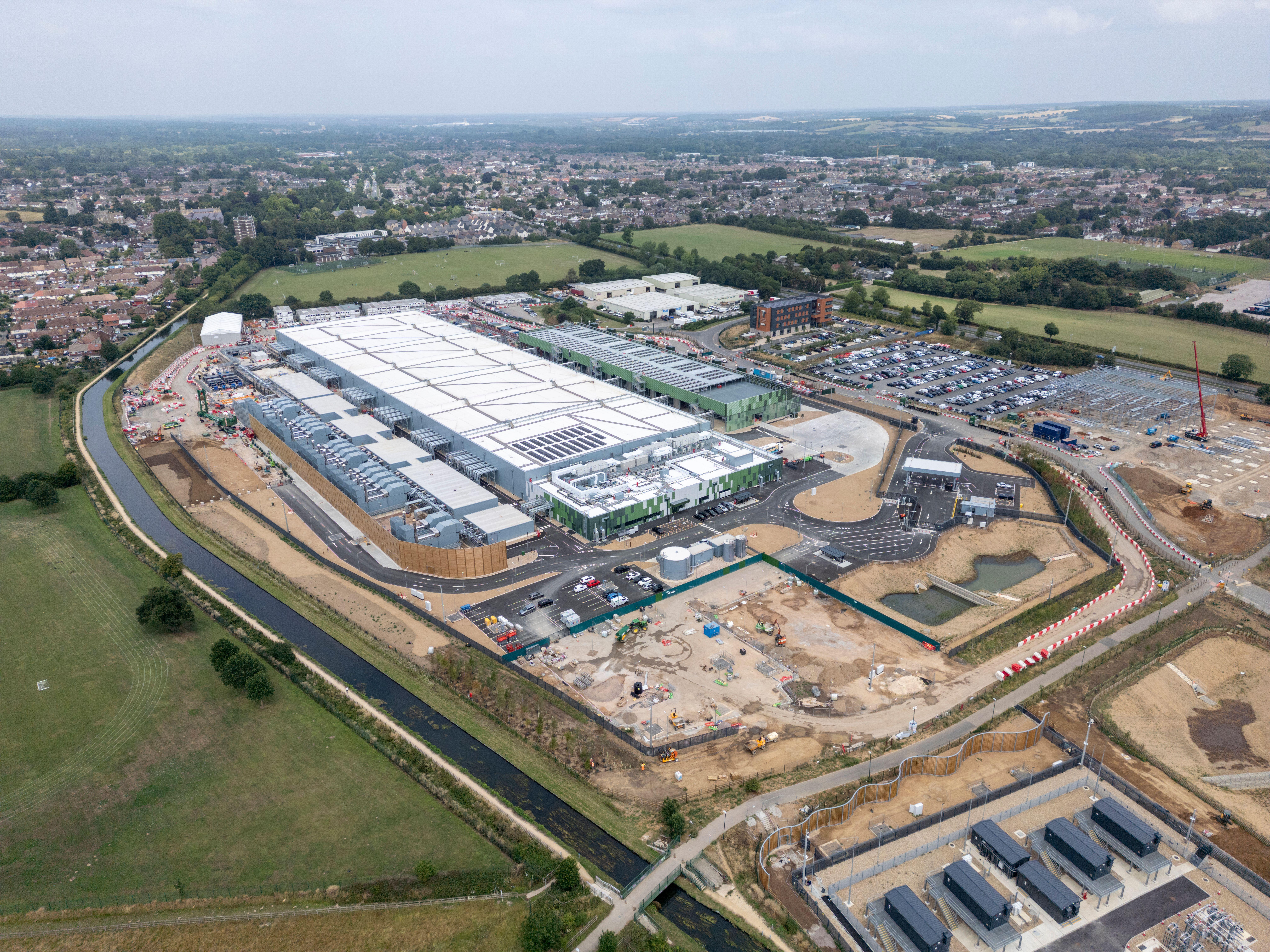
A new Google data centre under construction in Waltham Cross in Hertfordshire
ALAMY
Sir Demis Hassabis, who runs the artificial intelligence efforts at Google DeepMind, said last year that an era without disease was “within reach” because AI scientists would soon discover treatments for virtually every ailment. Elon Musk has predicted universal abundance because AI tools will be able to produce all goods and services at trivially inexpensive prices. The Tesla billionaire said: “Don’t worry about squirrelling money away for retirement in ten or 20 years. It won’t matter.”
The public, however, is more focused on the here and now. Dario Amodei, billionaire founder of Anthropic, developer of the popular Claude chatbot, predicted last May that half of white-collar jobs could be replaced by AI within five years.
• Anthropic chief: ‘By next year, AI could be smarter than all humans’
Months later, the Stanford Digital Economy Lab appeared to confirm critics’ worst fears. Based on an analysis of three years of pay stubs from ADP, America’s largest payroll processor, it found that young people (aged 22 to 25) in “AI-exposed fields” such as law, engineering and customer service were on the end of a 13 per cent drop in employment. The researchers dubbed these young job-seekers the “canaries in the coal mine” of the feared white-collar bloodbath.
• Is your job under threat from the march of the machines?
The “AI is replacing people” narrative is not universal. In its most recent jobs report, the professional networking site LinkedIn said the mismatch between people looking for work and open jobs was the highest since the pandemic, but also that “sluggish hiring is not AI’s fault”. Rather, it argued that the dip was due to economic uncertainty and pointed to 1.3 million new “AI-enabled” jobs on its platform.
What is clear, however, is that the tech industry has done a bad job selling AI to society — and particularly to the communities where it wants to build its kit. Bob Jenks, founder of Citizens’ Utility Board, a non-profit in Oregon focused on reducing energy bills, has led the pushback against data centres outside Portland, the state’s largest city.
“People are seeing large parts of land being eaten up by these things,” he said. “Their electric rates go up, but they don’t have friends or neighbours that have jobs there. X takes space in one of the data centres near here, and I think there are 13 employees who work there.
“There’s a general belief that this isn’t necessarily good for us.”
On Thursday, Chris Van Hollen, the Democratic senator for Maryland, proposed a bill to push the burden of new energy infrastructure onto private companies, rather than socialising the cost of the upgrades required to hook up new facilities. Americans, he said, “shouldn’t have to foot the bill for big corporations’ massive expansion of data centres”.
Framing the great data centre buildout as an issue of affordability may be enough to swing Republicans behind the pushback, but the concerns run far deeper — from land use and pollution to water consumption. Jones said: “These are political decisions, and this industry doesn’t want us to realise that.”