
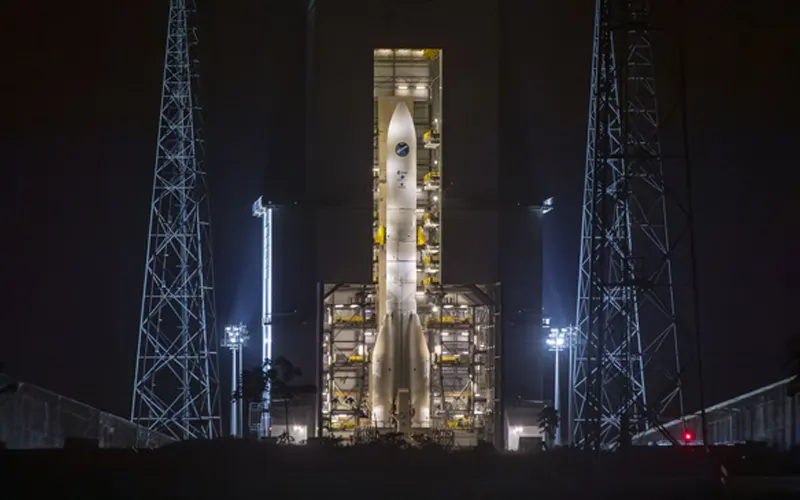
 Credit: ESA / CNES / Arianespace / ArianeGroup / Optique video du CSG / S. Martin
Arianespace has announced that the first flight of its more powerful four-booster Ariane 6 will be launched on 12 February from the Guiana Space Centre in French Guiana.
The inaugural flight of the Ariane 6 launch system was conducted in July 2024. In 2025, Arianespace launched four flights of the rocket carrying payloads for ESA, EUMETSAT, and CNES. All five flights thus far have utilized the rocket in its Ariane 62 configuration, which features two P120C solid-fuel boosters, each producing roughly 4,500 kN of thrust.
On 15 January, Arianespace announced that the first flight of the rocket in its Ariane 64 configuration, which features four P120C boosters, would take place on 12 February. This version of the rocket is capable of delivering payloads of up to 21.6 tonnes to low Earth orbit, a little more than double the 10.3-tonne capacity of the Ariane 62. The flight will also be the first to utilise the Ariane 6 launch system’s 20-metre-long fairing, with all previous flights using the shorter 14-metre fairing.
A flight of firsts, the inaugural Ariane 64 mission will also mark the start of Arianespace’s launch campaign for Amazon’s broadband internet constellation. Under the 18-flight launch contract awarded to Arianespace in 2022, this first mission, designated LE-01 (Leo Europe 01) by Amazon, will see Arianespace deploy 32 Amazon LEO satellites aboard Ariane 64, adding to the 180 satellites already in orbit. While Arianespace has yet to publish a full mission breakdown, the company has stated that the entire flight, which will presumably include deorbiting the rocket’s upper stage, will last 1 hour and 54 minutes.
Arianespace is targeting an ambitious increase in the Ariane 6 launch cadence, with the company aiming to double the number of launches conducted last year. This would result in as many as eight Ariane 6 flights over the next 12 months. The company also plans to introduce an upgraded version of the rocket’s solid-fuel booster, the P160C, which carries an additional 14 tonnes of solid propellant.
Keep European Spaceflight Independent
Your donation will help European Spaceflight to continue digging into the stories others miss. Every euro keeps our reporting alive.