
Welcome to this first edition of On the Wild Side, a monthly feature that aims to inform and inspire readers about the incredible wildlife in the New Forest National Park, and some of the associated conservation issues and successes. I’m Prof Russell Wynn, director of Wild New Forest and Chair of the New Forest Biodiversity Forum, and I’ve been studying the wildlife of the New Forest for over three decades. I’m excited to have this opportunity to share topical nature stories with the A&T readership, and welcome feedback via the appended contact details.
New arrivals
As we say goodbye to 2025, it’s a good time to reflect on some of the remarkable new species that arrived in the New Forest during the year. Perhaps the most eye-catching was the discovery of European praying mantis at a heathland site in the summer, with evidence to suggest local breeding (they were also discovered to be breeding at several other south coast locations for the first time this year). This species has been moving rapidly north through mainland Europe in response to warming temperatures, and with a decent tailwind they can fly across water bodies like the English Channel.
Another winged insect hitting the headlines last summer was the little arboreal ladybird, which first appeared in my garden moth trap in Woodlands in June and was subsequently reported from several nearby sites in the eastern New Forest.
Together with recent reports from the Southampton area, these sightings representing the first evidence for colonisation of mainland Britain by this species. It can be tricky to identify, but a key feature is the ten creamy white spots on an orange background, compared to 14-16 spots on the similar orange ladybird. We’re aiming to monitor these two ‘climate colonists’ in the coming years to see how quickly they spread, so if you have any sightings or photos of either species we’d love to hear from you.
 On the Wild Side, little arboreal ladybirds (photo: Russell Wynn)
The New Forest is an internationally important location for fungi, with about 3000 species currently recorded here. Thanks to the work of Hampshire Fungus Recording Group, and novel techniques such as DNA sequencing, new fungi species for the New Forest and Britain are being discovered with surprising regularity, including some that are completely new to science.
One of the most notable finds of 2025 was the strikingly elegant candelabra coral, found in six different locations and providing the first known records for both Hampshire and Wiltshire. It is a wood-rotting species, and the New Forest specimens were found on fallen beech and silver birch. Candelabra coral has increased on the near continent, and first arrivals have also been reported in in several other southern English counties. As with winged insects, fungal spores can travel large distances on the wind, even crossing oceans – recent scientific studies have captured them in the stratosphere using devices connected to weather balloons.
On the Wild Side, candelabra coral (photo: Russell Wynn)
There were no new mammal arrivals in the New Forest in 2025 (although Beavers are now getting very close…) but new birds included a surprising ‘ship-assisted’ visitor from the Americas. A male great-tailed grackle was found by a local birder at Calshot on 2nd Nov and a few days later relocated to Holbury, where it remained into early January. Grackles are inquisitive and often very tame birds that are known to occasionally stow away on transatlantic cruise ships. There was a slight ‘twist in the ‘tail concerning the bird’s identity, which for a period veered towards Boat-tailed grackle, which would be a first for Britain. However, a very dedicated birder recovered some grackle poo and sent it off for DNA analysis, which confirmed the identification as great-tailed grackle, only the second for Britain and certainly a first for the New Forest.
The selection of new arrivals described above highlights the increasing influence of climate change and human transport on our biodiversity, and in the New Forest our south coast location, proximity to major ports, and popularity as a tourist destination, all make us a hotspot for new arrivals. The protected habitats of the New Forest currently provide a safe refuge for incoming species, but an increasing focus on climate resilience and biosecurity will be needed if we are to maintain a healthy and biodiverse landscape in the future.
The iconic butcher bird returns
The great grey shrike is a remarkable bird that is now a very scarce winter visitor to Britain from northern Europe. It is a monochrome predator, about the size of a Blackbird, but with a striking pattern of black, white, and grey, and is often referred to as the ‘butcher bird’ on account of its habitat of storing prey in a ‘larder’ for later consumption. The unfortunate victims include small mammals, birds, reptiles, and large insects, which are impaled on spiky shrubs or barbed wire.
The extensive New Forest heaths have long been a traditional wintering site for the species, but lingering individuals have been absent in the last two winters, raising fears that the butcher bird was gone for good. Declines in the European breeding population and climate-driven changes in their wintering distribution have both been suggested as possible drivers. Local birders were therefore delighted when not one, but two, returned in late autumn 2025, with both still present at the time of writing in early January.
Ironically, great grey shrikes are particularly fond of eating our Dartford warblers, a highly protected bird species that is also an iconic feature of New Forest heathlands! Fortunately, thanks to ongoing heathland management and restoration work, and a series of mild winters, small birds like Dartford Warbler that winter on our heathlands are doing well, so let’s hope we can continue enjoying both great grey Shrikes and Dartford warblers in future winters.
On the Wild Side, great grey shrike (photo: Dimitri Moore)
By-the-wind-sailors run aground
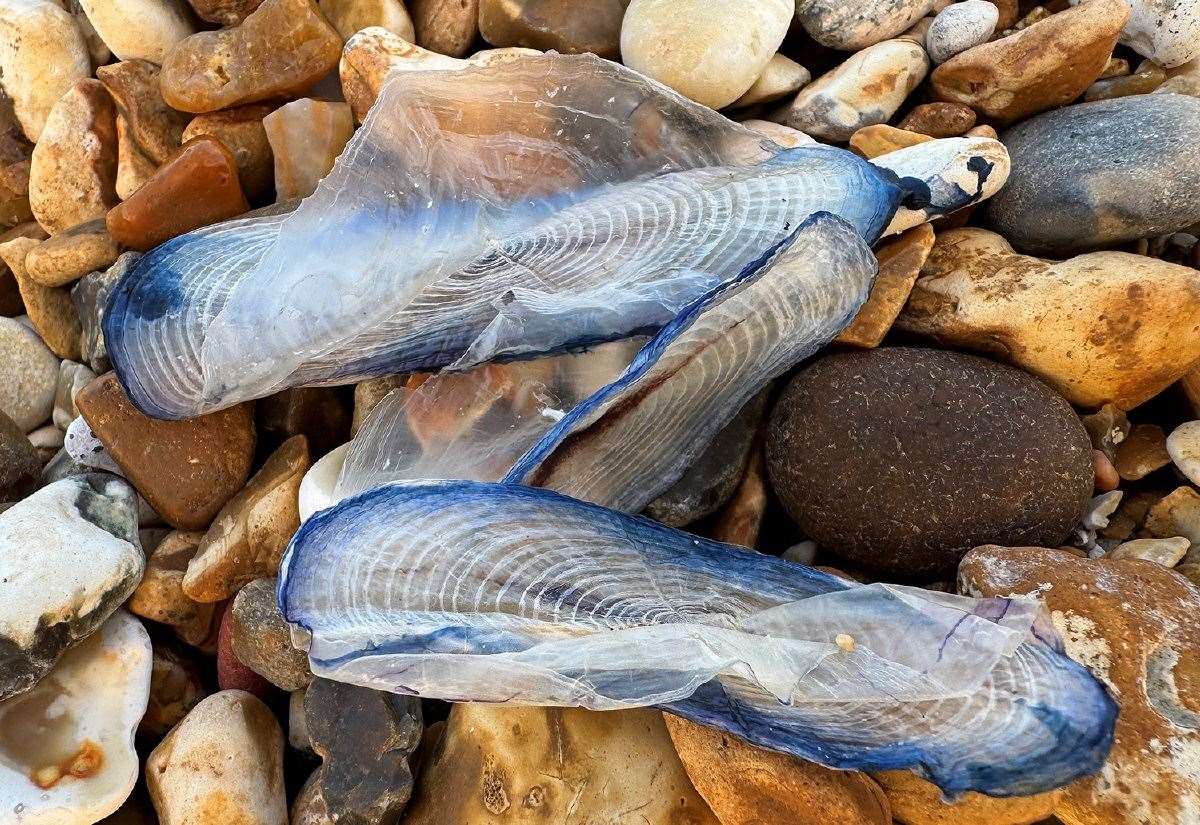
Persistent southwest winds for much of the late autumn period were responsible for a notable influx of By-the-wind-sailor to New Forest shores. These unusual marine creatures are free-floating hydrozoans that drift on the ocean surface. They appear as pale blue translucent discs, resembling discarded plastic, and have a small fin that catches the wind (hence the name). They have downward-hanging tentacles that are used to secure prey such as small fish, but these are fragile and invariably destroyed by the time they make landfall. I was alerted to the influx by local media, with reports of hundreds of thousands washed up on Boscombe Beach in early December, and large numbers at Lepe. I managed a quick search of Hurst Beach on 20 Dec and found several along the strandline within a few minutes. They are distantly related to the Portuguese Man O’ War, which also washes up sporadically on our coasts after autumn storms.
On the Wild Side, by-the-wind-sailor (photo: Russell Wynn)
Bat hibernation
The New Forest is recognised as a national bat hotspot, with 14 of the 18 UK species found here. Our resident bat species spend most of the winter hibernating, usually in a sheltered roof space or tree cavity. This is primarily due to an absence of prey such as moths and midges during the cold winter months. During hibernation, bats reduce their bodily functions such as breathing and blood flow to minimise energy loss, in a state known as ‘torpor’.
Although bats are known to occasionally awake from torpor, knowledge gaps remain around how this might be induced by periods of mild weather and how hibernation in general might be shortened or disrupted by the longer-term trend towards warmer winters. Modern acoustic bat detectors, that can be deployed remotely for long periods, are a useful new tool to monitor sporadic winter bat activity, as they don’t require the surveyor to be on site. Once fixed in place, they automatically detect and record the echo-location calls of bats in flight, which can then be retrieved and analysed later.
Since May 2025, I have continuously deployed a bat detector at a private site near Bramshaw that is a hotspot for several bat species. As expected, the detector picked up lots of activity over the six-month period from May to October, totalling nearly 100,000 bat calls, as well as an abundance of nocturnally ‘stridulating’ bush-crickets in summer. Bat activity quickly dropped off in early November once hibernation commenced, but a mild, dry, and relatively calm night on 15/16 Nov saw a remarkable total of 5,700 bat calls of six species. I’ve just downloaded and analysed the data through to the end of December and it looks like there were two futher bursts of activity involving at least four species around 22/23 Dec and 27/28 Dec, coinciding with mild, calm, and dry conditions.
Both common and soprano pipistrelle feeding buzzes were detected, suggesting they were actively hunting. The initial results therefore indicate that multiple bat species can become active for short periods in winter in suitable weather conditions, and that some of these species are using these windows to feed (as well as performing other necessary functions such as drinking, urinating, and grooming). I’ll aim to provide a further update in the spring once hibernation has ended, assuming the acoustic detector survives the winter weather! If you’re interested in recording bats yourself this year, have a look at handheld detectors that can be connected to a smartphone, or static detectors that can be deployed and left on site (I currently use the Echo Meter Touch 2 and the Song Meter Mini Bat 2).
Prof Russell Wynn is Director of Wild New Forest and Chair of the New Forest Biodiversity Forum He can be contacted at russ@wildnewforest.org.uk.
Wild New Forest is an independent community interest company delivering ecological survey and research and is hosting partner of the New Forest Biodiversity Forum, which supports and promotes biodiversity survey and recording within the local community, including training for local citizen scientists.
Both organisations generate data that informs conservation action across public and private land in the New Forest National Park. Further info at https://www.wildnewforest.org.uk and https://www.newforestbiohub.org.