
Coral Evans was walking along the beach in Brighton on Tuesday evening when she came across an unfamiliar sight.
“Hundreds of dust masks had washed up, along with single-use plastic gloves and cans of dried milk,” she said. “It was odd to see in winter – because nothing surprises us in summertime with the amount of people on the beach.”
The Brighton resident returned the next day to find an even greater shock awaiting her: “There were onions everywhere, hundreds of thousands of onions.”
Evans, who is the founding director of the Leave No Trace Brighton community group, said the beach was littered with countless miscellaneous items including single-use plastic coffee cup lids, unopened beer cans and vegetables such as sweet potatoes.
Onions from the sea on Brighton Beach. Photograph: Instagram
The spectacle spurred her to post a call to arms on the group’s social media platforms, urging others to get involved with a litter pick on the beach.
Brighton and Hove city council said its officers collected 1.9 tonnes of waste from beaches on Thursday, nearly four times the usual amount collected at this time of year.
Alongside the various objects, Evans said that she noticed “huge portions” of shipping containers washing ashore with segments of polystyrene insulation.
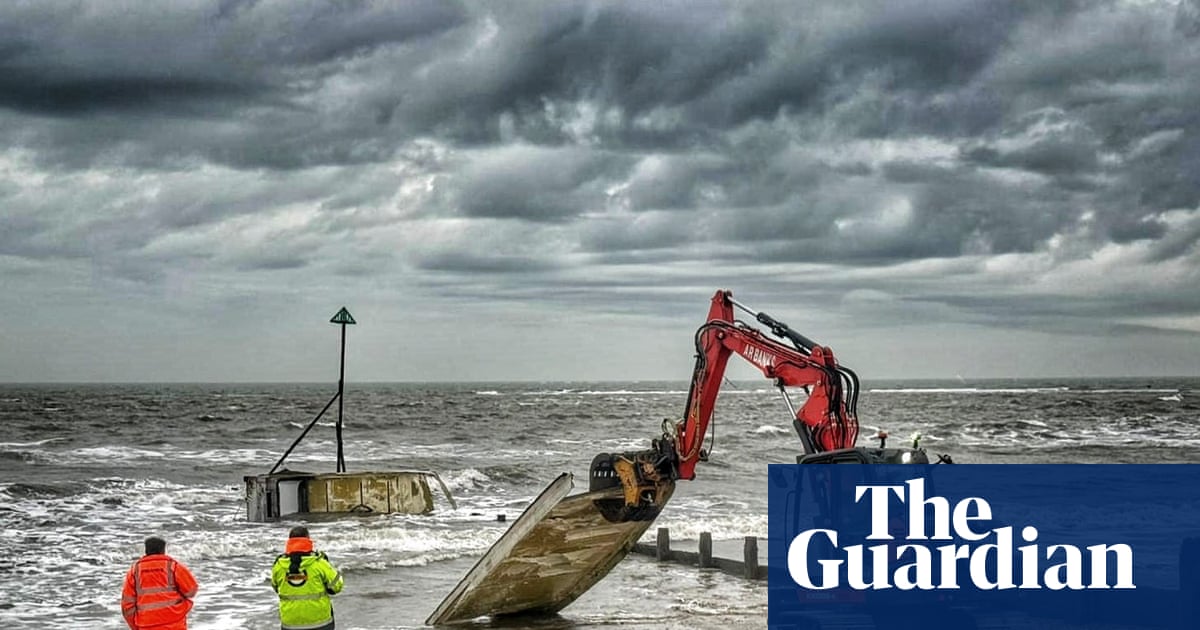
She added that she was aware of an entire shipping container arriving ashore in Rottingdean, its insulation broken down and posing a risk to local marine life.
East Sussex county council said on Thursday it was aware of various debris and the remains of shipping containers that had washed up along the region’s coastline in the past week.
It added that it was working with the county’s five district and borough councils to arrange for the safe removal and disposal of the debris through contractors.
Banana flotsam on the Sussex coast. Photograph: Selsey Beach Litter Ninjas
Meanwhile, beaches across West Sussex have experienced similar problems over the past month, with the situation having been worsened by the impact of Storm Goretti.
Donna Trethewey, founder of Selsey Beach Litter Ninjas, said there had been no reports of shipping containers or their contents washing up in her area for years, until three separate incidents in the past six weeks led to 24 containers going overboard.
The first incident on 6 December last year involved 16 containers from the refrigerated cargo ship Baltic Klipper in the Solent, the stretch of water between the Isle of Wight and the British mainland.
“The original spillage saw seven containers washing up across our 7½km [5 mile] beach … Whole containers washed up and literally broke up before your eyes,” Trethewey said.
She added that containers breaking down at sea had led to their contents, including produce such as bananas and avocados alongside their plastic packaging, being washed up ashore.
“We got as much of the big stuff as quickly as we possibly could before it broke down further, but there is still a large amount of small insulation foam pieces across the beach.”
Trethewey said the group provided the litter it had collected to a contractor for West Sussex county council, who then took the items away for processing and eventual recycling.
Shipping cargo debris on Selsey Beach. Photograph: Selsey Beach Litter Ninjas
The local authority said on Wednesday it was aware of debris from a container washing ashore at Elmer in Bognor Regis, but that weather and water conditions had made recovery operations difficult, while waste materials from a container had been reported ashore between West Wittering and Shoreham-by-Sea.
A report by the World Shipping Council last year found 576 shipping containers had been lost at sea across 2024, out of the more than 250m transported.
Dr Simon Boxall, an academic in oceanography at the University of Southampton, recalled an incident in 1992 when plastic Friendly Floatees bath toys washed into the Pacific Ocean from a container ship and ended up distributed across the world, demonstrating how the global ocean network is connected.
“It is estimated that 2,200 containers fall off ships into the water each year. They are all being loaded on to ships so it’s not unheard of for a crane operator or system to slip and pop a container into the water,” he said.
Washed-up shipping containers on the Sussex shoreline. Photograph: Selsey Beach Litter Ninjas
Boxall said that Southampton’s reputation as the second biggest container port in Britain was a contributing factor to the issue, as well as the English Channel being one of the busiest shipping lanes in the world.
“Regarding the south coast, it’s not surprising we are seeing them as they have always been washing up. I can think of many cases over the years.”
The wreckage from a shipping container on the MSC Napoli on Branscombe Beach in January 2007 saw several BMW motorcycles, among other goods, allegedly claimed by opportunistic scavengers.
The lecturer highlighted threats to wildlife through the spilling of herbicides, pesticides and acids, with hazards to navigation also posed due to the containers floating just below the surface of the water.
An Environment Agency spokesperson said it was closely monitoring the potential impact of washed-up containers in Sussex to wildlife and water.
Members of the public have also been asked not to touch, move or take any washed-up waste or produce and to keep children and animals away.
Despite the longstanding problem, a change in legislation could see the tide starting to turn.
The International Maritime Organization, working alongside the World Shipping Institute, have introduced a law this year that forces shipping companies to report any containers which have been lost at sea.
Boxall said: “As of 1 January, it is a criminal offence to not report the loss of a container. The issue is not being treated as a witch-hunt, but rather a way of logging what happens.”
A clean-up operation on Selsey Beach in West Sussex. Photograph: Selsey Beach Litter Ninjas
Regarding the onion spectacle on Brighton Beach, Evans said she would welcome moves to see shipping companies taking responsibility in clearing their debris.
“It’s only a few containers to them but it displaces whole communities. Surfers and swimmers have been advised not to enter the water, and there’s no sign of the containers’ owners getting involved to clear the mess.”
Despite the ordeal, Evans has said the situation has been a great opportunity for the community to come together, with up to 400 local people volunteering to collect waste over the week.
“We have 7½ miles of beach here in Brighton. Three days later, it was absolutely clear.
“Out of everything that’s happened, we’ve definitely galvanised the community through this. You know what they say: when life gives you onions …”