
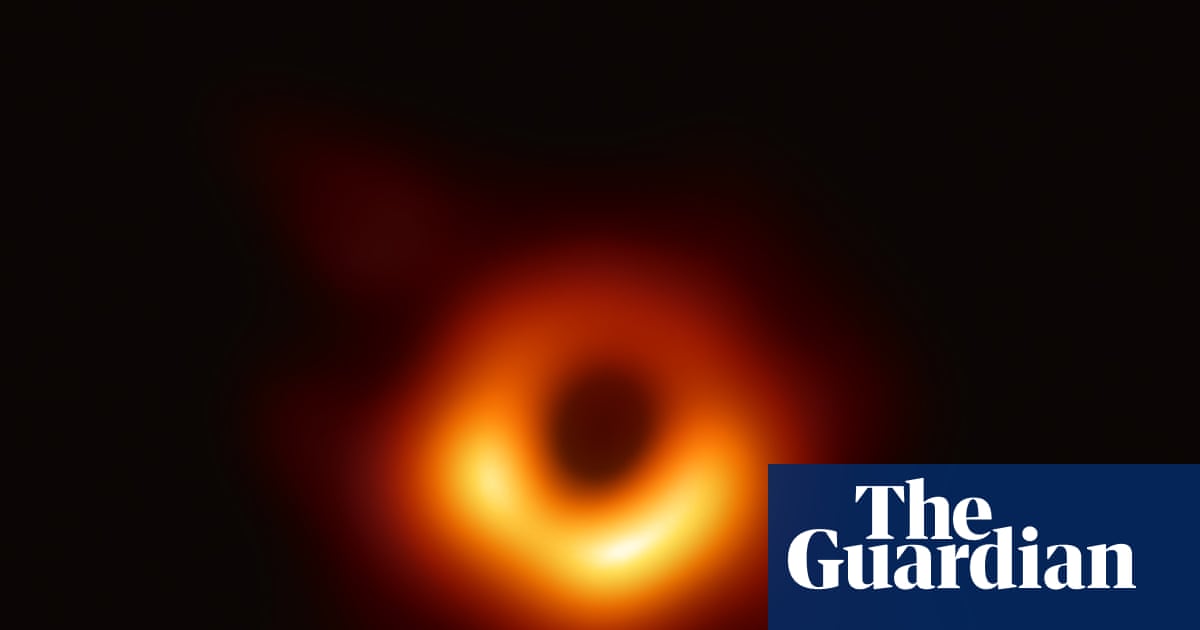
Dark, hungry and inescapable: black holes are often portrayed as the ultimate cosmic villains.
But now astronomers are preparing to capture a movie of a supermassive black hole in action for the first time, in observations that could help reveal another side to these elusive – and perhaps misunderstood – space objects.
The Event Horizon Telescope (EHT) will track the colossal black hole at the heart of the Messier 87 galaxy throughout March and April with the aim of capturing footage of the swirling disc that traces out the edge of the event horizon, the point beyond which no light or matter can escape.
“The movie campaign is really revolutionary, not just because it’s technologically extremely challenging, but because it will accelerate our science by an order of magnitude,” said Sera Markoff, the newly appointed Plumian professor of astronomy and experimental philosophy at the University of Cambridge and a founding member of the EHT consortium.
Sera Markoff, newly appointed Plumian professor of astronomy at Cambridge University and a founding member of the EHT consortium. Photograph: Tina Korhonen
“We may be able to get a better handle on the speed that the black hole is rotating and the way black holes launch jets, both of which are major outstanding questions in our field.”
Black holes, she added, have a reputation as “scary” objects, but are increasingly recognised by scientists as holding the key to understanding how the first galaxies emerged in the early universe and their subsequent evolution.
“Black holes have a bad rap as these evil vacuum cleaners that just suck everything up,” she said. “To me they represent the edge of our understanding of our universe, and they are endlessly fascinating. They actually play a very important role in the ecosystem of the universe.”
The EHT is a global network of 12 radio telescopes spanning locations from Antarctica to Spain and Korea, which in 2019 unveiled the first image of a black hole’s shadow. During March and April, as the Earth rotates, M87’s central black hole will come into view for different telescopes, allowing a complete image to be captured every three days.
The scale of the black hole – its mass is equivalent to 6bn suns and it spans an area equivalent to that of the solar system – means it moves slowly enough for these snapshots to be stitched together into a moving sequence.
Measuring the black hole’s spin speed matters because this could help discriminate between competing theories of how these objects reached such epic proportions. If black holes grow mostly through accretion – steadily snowballing material that strays nearby – they would be expected to end up spinning at incredibly high speeds. By contrast, if black holes expand mostly through merging with other black holes, each merger could slow things down.
The observations could also help explain how black hole jets are formed, which are among the largest, most powerful structures produced by galaxies. Jets channel vast columns of gas out of galaxies, slowing down the formation of new stars and limiting galaxy growth. In turn this can create dense pockets of material that trigger bursts of star formation beyond the host galaxy.
“M87 is launching these enormous jets that punch through the entire galaxy,” said Markoff. “They can change the entire evolution of the galaxy and even surrounding galaxies.”
While the movie campaign will take place in the spring, the sheer volume of data produced by the telescopes means the scientists will need to wait for Antarctic summer before the hard drives can be physically shipped to Germany and the US for processing. So it is likely to be a lengthy wait before the rest of the world gets a glimpse of the black hole in action.
Sera Markoff: ‘My interest in astrophysics really just came from reading science fiction and comic books.’ Photograph: Cambridge university
Markoff was announced in December as the 17th Plumian professor, one of the oldest named professorships in the world. Sir Isaac Newton oversaw the creation of the position in 1704, with previous Plumians including distinguished astronomers Sir Arthur Eddington, Sir Fred Hoyle and Lord Martin Rees. Markoff says she hopes to use the position to encourage more people from under-represented backgrounds into science.
“I didn’t come from a scientific or academic family, so my interest in astrophysics really just came from reading science fiction and comic books,” she said. “Given that I thought I would go to art school, it was quite an odd thing for me to be interested in, but these books exposed me to the ideas of black holes and instilled a desire to explore the universe. I was also lucky enough to have many supportive teachers, but I never seriously thought that I would be able to go into a career like this. Now I like to joke that I do sci-fi for a living.”