
 사진 확대
사진 확대
The world still wants the “K” label. Global demand has grown, and exports and sales are hitting all-time highs. But inside the industry, the screams have already begun. K-pop has seen its physical album sales plunge to a three-year low. K-Drama, whose production volume is steadily declining, now has only a narrow path to recoup soaring production costs through global platforms such as Netflix and Disney+. K-Movie is entering a phase in which the domestic market is effectively collapsing. Warning lights are flashing for all three: K-pop, K-Drama, and K-Movie, the “three main engines” that have supported K-content, are all groaning under reduced output and a shortage of fuel.
While Intellectual Property Right (IPR) and profits are being sucked into global platforms, the space for “experimentation” by small and mid-sized production companies and newcomers is rapidly disappearing. With the creative agents hollowed out and only the formula for success left behind, K-culture is now easily replicated around the world. Anxiety is growing that K-culture, which had risen to the mainstream of global culture, could degenerate into a brand without real power.
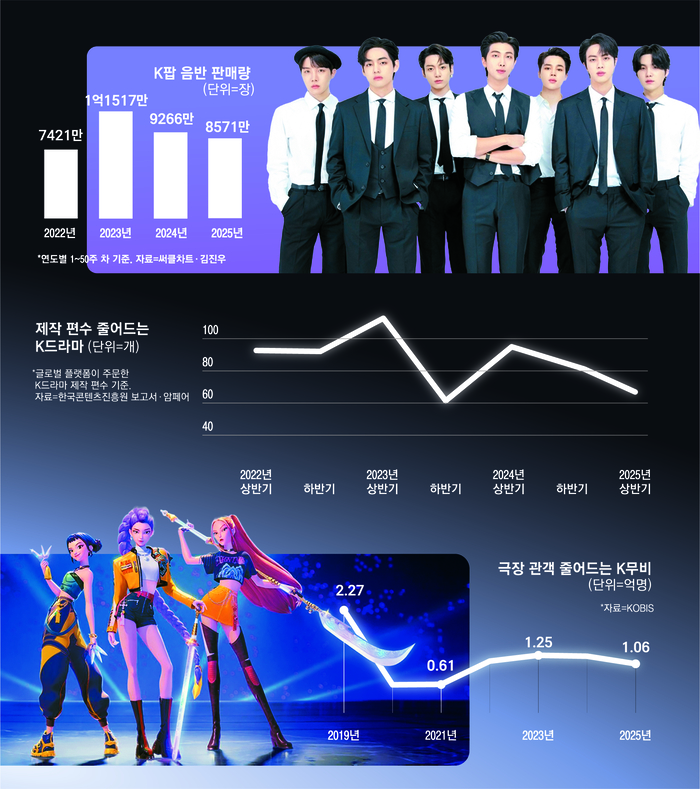
The warning is clearest in K-Drama. Ampere Analysis, a UK media research firm, published back-to-back articles in May and August last year pointing to a collapse in the K-content supply chain. According to Ampere Analysis’s research on the structural limitations of K-Drama, global Over-the-top media service (OTT) platforms placed around 100 K-Drama content orders in both 2021 and 2022, maintaining a stable level. In 2023, the number surpassed 110, setting a new record.
However, after that, the number fell to the 90s in the first half of 2024 and the 80s in the second half of 2024, and then shrank further to the 60s last year. In other words, outside of Netflix and Disney+, there are virtually no buyers for K-Drama. Kim Yoon-ji, a senior researcher at the Overseas Economic Research Institute of the Export-Import Bank of Korea, diagnosed the situation by saying, “Despite rising production costs, the scale of overseas purchases of K-Drama has not increased proportionally,” adding, “Netflix has pledged and is executing purchases worth 600 million United States dollar (USD) annually over three years, but due to the problem of rising production costs, the number of titles is decreasing in order to cover the per-title production cost.”
K-pop is no exception, with its own warning lights beginning to blink. According to Circle Chart’s “2025 Album Sales Review,” physical album sales by artists ranked within the top 400 during weeks 1 to 50 peaked at 115.17 million copies in 2023, then fell to 92.66 million in 2024 and 85.71 million in 2025, marking two consecutive years of decline.
Kim Jin-woo, a music data journalist who released these statistics, said, “Exports of K-pop albums to Japan and China have continued to decline. In Japan, local idols such as the nine-member male group Snow Man have emerged and are rising on their own,” adding, “Local groups that, three to four years ago, were not even considered competitors to Korean K-pop idols are now on the rise, and as K-pop idols have consistently appeared on programs such as NHK Kōhaku Uta Gassen, the skill level of local idols has been raised across the board.” However, he added, “A rebound is expected after the return of BTS and Blackpink this year, and we can also look forward to a trickle-down effect to other artists afterward.”
Foreign media also share the assessment that K-pop is entering a period of uncertainty. At the end of last month, The Guardian reported, “As album sales fall, K-pop companies are shifting their focus to global tours and core fandoms,” and that they have “pursued profit maximization while effectively abandoning mainstream popularity.” The Guardian pointed out that small entertainment agencies, which had presented a wide range of works based on experimental concepts, are struggling to survive due to rising production costs and other factors, and that the creativity that was the source of K-pop’s success is weakening.
K-Movie, which reached its peak with Parasite, has shown signs of decline every year since the COVID-19 pandemic. While K-Drama has become dependent on global platforms and seen its supply shrink due to production-cost inflation, and K-pop is heading toward a situation where only groups that have secured a handful of global “mega IPs” can survive, K-Movie is collapsing first from within rather than due to external factors.
According to the Korea Box-office Information System (KOBIS) operated by the Korean Film Council (KOFIC), total cinema attendance in South Korea in 2025 was 106.08 million, less than half of the 226.67 million recorded in 2019. After reaching 125.13 million in 2023 and 123.12 million in 2024, the number has now declined for three consecutive years since emerging from the pandemic.
As the very foundation of the domestic market collapses in this way, production companies are losing the capacity to reinvest, and the supply of new films is slowing. Korean distributors that once released around 40 domestically produced films a year managed to distribute only about 20 titles last year. Industry insiders warned that as the backlog of films produced during the pandemic is exhausted and new film production fails to proceed quickly, the number of releases could fall even further in 2026.
The “Korean elements” that used to be the exclusive domain of K-Drama and K-Movie are already being dissolved into the American production systems of Hollywood and Netflix. While there was widespread excitement over the Academy Awards (the Oscars) trophy for Minari and the eight Emmy Awards won by the Netflix black comedy Beef, from the perspective of K-content exports these raise the question of a “paradox of success.” Korean sensibilities are being deterritorialized, while production know-how and profits are being attributed overseas.
Jangwoo Lee, head of the Research Institute of Creative & Cultural Industries, Kyungpook National University, said, “It is time to soberly reflect on whether the success of K-content truly came from Korea’s uniquely outstanding aesthetic sense, or from well-timed and well-placed investment,” adding, “Alongside a high level of sensibility, both film and music ultimately succeeded because they were backed by large-scale investment. The Government of South Korea is calling for government-led Research and Development (R&D) investment, but that is a second- or third-rate policy. For free creative innovation, measures such as tax relief are far more effective.”
This article has been translated by GripLabs Mingo AI.