
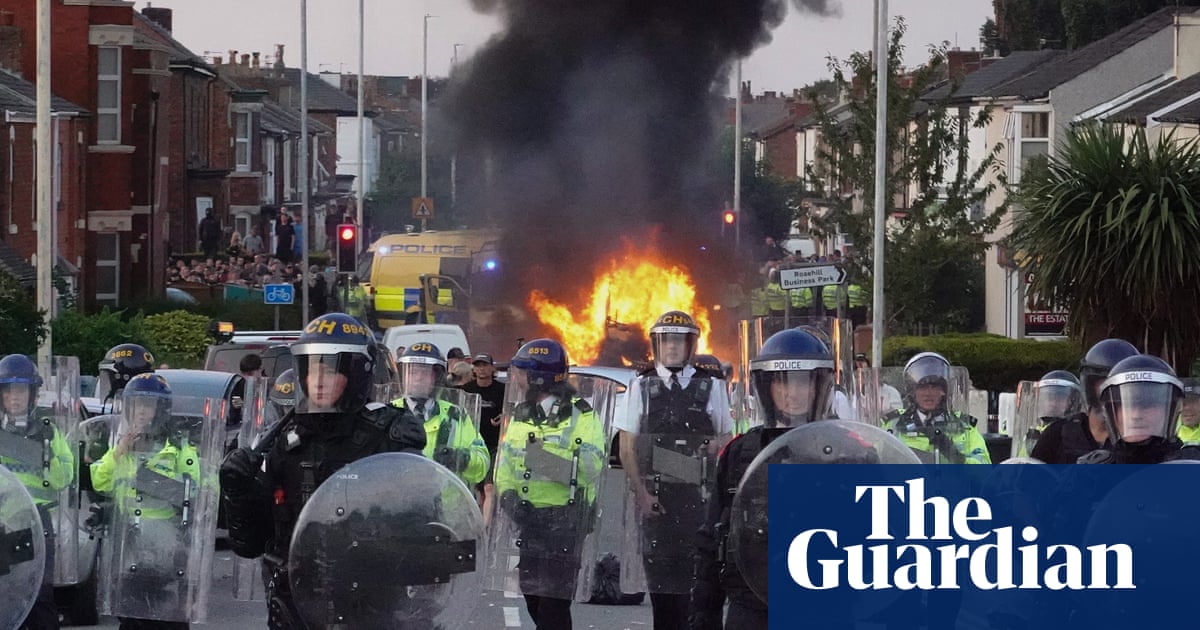
The response to the 2024 riots in England and Northern Ireland failed to address its root causes and delinked the violence from racism, a thinktank has claimed.
A paper by the Institute of Race Relations (IRR) says an obfuscation of the causes and consequences of the riots risks legitimising further far-right mobilisation and vigilante violence. It says that what happened has often been reduced to “mindless” thuggery or violence.
Liz Fekete, IRR director, said: “What emerges from the binding narrative of defendants who participated in the riots could be compared to the distorted confines of an echo chamber.
“Unless society comes to terms with the deeper causes of anti-migrant, Islamophobic and racist violence, we will be caught in a vicious cycle of events that repeatedly reinforce each other, with the prospect of ugly protests and riots forming an infinite loop.”
The violence broke out after the murder of three young girls in Southport, amid the spread of false information online that the perpetrator was an asylum seeker.
The report, by the criminologist Dr Jon Burnett, studied a sample of court cases related to the riots. He found that the Conservative prime minister Rishi Sunak’s “stop the boats” slogan and the policy framework around it, which he said was continued by Labour when it took power, “was repeatedly echoed (either by defendants or by broader mobilisations they were among)”.
Other defendants echoed dominant narratives that the state had not gone far enough, accusing the government of aiding and abetting an “invasion”, Burnett wrote.
He said: “While the forces underpinning the riots are complex, in multiple cases the ideological positions embedded in people’s justifications for violence echoed the ideological positions of government policies over time, politicians or media narratives more generally.”
Rajiv Menon KC, said the report described the handling of the situation as “the wholly inadequate response of a government and a criminal justice system incapable of addressing the role of racism in the riots”.
The report also says claims of two-tier justice in the response to the riots were wide of the mark. It identified dozens of cases – not a definitive list – of Muslim and other black and minority ethnic people who mobilised to protect their communities from a far-right-inspired presence and were subjected to a “punitive approach and harsh sentences”. It says that in some cases judges commented to the effect that “racial abuse is unpleasant but you should have risen above it”.
Andrea Coomber KC, the chief executive of the Howard League for Penal Reform, said: “The ‘two-tier justice’ narrative that swiftly developed is particularly misleading, as the report’s analysis of cases demonstrates. Instead, and as with the riots in 2011, both government and the courts prioritised a ‘one-size-fits-all’ response of speedy prosecutions and punitive sentencing, an approach that swept up many vulnerable people from across different backgrounds – many of whom did not initiate the violence.”
She said the report showed the causes were “more complex and nuanced than has hitherto been understood, particularly by the government”.
Burnett wrote: “The government failed to consider whether deprivation caused by state policies over time was a contributory factor in the riots and whether economic policies contributed to a situation whereby the far right sought to gain a foothold in areas that perceived themselves as abandoned by government.”
Coomber said the lack of reflection by government on prevention of future occurrences through tackling underlying causes of social and economic deprivation was a problem throughout the criminal justice system.
A government spokesperson said: “In our immediate response to the riots we focused on protecting racial and religious communities who were targeted by this abhorrent violence, and we’re now working to develop a longer-term strategy to bring communities together and build common ground.
“Through Pride in Place we’re also investing £5bn across 250 areas to respond to the frustrations that fester by improving people’s lives and the places in which they live.”