
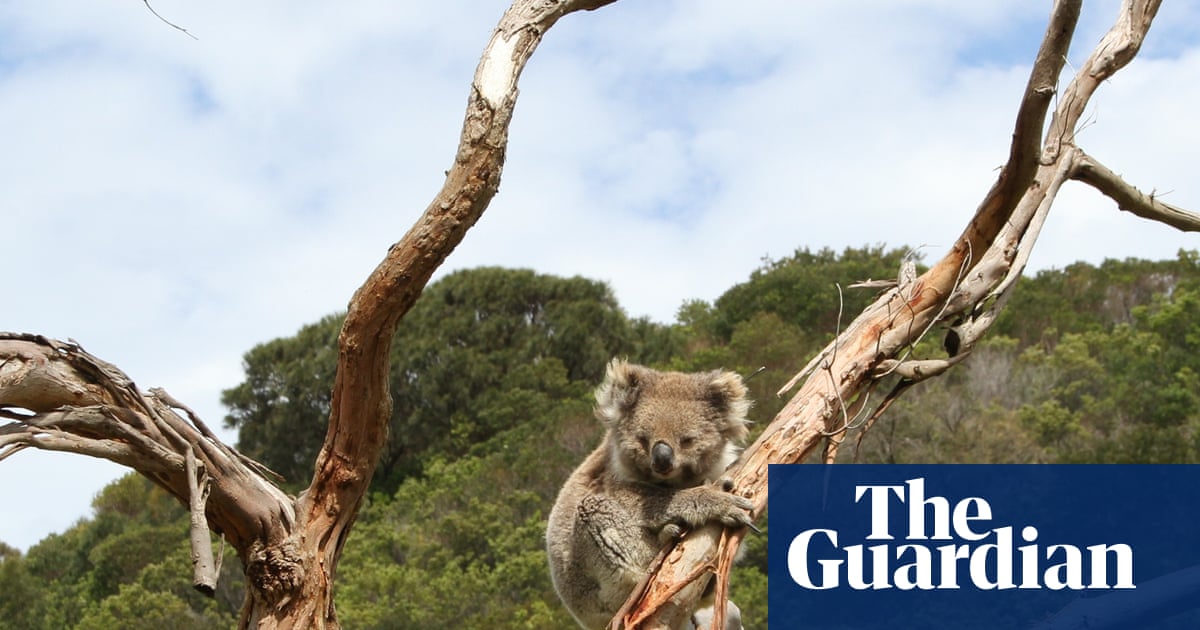
On French Island in Victoria’s Western Port Bay, koalas are dropping from trees. Eucalypts have been eaten bare by the marsupials, with local reports of some found starving and dead. Multiple koalas – usually solitary animals – can often be seen on a single gum.
Koalas were first introduced to French Island from the mainland in the 1880s, a move that protected the species from extinction in the decades they were extensively hunted for their pelts. In the absence of predators and diseases such as chlamydia, the population thrived.
But the island is now struggling with an overabundance, part of a paradoxical threat facing the marsupial across the country: in the north-eastern states, koala numbers are declining, but in parts of southern Australia, the animals are eating themselves out of house and home. What makes saving the celebrated species so difficult to get right?
Too much of a good thing
There are between 729,000 to 918,000 koalas nationally, according to the latest estimate from the CSIRO’s National Koala Monitoring Program. Those figures are up from a 2023 estimate of 287,830 to 628,010 koalas nationally, but experts have pointed out the updated figures reflect more accurate technology and extensive survey work, rather than a true increase in the koala population.
The koala population in the Mount Lofty Ranges in South Australia has grown so large that it is a threat to its own long-term survival. Photograph: Desley Whissen
But in South Australia’s Mount Lofty Ranges, the koala population – about 10% of Australia’s total – is booming. The ranges “tick all the right boxes”, says Dr Frédérik Saltré, a senior lecturer in ecology at the University of Technology Sydney. “Rainfall, temperature, soil acidity really boosted the habitat suitability … so they could actually thrive in this ecosystem.”
It’s now a victim of its own success. A new study co-authored by Saltré has found that the Mount Lofty Ranges koala population has grown so large that it is a threat to its own long-term survival. Published in the scientific journal Ecology and Evolution, it projects the population will grow by between 17% and 25% over the next 25 years.
“We might think it’s a good thing having a lot of individuals, but it causes a lot of ecological problems down the track,” he says. “They’re going to have massive issues feeding themselves.”
Researchers are concerned about the risk of overbrowsing, which damages the trees koalas rely on for food. Photograph: Desley Whissen
Koala overpopulation in the Mount Lofty Ranges was identified as a potential problem as early as 1996.
Saltré, also a research scientist at the Australian Museum, is concerned about the risk of overbrowsing, which damages the trees koalas rely on for food and can eventually result in mass starvation.
Mathew Crowther, a professor in quantitative conservation biology at the University of Sydney, says many of the overabundant koala populations in southern Australia are in locations where the animal was not originally found.
“It means that the eucalyptus trees are not necessarily that resistant to them, so the koalas overbrowse,” he says.
Koalas are notoriously picky eaters – of 800-odd species of Australian eucalypts, they eat fewer than 50. Photograph: Desley Whissen
Koalas were introduced to the Mount Lofty Ranges from Kangaroo Island, home to another overabundant population. The Kangaroo Island koalas, in turn, originate from French Island – specifically, from 18 animals sent interstate in the 1920s.
Koalas are notoriously picky eaters – of 800-odd species of Australian eucalypts, they eat fewer than 50. But these three locations are all abundant in manna gum, which Assoc Prof Desley Whisson, a terrestrial wildlife ecologist at Deakin University, says is one of the koala’s preferred food trees.
“It’s high in available nitrogen, low in toxins, and also high in moisture, so the best thing for a koala,” she says. It also tends to grow in a monoculture, supporting higher koala populations than mixed forests with lower densities of the animals’ favourite trees to feast on.
Exacerbating the problem are commercial plantations of blue gum – another preferred food tree – which Whisson says “have facilitated an increase in koala populations”. In Victoria’s south-west, about 42,500 koalas live in such plantations. When the trees are harvested, the displaced koalas move on, contributing to the decline of native vegetation nearby.
Habitat loss overshadowed
Further north, the picture is also dire. Koalas in Queensland, New South Wales and the Australian Capital Territory have been listed as endangered by the Australian government since 2022.
In these places, Crowther says, native populations have declined due to land-clearing, habitat fragmentation caused by urban development, disease, and death from vehicle strikes and dog attacks.
“By far the biggest issue is habitat loss,” Whisson agrees, adding that climate change is also a threat. “We’re seeing a lot of drought; we’re also seeing an increase in fire in some locations.”
Analysis has shown that nearly 2m hectares of forests suitable for koalas have been destroyed since the marsupial was declared a threatened species in 2011. Most of the clearing – 81% – occurred in Queensland.
While the southern states have a reputation for overabundant koala populations, Whisson says that aside from a few locations – including islands, the Mount Lofty Ranges and Budj Bim national park in Victoria’s south-west – for the most part koala populations are at low densities.
“I’m actually a bit concerned that we might be losing some of our populations,” she says. The issue is overshadowed by the overabundance problem, because “it’s a very visible, very difficult situation to deal with”.
Move or sterilise?
Koala overabundance has no easy fixes. “The only way you can get any kind of rapid knockdown of a population is to remove some and put them somewhere else,” Whisson says. “That is really expensive, and it doesn’t always work.”
Koala translocations were clearly once successful in establishing the now overabundant populations in Victoria and South Australia, but there have also been notable bungles, most recently earlier this year in NSW.
Culling the animal for population control is banned – and unlikely to ever be adopted, given its status as a beloved Australian species.
Because koalas can live for up to 15 years, fertility control takes a long time to have any impact. Photograph: Desley Whissen
Fertility control – involving sterilisation or long-term contraception in females – is another avenue, which has been used to control populations since the 1990s. New modelling Saltré has carried out suggests that, in the Mount Lofty Ranges, sterilising approximately 22% of adult females annually in the highest-density areas would be enough to stabilise populations to sustainable levels, at an estimated cost of $34m over 25 years.
Saltré says it is a more cost-effective strategy than translocation, but concedes “we’re playing the long game here, which is usually way [beyond] the political timeline”.
Because koalas can live for up to 15 years, fertility control takes a long time to have any impact, Whisson says. A successful intervention would require government taking a holistic approach.
In one respect, declining koala populations and overabundance are two sides of the same coin – both addressable through landscape-scale restoration of habitat. In NSW, confirmation in September that the great koala national park would be created, with a moratorium on logging within its bounds, was welcomed by forest advocates. In the southern states, “bigger expanse[s] of mixed forest that doesn’t support such a high abundance of koalas” are needed, Whisson says.
“With climates changing, the predictions are that the southern states of Australia will be the stronghold for koalas,” she says.
That means, as Saltré puts it, “we need to find a sweet spot where the species can be sustainable over a long time”.