
Spanish authorities are putting on the pressure for road safety and law enforcement for cyclists as new data reveals a worrying trend in accident rates. The Guardia Civil and the Dirección General de Tráfico (DGT) have launched an intensified surveillance campaign to make sure riders stick strictly to the General Circulation Regulations.
Recent figures released by the DGT in December 2025 show that 7,033 cyclists were injured between 2013 and 2022. The rise in incidents has led to the Guardia Civil to deploying mobile patrols and static checkpoints. Cyclists are now under much closer scrutiny to prevent accidents in increasingly congested urban areas.
Common traffic violations and high fines
Cyclists face fines ranging from €100 to €200 for manoeuvres that were previously given a blind eye to by many. Riding on pavements is one of the most frequent offences, carrying an immediate €100 on-the-spot penalty. Safety experts stress that pedestrian pavements are reserved exclusively for pedestrians, yet many cyclists continue to use them to avoid road traffic.
Most Read on Euro Weekly News
Crossing a pedestrian zebra crossing without dismounting is another major focus for authorities. This specific no-no results in a whopping €200 fine. Furthermore, the lack of proper lighting or reflective clothing during night hours or low-visibility conditions carries a €200 penalty, as visibility remains a primary factor in preventing fatal collisions on shared roads.
Current rules for group riding and road positioning
Spanish law maintains specific requirements for how cyclists must ride in different environments. Urban riders are encouraged to use bike lanes where available, though the DGT mentions these are not always compulsory. The rules depend on the local council. When no lane exists, cyclists must stay as far to the right as safely possible.
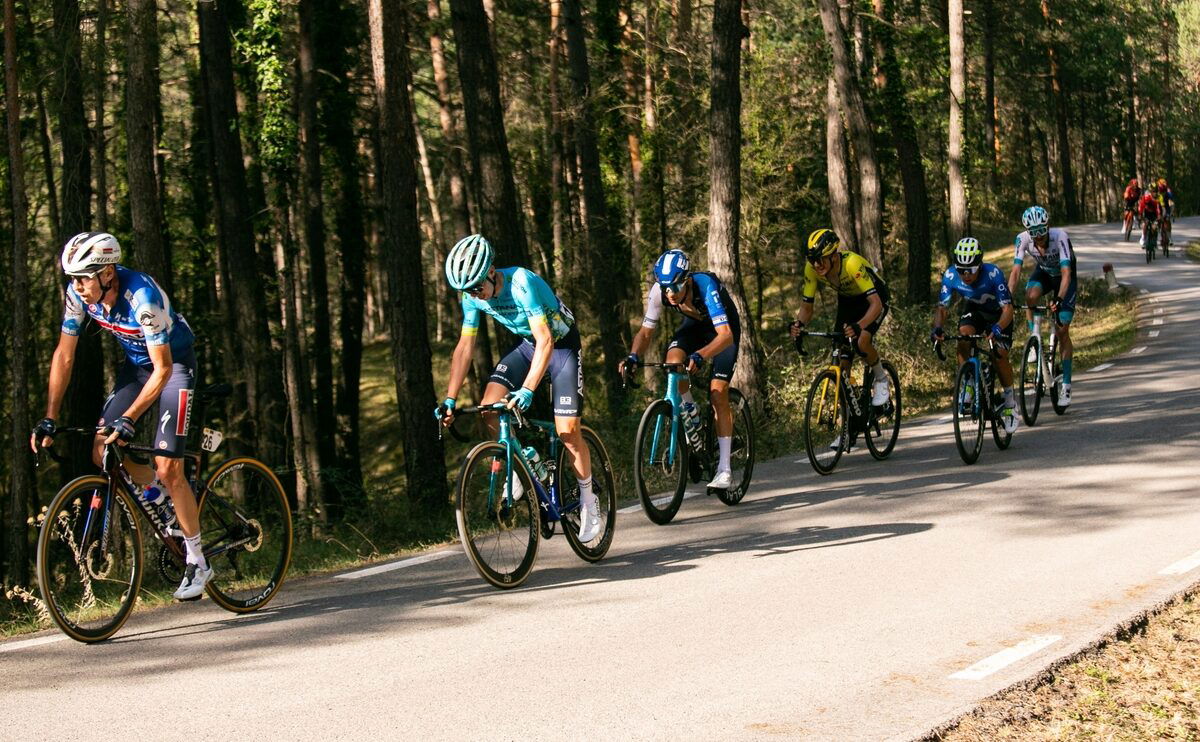
Rural roads allow for riding in columns of two to increase visibility to other vehicles, provided riders stay close to the right edge of the road. Single-file formation becomes compulsory in areas with low visibility or on sharp curves. Authorities insist that “the bicycle is a vehicle like any other” and must follow the same legal framework to ensure safety for all.
Most common doubts about what is and isn’t allowed when riding a bicycle in Spain:
Mobile phone, forget it!
While riding a bike it is totally forbidden to use the mobile phone. Headphones connected to receivers or sound players are also prohibited. Headphones limit hearing capacity and can cause distractions.
Mobile phone or headphones when riding: €200
No alcohol
Yes, the maximum blood alcohol level for drivers in general (0.5 g/l of alcohol in blood or alcohol in exhaled air greater than 0.25 milligrams per litre) also affects cyclists. They are also obliged by law, like all other drivers, to undergo the breathalyser test if required by an officer.
Positive blood alcohol level: €500 and upwards
Passengers
Bicycles are only allowed to carry a passenger up to 7 years of age, in an approved child seat, provided that the rider is 18+.
Carrying a child incorrectly: €100
Turn on the lights
Whenever travelling at night, below underpasses or through tunnels, cyclists must have the lights on in front and behind to see and become visible.
No lights: 200€
Give priority to pedestrians
Cyclists must also give way at pedestrian crossings and when they turn to enter another road.
Not respecting pedestrians priority: €200
Giving way to bikes
Cyclists have priority of passage over motor vehicles when travelling on a bike path. In other situations, they must respect the priorities of other road users.
Motor vehicle drivers not respecting the priority of cyclists at an intersection: €200
Groups in roundabouts
Cyclists when travelling in groups have priority at the roundabouts, as in the rest of the intersections, when the first of the cyclists has already entered it.
Starting up
Before starting, all cyclists must – like the rest of the drivers – observe the road to which they are going to join, check that no other vehicles are coming nearby or that they are far away enough that there is no danger to start the march and signal the manoeuvre.
Beginning to ride without checking other vehicles are coming: €200
Respect signs
Traffic light signals, as well as regular fixed signs (stop, give way, limited speed…), are for all drivers, including cyclists.
Jump the traffic lights: 150-500€
Signal manoeuvres
In addition to moving into traffic, by bike it is also compulsory to signal other manoeuvres, such as turns, changes of direction and lane. The signalling can be done both with the right arm, extending it horizontally at shoulder height, and with the left, bending it at an angle.
Not signalling: €200
Pedestrian crossings, walking
Contrary to what many cyclists may believe, bicycles do not have priority on pedestrian crossings (not to be confused with cyclist crossings). To cross a pedestrian crossing, it is mandatory to get off the bike and cross it on foot.
Riding across pedestrian crossings: €200
On the pavement, no
It is totally forbidden to cycle on pedestrian pavements and pedestrian areas, unless it is signposted as a bike lane for shared use with pedestrians.
Travelling on the pavement: up to €100
Reflective wear and reflectors
When it is mandatory to turn on the lights, cyclists must also wear a reflective garment so that other drivers can see them 150 metres away.
Riding without reflectors or reflective clothing: 80€
Helmet out of town
On the road, an officially approved protective helmet is the law for all cyclists, with three exceptions: in prolonged climbs, for medical reasons or with extreme heat. It is essential to put it on correctly and always wear it fastened so that it cannot fall in an accident.
Riding out of town without a helmet when it is mandatory: €200
On the hard shoulder
On the road out of town, cyclists must use the shoulder on their right, if any, to circulate. They will only be able to abandon it in prolonged descents in safe conditions.
Occupy the roadway when it is possible to circulate on the hard shoulder: €200
In parallel
Cyclists are allowed to circulate in rows of two (maximum), leaning as much as possible to the right of the road.
Travelling side-by-side in groups of more than two: €100