
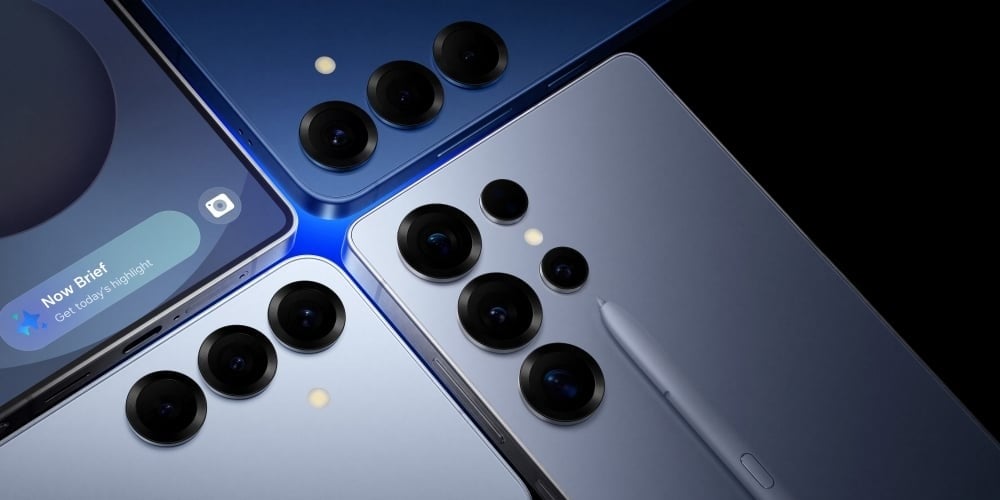
Most flagship smartphones today do look strikingly similar. Big OLED screens, slim bezels and stacked cameras dominate the landscape. This convergence is not a failure of creativity but a sign that the fundamentals are largely solved. Large, bright displays, multi-lens cameras and all-day battery life are no longer differentiators. They are basic expectations. We may have reached a point where this sameness is not a sign of stagnation, but of maturity. Phones look alike on the outside because the obvious design problems have been solved. That does not mean innovation has stopped. It has simply moved deeper.
1. Increasing Focus on Internal Hardware and Software
Under the hood, progress is accelerating. Smartphone makers are reorganizing their devices around next-generation operating systems and increasingly powerful chips, with generative AI becoming a core feature rather than an add-on. Apple’s latest A-series silicon brings advanced on-device machine learning to photos and videos, automatically analyzing scenes and optimizing results in real time. Google’s Pixel lineup leans heavily on AI as well, from smarter voice recognition and predictive text to sophisticated computational photography. The broader shift is toward phones that can run large models locally, handle complex tasks offline for privacy, draft content, translate languages instantly and adapt to user behavior. In effect, the modern smartphone is becoming a pocket-sized computer that learns as you use it.
2. Advances in Mobile Connectivity
Connectivity is another area where users will feel the change even if they never see it in a product render. The era of having no signal is slowly fading. Satellite connectivity is beginning to fill the gaps left by traditional cellular networks, enabling basic messaging and emergency features far beyond tower coverage, with voice and data support on the horizon. Upcoming phones are expected to push this further by integrating everyday apps such as maps and messaging with satellite links. Whether you are in a remote village or hiking in the mountains, your phone’s reach is expanding dramatically. This kind of innovation is invisible in the spec sheet glamour shots, but valuable in everyday use.
3. Battery Capacity and Charging Improvements
Power systems have also taken a major leap forward. Battery capacities that once seemed excessive are now common, with many phones packing cells in the 5,000 to 8,000 mAh range. Fast charging has become genuinely fast, with some devices capable of refilling from empty to full in well under half an hour. New battery chemistries and more efficient power management deliver longer endurance without making phones thicker. Wireless charging has improved as well, reaching speeds that rival older wired solutions. As a result, battery anxiety is becoming less of a daily concern for many users.
4. Thermal Management and Sustained Performance
All that extra performance and power creates heat, and manufacturers are addressing that head-on. High-end phones now use advanced vapor-chamber cooling systems that spread heat more effectively across the chassis. This allows chips to sustain higher performance for longer periods without throttling, even during gaming, video recording or AI workloads. While the exterior design may appear familiar, the internal engineering is increasingly focused on consistency and reliability.
5. Ongoing Exploration of New Form Factors
Foldables show that hardware experimentation continues alongside mainstream designs. Devices like the Galaxy Z Flip and Z Fold demonstrate alternative form factors, while newer tri-fold designs unfold into larger displays and push the limits of hinges, screens and battery engineering. These products are not aimed at all users, and early generations typically appeal to enthusiasts. Even so, they play a role in advancing components that later appear in conventional smartphones.
6. Incremental Design, Continued Evolution
The broader picture suggests that while external design changes have slowed, smartphone development remains active in other areas. Flagship designs have converged because the basic formula works well, and manufacturers are now emphasizing refinement. Inside the device and in software, progress continues through AI capabilities, connectivity improvements, sensor upgrades and better power and thermal management. Smartphones may look familiar, but they are still evolving in meaningful ways.