
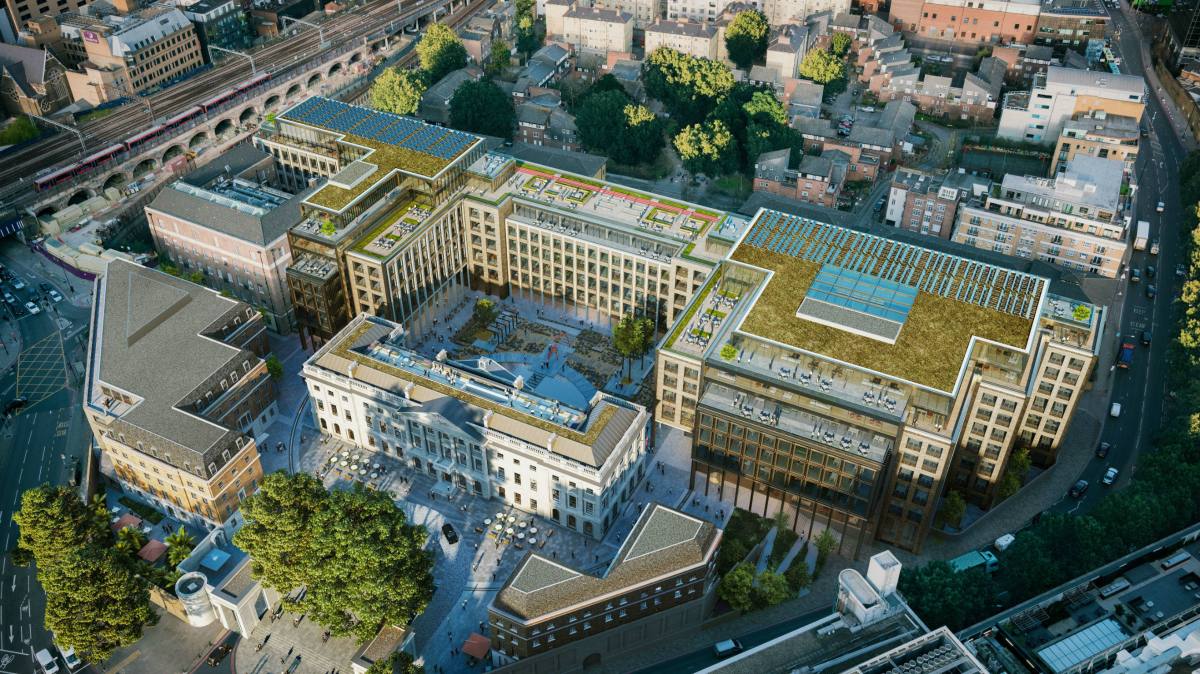
Campaigners have accused ministers of relying on a secret diplomatic note to smooth the way for Beijing’s proposed “mega-embassy” in central London, as ministers are poised to give permission for the project as early as Tuesday.
Letters seen by The Times showed the Foreign Office cited a note verbale, a type of diplomatic communication, sent during Boris Johnson’s time as foreign secretary, to argue that Royal Mint Court would only be designated as diplomatic premises if planning permission were secured.
The document has never been published and was not disclosed to interested parties of the scheme, or The Times, when requested. Officials said the document showed that diplomatic consent had been granted in 2018 on a conditional basis and could be withdrawn if planning permission were not secured.
But an official letter sent by Johnson the same year granted diplomatic status and made no mention of planning permission, leading campaigners to argue they were being asked to accept the legitimacy of the planning process on the basis of a condition they had never seen.
The embassy is expected to be approved by ministers despite fears over sensitive communications infrastructure nearby. But the row could further delay the decision.
Critics of the embassy plan said the reliance on the eight-year-old diplomatic exchange raised questions about transparency and whether ministers had always intended to approve the embassy plan. MPs are preparing to raise the issue in parliament on Monday.
Luke de Pulford, the executive director of the Inter-Parliamentary Alliance on China (IPAC), said the disclosure helped explain why campaigners and local residents felt they had been left to fight the proposal themselves, after a fresh protest at the site on Saturday.
“The embassy represents a massive geopolitical win for China,” he said. “At the height of the Cold War, could you imagine Thatcher approving the Soviets building the largest embassy in Europe, in London? It is unthinkable.
“We now have cross-party leaders turning up to protests and cabinet members briefing that this is a terrible idea.
“Meanwhile big questions remain over how transparent the UK has been with our closest security allies over the risks posed by Chinese proximity to sensitive cables. The UK is relying on secret notes to the Chinese to progress the application, and government can’t even confirm Starmer’s China visit until they have given the green light. It’s all utterly farcical.”
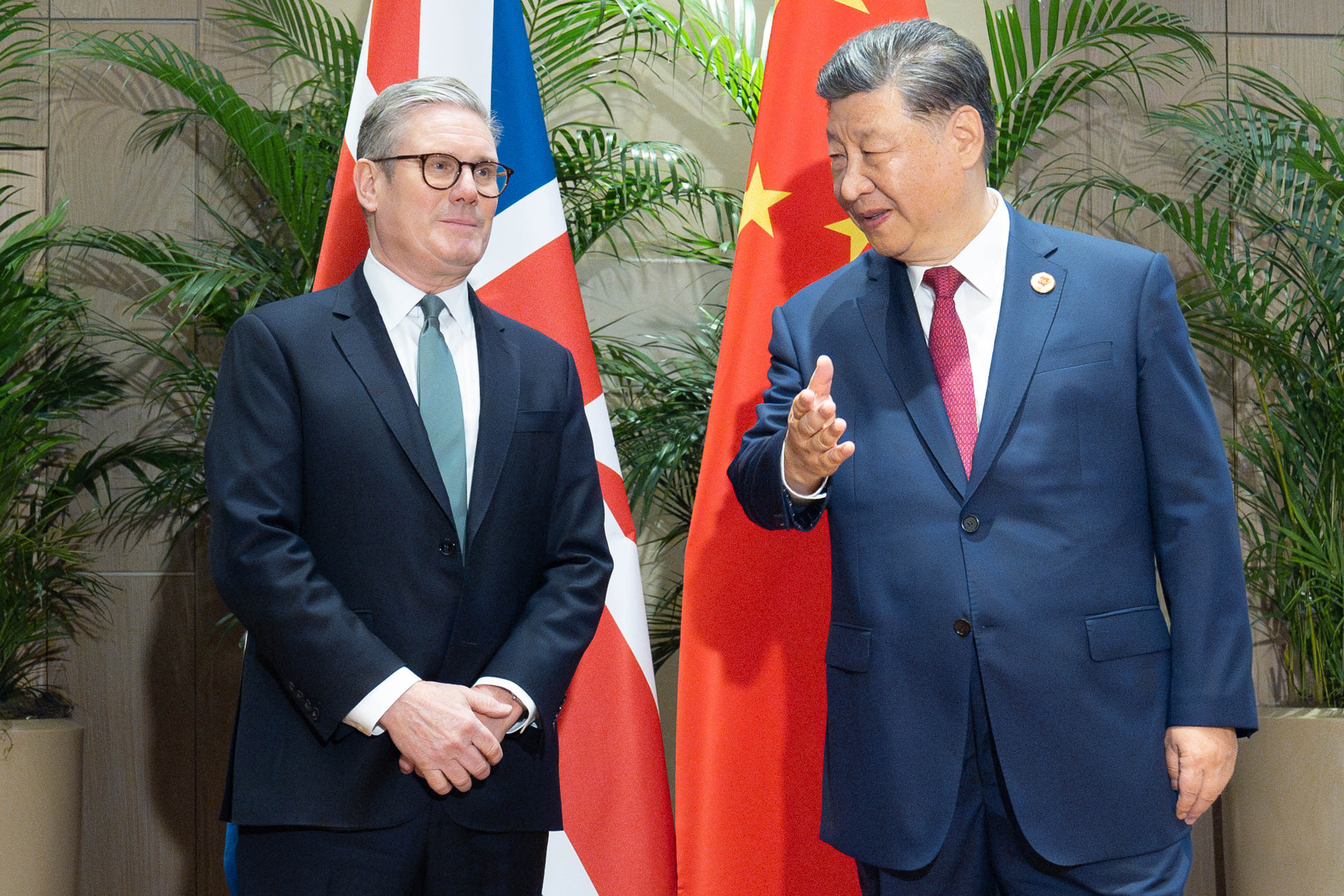
Sir Keir Starmer meeting President Xi at a G20 summit in Rio de Janeiro in 2024. The prime minister is expected to visit Beijing soon
STEFAN ROUSSEAU/WPA POOL/GETTY IMAGES
IPAC has been at the forefront of opposition to the embassy, which would be Beijing’s largest diplomatic complex in Europe. The site sits close to sensitive communications infrastructure serving the City of London and Canary Wharf, prompting security concerns among campaigners and Britain’s allies.
Last week reports detailed the unredacted plans for the site, which showed an underground complex close to some of Britain’s most sensitive communications cables.
On Tuesday The Times revealed that the government had been forced to reassure the US and other Five Eyes allies that no sensitive government or financial data travelled through the cables, after Washington raised alarm about the potential for Chinese surveillance.
De Pulford said the row illustrated how Sir Keir Starmer, who is expected to travel to China in the coming weeks, had been reluctant to confront Beijing.
“While he’s jetting off to China, he’ll be leaving the job of defending national security to a merry group of Tower Hamlets residents,” he said. “You just have to think about how ridiculous that is.”

Luke de Pulford
JOHN NGUYEN FOR THE TIMES
De Pulford was speaking after hundreds of protesters gathered at the proposed site at Royal Mint Court, including activists, residents and politicians from across the political spectrum.
Meanwhile residents in Tower Hamlets are preparing a judicial review to challenge the embassy plans. If lodged, it would probably take months to resolve, potentially running in parallel with the government’s efforts to reset relations with Beijing.
De Pulford said the prospect of an unresolved legal challenge hanging over the decision risked becoming an embarrassment for ministers. “There’s no good option. Saying no to the embassy means upsetting Beijing, and saying yes means a catastrophic judicial review that may result in senior cabinet resignations,” he said.
De Pulford, who set up IPAC in 2020 and works with politicians in more than 40 countries, said he and other campaigners had felt abandoned by successive governments.
“We don’t have the protections of government, because even them protecting us means pissing off the Chinese, which they don’t want to do,” he said. “So they just let us suffer for the sake of our own national security, doing the job that they should be doing.”
His campaigning has focused on the influence exerted by the Chinese Communist Party, including the use of Uighur forced labour, the suppression of democracy in Hong Kong and alleged Chinese infiltration of British institutions.

Jimmy Lai, the founder of pro-democracy newspaper Apple Daily, has been found guilty of foreign collusion and sedition
ANTHONY WALLACE/AFP/GETTY IMAGES
De Pulford is a Conservative member but insists his fight is not party political, and he was as critical of previous Tory administrations in their dealing with China.
“I felt that because I was in the Tory party, I had the licence of loyalty. So I went harder at the Conservatives than I’ve been able to under Labour. But if you want to be honest about it, the current government’s posture is weaker on China,” he said.
“When there was a state-sponsored cyberattack against the whole of the IPAC network, the UK government didn’t tell any of the people who were attacked,” he said, adding that it included 43 MPs. Those affected learnt of the incident only after the United States unsealed an indictment.
“The briefing we got from the FBI was very different from the briefing we got from parliamentary security,” he said.
Similar patterns, he said, emerged when he and others were named in Chinese legal proceedings against the Hong Kong publisher Jimmy Lai. “They didn’t want to stand up for two UK citizens. Even privately,” he said.

Protesters in Britain are said to have been repeatedly targeted by the Chinese authorities
JOANNA CHAN/AP
The personal cost of the work, he said, had been significant. He described impersonators emailing his mother pretending to be him, persistent harassment, cyberattacks and attempts to infiltrate IPAC’s work, including via honeytraps. The organisation has relocated offices to protect staff.
De Pulford accused ministers of clinging to the belief that improved relations with Beijing would deliver economic gains, despite evidence that China was no longer interested in widespread investment in Britain.
He also warned that the risk of escalation over Taiwan was being underestimated, with potentially catastrophic economic consequences.
“Failing to deter a war over Taiwan will wipe $10 trillion off the global economy, probably around 12 per cent of the UK’s GDP, way worse than Covid or any other economic crisis that you can think of,” de Pulford said. “The premium on an iPhone goes up from, say, £1,000 to £10,000 per unit, because of the rarity.”
“I don’t even think that the UK has assessed its exposure to the cost of escalation in the Taiwan Strait.”
He said Britain continued to run a significant trade deficit with China while exports fell, and warned that the country was failing to align with allies attempting to reduce their exposure.
“We’re the only mugs among our allies who have not done that,” he said. “We’re already becoming a dumping ground for Chinese EVs.”
And he said that the impact of those policies was being felt disproportionately by working-class communities, as decisions taken in Westminster to prioritise cheap imports had weakened Britain’s industrial base and left workers unable to compete with heavily subsidised Chinese producers.
“Protecting ourselves against this could and should be a Labour cause,” he said.
Despite repeatedly drawing comparisons with the Cold War, de Pulford said the analogy understated the scale of the challenge.
“The Cold War analogy is actually comforting compared to what we’re going to deal with with China. It’s worse,” he said, arguing that China’s combination of military power and economic leverage made it uniquely difficult to counter.
A Foreign Office spokesman said protecting national security remained the government’s “first and most important duty” and said intelligence and law enforcement agencies worked to protect those targeted by intimidation and transnational repression in the UK.