

David James’s articles from Travers Smith LLP are most popular:
within Employment and HR topic(s)
in United Kingdom
with readers working within the Advertising & Public Relations industries
Travers Smith LLP are most popular:
within Environment topic(s)
The Financial Conduct Authority (FCA) and the Pensions Regulator
have issued a new joint consultation on their long-awaited value for
money (VFM) framework for workplace defined contribution (DC)
pension schemes.
The revised plans aim to take effect from 2028 and follow
industry criticism of the FCA’s original proposals issued in
2024. The Regulators have softened some measures, but the core
principles stand. The Regulators remain focused on improving
transparency, comparability and competition in the pensions
sector.
We set out below:
the background and scope of the new regime;
an overview of how the VFM framework will operate;
a commentary of how the proposed framework has changed since
the FCA’s earlier consultation; and
developments to watch out for in preparing for the new
regime.
1. Background
The FCA consulted on a VFM regime in relation to contract-based
schemes in 2024 (the “2024
Consultation”, see WHiP Issue 111 for more on this). The Pension
Schemes Bill introduces a power to make regulations to introduce
the VFM framework for trust-based occupational DC schemes (see WHiDC: Pension Schemes Bill special).
2. Which schemes will fall in scope?
The VFM regime will apply to default arrangements of workplace
DC pension schemes – i.e. the default strategy of qualifying
auto-enrolment (AE) schemes and legacy
“quasi-defaults” which predate AE.
Executive Pension Plans and Small Self-Administered Schemes will
be excluded from the framework. Exemptions will also be available
for contract-based arrangements closed to new employers that are
undertaking a transfer of all members to another arrangement and
trust-based schemes that have notified the Pensions Regulator that
they have commenced wind up.
3. How will the VFM framework operate?
Torsten Bell, the Pensions Minister, describes the framework as “being
straight with people and making sure people’s savings work as
hard as they did to earn them”.
The Regulators state four aims:
Consistent measurement and disclosure –
trustees and firms must measure and publicly disclose investment
performance, costs, and service quality using metrics designed to
assess VFM effectively.
Objective comparison – those responsible
for oversight (trustees for trust-based schemes, and independent
governance committees (IGCs) and governance
advisory arrangements for contract-based schemes) can assess
performance against the market on a consistent, objective
basis.
Transparency of outcomes – assessment
results must be publicly disclosed.
Action on poor value – trustees and
firms must take specified actions where an arrangement is assessed
as not delivering VFM.
The assessment process will involve three steps:
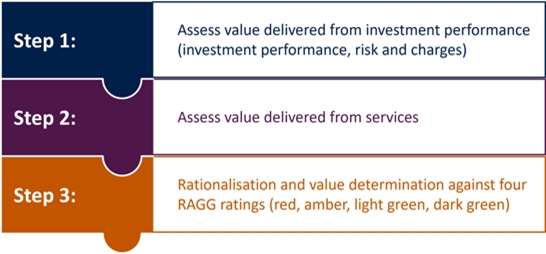
Employers will have a central role in the regime. The Regulators
intend that schemes will provide them with the information to
select arrangements that deliver long-term value, leading to better
value pensions, without savers themselves having to take
action.
4. What’s changed in the latest consultation?
The fundamentals of the new framework remain unchanged from the
2024 Consultation. Schemes must publish key metrics every year,
covering investment performance, asset classes, costs, charges, and
service. Trustees and providers will need to assign a VFM rating to
their default arrangement(s). Underperforming schemes face
consequences – e.g. taking steps to improve, notifying
contributing employers of poor performance, closing to new business
and/or ultimately transferring members elsewhere.
The revised framework, though, proposes a more streamlined and
nuanced approach. In several respects, it is designed to be more
objective, and more accommodating of innovative investment
strategies:
1. Forecasting investment performance:
The most notable new requirement is the inclusion of
forward-looking metrics. Rather than focusing solely on past
performance, schemes will need to set out expected net returns and
risks over the next ten years. Schemes will be able to decide their
own bespoke methodology and assumptions when calculating these
metrics (tailored to the scheme’s chosen investment
strategy).
Guardrails will apply to limit the risk of unrealistic or
inflated metrics: (i) schemes will need to record, but not
disclose, their assumptions; and (ii) they must also obtain and
consider advice from an appropriate third-party on the
reasonableness of the assumptions.
Comment
The use of bespoke forward-looking metrics is intended to
support the Government’s agenda to drive pension scheme
investment in productive, long term asset classes, and alleviate
some of the potential obstacles to private market investment. For
instance, the Regulators have stated explicitly that they
“do not want to discourage trustees and firms from finding
ways to manage the potential ‘lag’ in returns from assets
with a projected J curve shaped return.”
A focus on future performance could also reduce the risk of
herding towards benchmarks focused on short-term returns. A risk
remains that the use of non-standardised forward-looking metrics
could make it harder for employers and savers to compare schemes
and could potentially increase the risk of challenge where actual
performance falls short of projections.
2. Streamlined reporting:
(a) Past performance and charges: Past
performance will still need to be assessed and reported on three
levels:
Gross investment performance (net only of transaction
costs).
Gross investment performance net of investment charges.
Gross investment performance net of all costs and charges.
Notably, one hard edge has been softened. The previous proposals
required schemes to report 15-year historic data on investment
performance and charges. That has gone. Instead, backwards looking
investment performance data must be disclosed for periods of 1
year, 3 years and 5 years where available, and 10 years where
reasonably practicable to obtain. As for how performance data is
calculated, the original proposal was to calculate based on the
annual performance of multiple cohorts of members as they each pass
through a given point in the retirement journey, aggregating those
performances into a geometric average. In response to feedback, it
is now proposed this be changed to consider the average experience
of multiple cohorts of members as they pass through a specific year
to retirement points (i.e. arithmetic averaging).
The Regulators have also dropped the proposal to require schemes
to distinguish between service costs and investment changes. Both
updates will be a welcome reduction in the reporting burden for
schemes.
(b) Service quality: The 2024 Consultation
proposed five service metrics, being (i) secure, prompt, and
accurate transactions, (ii) member satisfaction (iii) retirement
decision-making support for members (iv) ability to easily amend
pensions and (v) supporting members to engage with their pensions.
The Regulators are proposing minor changes to the first two ratings
for record-keeping and assessing member satisfaction. The initial
proposal to adopt a standardised member survey will now not be
included at launch, with work continuing across industry to develop
one over the medium term. The remaining three metrics will also not
now be required when the VFM framework is launched and will instead
be developed following further consultation with industry. However,
a new metric will be introduced to require information about member
nomination of beneficiaries.
Comment
Despite being scaled back, the revised proposals will still
impose a material compliance burden. Slimming down historic metrics
means less paperwork, but more subjective, forward-looking metrics
add another layer of work and judgement for schemes. Smaller,
own-trust schemes may have the most to do with the fewest
resources. This could drive further consolidation, with smaller
schemes transferring to bigger providers better equipped to
shoulder the reporting burden.
3. Comparison against commercial market comparator
group:
Instead of letting schemes cherry-pick three comparison groups,
schemes will need to use a single commercial market comparator
group, drawing from a central data repository. The commercial
comparator group will consist of contract and trust-based
arrangements that are open to new employers which are either firm
or scheme-designed multi-employer arrangements (i.e. no bespoke
arrangements or single employer trusts).
Comment
This approach could reduce the scope for gamesmanship and lead
to a more complete, objective and consistent approach to measuring
value (provided the central data set is efficiently kept up to
date, is robust and includes sufficiently granular detail on the
scheme specific context for that data).
4. Four-point ratings system:
The Regulators are also proposing a new, four-tier
“RAGG” rating (rather than the three tier “RAG”
rating proposed originally). Adding “light green” and
“dark green” above “amber” and “red”
offers welcome nuance, giving employers and savers a more granular
view. Schemes rated amber or red will be barred from taking on new
business, and red cases must transfer members elsewhere if that is
in their best interests. Amber rated schemes will be required to
prepare and submit an improvement plan setting out how they will
achieve a green rating with specified timescales for prescribed
actions or set out other arrangements such as a transfer of members
to a better value arrangement. Few arrangements are expected to
attain a dark green rating.

Comment
More nuanced ratings may mitigate the risk of cliff-edges and
herding toward uniform investment strategies, where schemes can
avoid “standing out from the crowd”.
5. What happens next
Feedback to the consultation: The joint
consultation closes on 8 March 2026. It includes draft rules and
guidance for contract-based schemes. The VFM framework will apply
to trust-based schemes through regulations made under the Pension
Schemes Bill currently before Parliament. Responses to the
consultation will inform both the development of these regulations
and the draft rules and guidance for contract-based schemes.
Further engagement: The FCA plans to offer
roundtables and stakeholder events to discuss practical aspects as
they develop the framework. The Government intends to consult on
draft regulations to implement the VFM framework for trust-based
schemes and the Pensions Regulator will consult on any changes to
its Code of Practice or guidance. The FCA is also likely to
undertake a further consultation.
Implementation: Final rules will be confirmed
once the Pension Schemes Bill receives Royal Assent. The Regulators
are currently expecting that the first VFM assessments will be
required in 2028. In the meantime, workplace DC providers and
trustees and employers with DC or hybrid schemes should monitor
developments in the regime, consider responding to the consultation
and start reviewing data.
The content of this article is intended to provide a general
guide to the subject matter. Specialist advice should be sought
about your specific circumstances.