
Photo by Sean Gallup/Getty Images
Since being elected Green Party leader, I’ve faced plenty of attacks from politicians over my stance on Nato. Apparently, pointing out that the Cold War-era alliance in its current form isn’t working makes me naïve. Highlighting the UK’s reliance on the United States for our security makes me stupid. And insisting that we adapt our security system to meet the threats of the 21st century makes me crazy.
Now we are in a position where leaders, journalists and people across the world are asking the question: what happens if one Nato member attacks another? How would the United Kingdom and other Nato members respond if the US were to invade Greenland? Suddenly, the idea that we might need to rethink our security structures doesn’t seem so naïve, while people like Nigel Farage, who have spent years cosying up to Trump, are clearly not the ones we should be listening to at this moment.
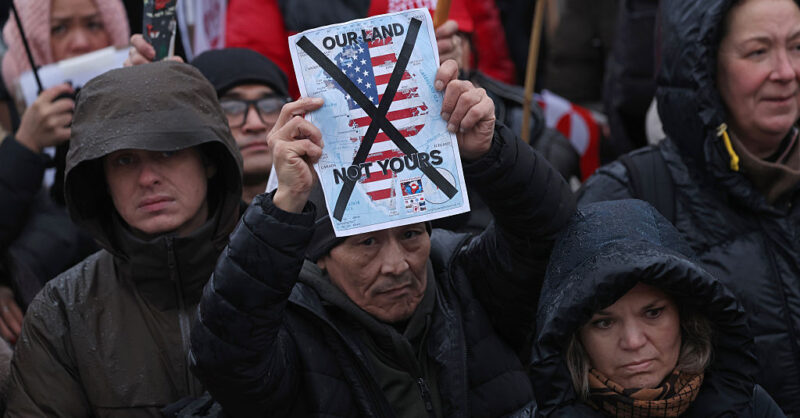
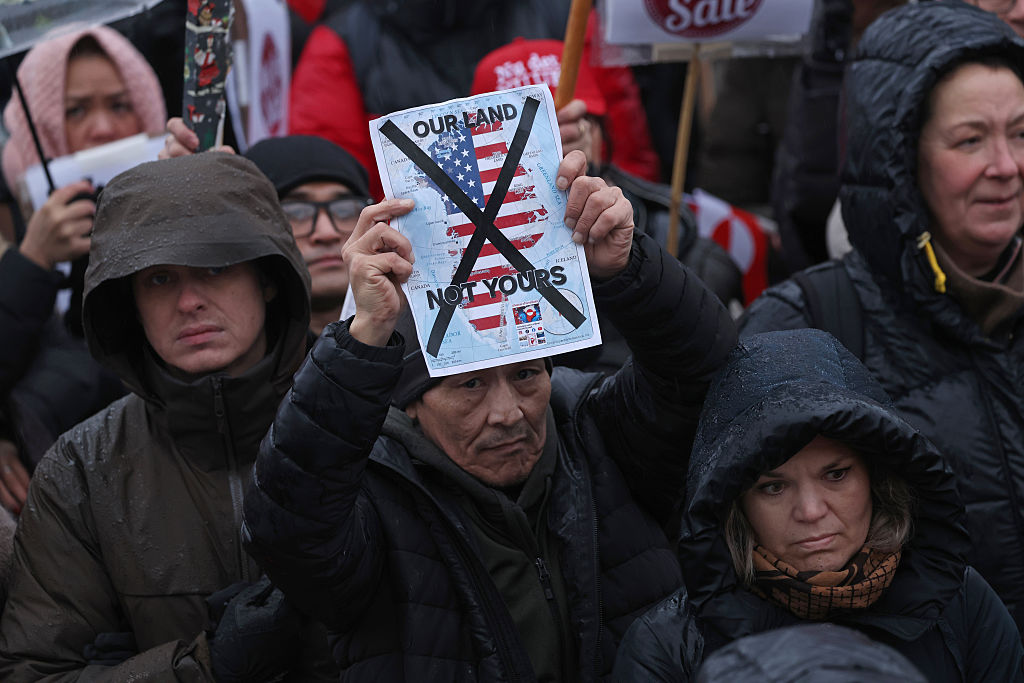
In the last 24 hours, Donald Trump has threatened to impose huge tariffs on any country opposing his plan to “buy” Greenland from Denmark. As Greenlanders march under the banner of “Greenland is for Greenlanders,” it has become increasingly clear that this dangerous president will neither respect international agreements nor diplomatic ties, and will not accept that his already extensive access to Greenland under the 1951 Defence of Greenland Agreement is sufficient.
When Trump says, “One way or the other, we’re going to have Greenland,” we should sit up and listen.
It is now frighteningly clear that basing our entire national security on being America’s poodle will soon become entirely untenable. The pressing question is: what do we do about it?

New year, new read. Save 40% off an annual subscription this January.
First, we need to disentangle our security apparatus from the United States so that we can be genuinely independent. As an urgent first step, the government should review how we might remove US bases from British soil while maintaining our own security – and retaining the capacity to support our allies in Ukraine. There are currently 13 US military bases in the UK, operated by an estimated 10,000 personnel. If Trump were to take military action against Greenland, we must be able to act swiftly to remove America’s military presence from our country peacefully and efficiently. The government should also cancel its £240m deal with US firm Palantir, signed despite MPs raising serious security concerns about the company.
Second, we need to ditch Trident – and fast. Even supporters of nuclear weapons recognise the risks of maintaining a system that relies on the United States. Billions have already been spent on Trident renewal, but we must not fall prey to the sunk-cost fallacy. The government should immediately pause the renewal and bring a full debate to parliament on whether we wish to spend billions of pounds on a weapons system that cannot operate without US support.
In the longer term, we need a comprehensive security review that fully accounts for the serious threats facing the UK today. In the 140 pages of the government’s most recent Strategic Defence Review, the word ‘climate’ appears only twice, while ‘flooding’ and ‘wildfire’ are absent entirely. Yet senior military figures warn that the dangers posed by the climate crisis far outweigh those from other states. When discussing defence spending, these are precisely the threats we must assess and budget for – rather than simply acquiescing to America’s arbitrary demands for military expenditure, which flow straight into the coffers of US arms manufacturers.
We also need to strengthen our relationships with European allies and with nations across the globe, while working within Nato to ensure the alliance prioritises peacebuilding over militarism. Leaving the EU weakened the UK and left us overly reliant on the toxic so-called “special relationship.” Amidst the threats posed by Russia and the instability of today’s world, alliances with nations that share our values have never been more important. The UK has a vital role to play in fostering new forms of multilateral cooperation – particularly with Europe and the Global South – to reduce our dependence on the US.
The first duty of any government is to keep its people safe. In today’s unpredictable world, that will not be achieved by clinging to outdated notions of security, or by cowering at Trump’s feet in the hope that he will protect us. It requires confronting the threats facing us head-on – from Putin’s imperial ambitions and Trump’s insatiable demands, to cyber warfare and the destabilising effects of climate breakdown. For too long, British leaders have buried their heads in the sand. It is time to wake up.
[Further reading: Zack Polanski’s new fortress]
Content from our partners