
Your support helps us to tell the story
From reproductive rights to climate change to Big Tech, The Independent is on the ground when the story is developing. Whether it’s investigating the financials of Elon Musk’s pro-Trump PAC or producing our latest documentary, ‘The A Word’, which shines a light on the American women fighting for reproductive rights, we know how important it is to parse out the facts from the messaging.
At such a critical moment in US history, we need reporters on the ground. Your donation allows us to keep sending journalists to speak to both sides of the story.
The Independent is trusted by Americans across the entire political spectrum. And unlike many other quality news outlets, we choose not to lock Americans out of our reporting and analysis with paywalls. We believe quality journalism should be available to everyone, paid for by those who can afford it.
Your support makes all the difference.Read more
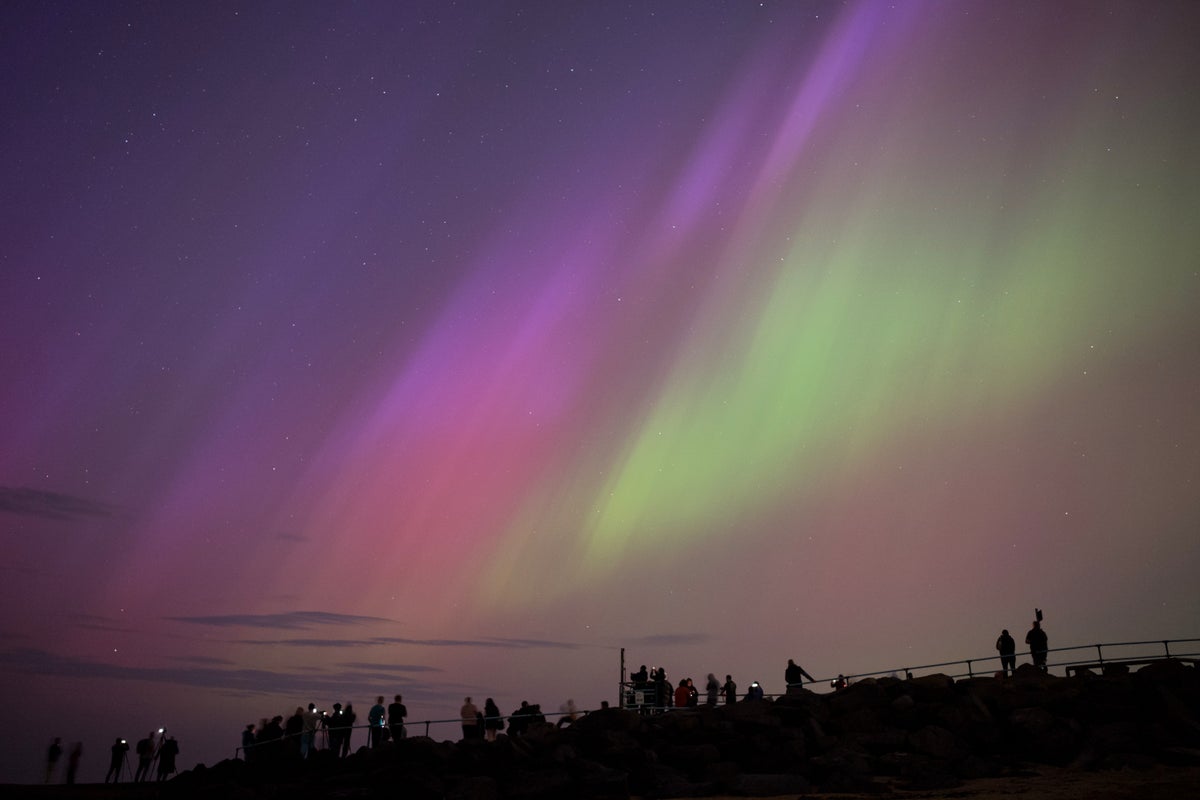
The Met Office has issued an extreme space weather alert that could bring strong auroras to the skies over the UK on Monday night.
A colossal solar flare launched a coronal mass ejection (CME) from the surface of the Sun on 18 January, which is expected to arrive late on Monday, or early Tuesday morning.
The incoming CME could deliver strong geomagnetic storm conditions that will bring the aurora borealis, or Northern Lights, far further south than usual.
“A coronal mass ejection is expected to arrive on 20 January, which is likely to give a G3/ Strong Storm, with the chance of seeing aurora down to mid-latitudes, depending on exact timing of the CME arrival,” the Met Office said.
The full magnitude of the auroras will depend on the exact timing that the charged particles from the CME reach Earth.
There will be patchy cloud over most of the UK on Monday evening, according to the latest forecast, though there will potentially be breaks to allow viewing across many parts.
“There is still some uncertainty around the exact timing of the CME’s arrival, but it is expected overnight tonight or tomorrow morning,” said Krista Hammond, Met Office Space Weather Manager.
“The CME is likely to result in geomagnetic storming, giving the potential to view the aurora. However, sightings are dependent on the CME arriving during hours of darkness and clear skies. Unfortunately, cloud and rain on Tuesday evening may make viewing difficult, even if the timing is favourable.”
The best way to see auroras is to get away from areas with any light pollution and allow time for your eyes to adjust to the darkness.
According to the US National Oceanic and Atmospheric Administration (NOAA) Space Weather Prediction Center, the best time to view them is usually within an hour or two of midnight.
“These hours of active aurora expand towards evening and morning as the level of geomagnetic activity increases,” NOAA notes on its website.
“There may be aurora in the evening and morning but it is usually not as active and therefore, not as visually appealing.”