
This post is in response to
Unexpected Creative Tool Use By a Wild Wolf to Catch Crabs
By Marc Bekoff Ph.D.
We now know that a wide variety of animals use tools, and there are some unexpectedly clever individuals among them.1 Examples involving invertebrates, reptiles, fish, birds, and mammals show different levels of sophistication and complexity, and the recent example of a highly intelligent wild wolf using a tool expands the biodiversity of such use to a wider array of nonhumans. Domestic dogs, who evolved from a common wolf ancestor, also use tools, so it’s not surprising to learn that their wild relatives do as well.
Yet when Jane Goodall first reported a wild chimpanzee using a tool, there was no shortage of skeptics who questioned her observations. They were silenced when she showed them films of David Greybeard engaging in tool behavior.
Should We Be Surprised That Cows Use Tools, Too?
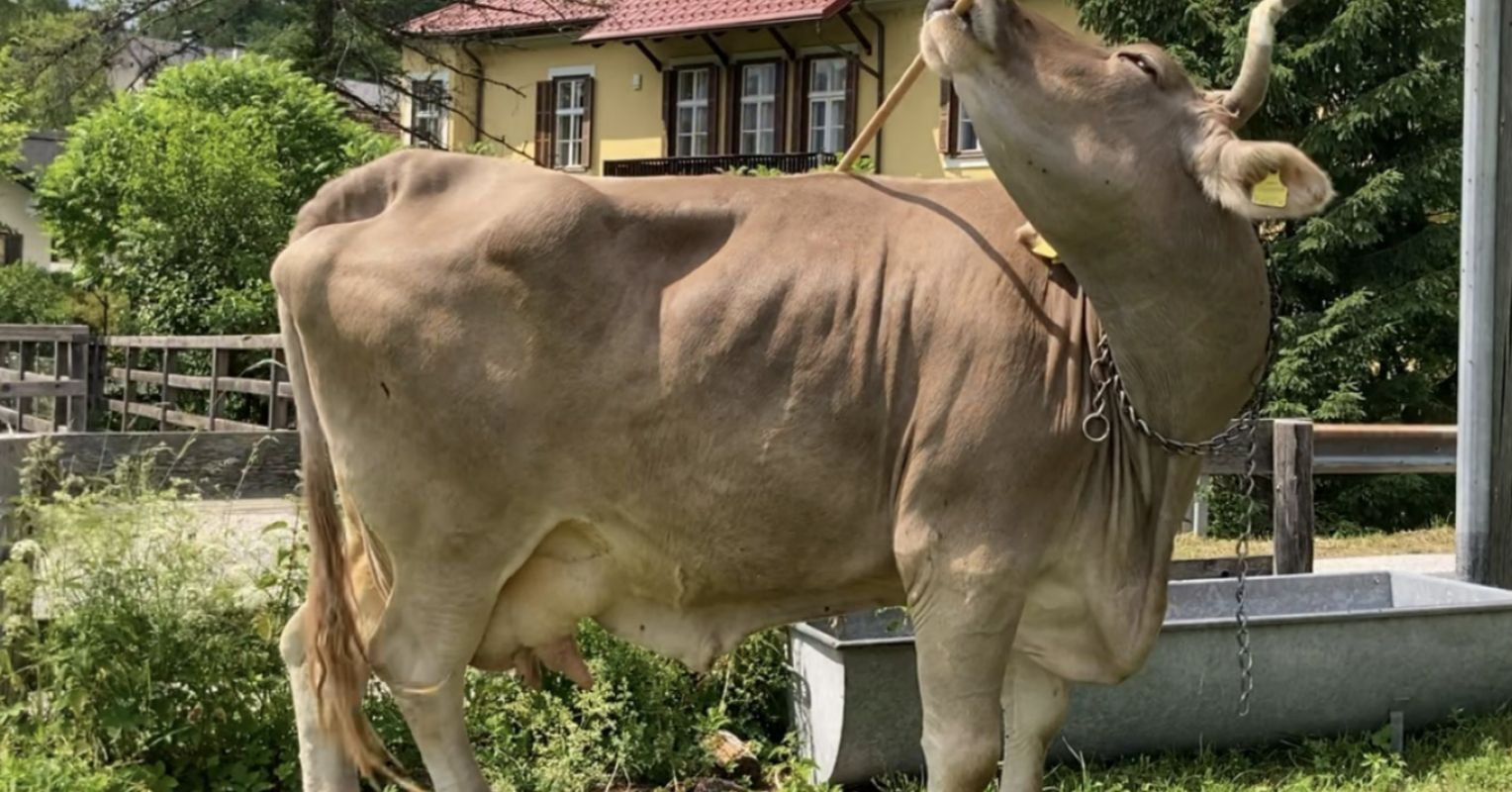
There’s a lot more going on in cows’ inner lives than we give them credit for. Cows are bright and highly emotional sentient beings, and a new research paper, along with images and videos published today by A. J. Osuna-Mascaró and A. M. I. Auersperg titled “Flexible use of a multi-purpose tool by a cow” in the prestigious journal Current Biology, shows Veronika, a pet cow, demonstrating what the researchers call “flexible egocentric tooling.”
Veronika was observed using a deck brush to self-scratch. While she preferred the bristled end, she switched to the stick end when targeting softer lower-body areas. Somehow she learned that different parts of the broom could help satisfy her need to scratch herself, adapted to where she needed to use it by engaging in “flexible egocentric tooling,” and there’s little doubt that it felt good to do so.
The Importance of Rare “Surprises” in Studies of Animal Behavior
Veronika moves the needle by adding cows to the “tooling club.” It’s essential to study as wide a variety of animals as possible to learn about their cognitive and emotional lives.
Unfortunately, cows and other highly intelligent and emotional animals are far too often written-off as being dumb and lacking emotions. However, despite this sort of speciesism, detailed research shows they are skilled problem-solvers and fully sentient beings with very active brains and rich and deep emotional lives.
So-called “surprises”—rare as they may be—abound in the study of animal cognition. Detailed comparative research is showing that countless vertebrates, mammals, birds, fish, reptiles, and amphibians are very clever problem-solvers. Almost daily, it seems like insects and other invertebrates are joining the “smart/sentient club,” defying narrow-minded expectations that they are dumb and unfeeling (insentient) creatures.
If one has an open-mind, I argue, what we’re learning shouldn’t be called “surprises”—that phrasing reflects our narrow-minded speciesism, suggesting that only humans or other great apes or mammals and birds are the only smart sentient animals.
Where Do We Go From Here?
These unique, important, and rare observations raise a number of important questions. Definitions of tool use vary from an individual having to make a tool and then use the object to accomplish something. Veronika didn’t make the broom, but she learned to use it and showed behavioral flexibility when she used a different end of the room to scratch her lower body.
I think it’s clear that she is using the deck brush as a tool and intentionally manipulating it to scratch various parts of her body. While she didn’t manufacture (make) the brush, she clearly learned it could be used to scratch herself, and it felt good to do it. It would be highly informative to see if Veronika goes on to use another object as a tool or learns to make and then use a tool that has the same function as the broom.
Veronika is clearly manipulating the brush to adjust to where she wants to scratch, and I’m sure other cows have the bovine IQ to also do it. One fascinating and very important research question is whether tooling will spread to other cows in her group or other neighboring cows. If it did, it could become a local cultural tradition, like other behaviors in other animals.
The researchers should be congratulated for being keen observers by watching and filming Veronika and for expanding the biodiversity of tooling. This study calls attention to the fact that thinking of animals such as cows as dumb is robbing science of learning about the evolution of their rich cognitive skills. I look forward to more reports such as this so we can move on from close-minded studies of animal minds in which the cognitive and emotional capacities of certain animals are wrongly underestimated and categorically dismissed. Bovine and other sorts of speciesism need to be shelved.