

As Ottawa considers Churchill for a military base, three of Manitoba’s prominent transportation networks — including the Port of Churchill’s ownership — have inked a deal to work more collaboratively.
Leadership behind the Port of Churchill, Winnipeg Richardson International Airport and CentrePort Canada (Manitoba’s largest inland port) signed a memorandum of understanding with federal and provincial governments on Monday.
“(This will) better connect Manitoba to the global market through air, land and sea,” said Manitoba Business Minister Jamie Moses.

MIKE DEAL / FREE PRESS
Northern and Arctic Affairs Minister and Minister responsible for the Canadian Northern Economic Development Agency, Rebecca Chartrand speaks in the rotunda of the Manitoba Legislative Building to announce a new Manitoba trade alliance and sign a memorandum of understanding, Monday.
Churchill is, strategically, the gateway to the North, added federal Northern and Arctic Affairs Minister Rebecca Chartrand.
The feds are “currently exploring” the area as a potential military base, Chartrand said. She stopped short of making any commitments.
She, Moses and leaders in attendance were focused on the private sector.
The new memorandum of understanding outlines single-window access to services. This means Arctic Gateway Group — owner of the Port of Churchill and its Hudson Bay Railway link — will co-ordinate with CentrePort Canada and the Winnipeg Airports Authority to move clients’ goods throughout the province.
“All three of us plan to act as one office,” said Chris Avery, chief executive of Arctic Gateway. “When someone comes to (one of) us, you get all three.”
The work has already been happening; the three entities talk on a near-daily basis, said Carly Edmundson, CentrePort Canada president.
“That’s only going to continue now that we’ve put some real specific strategy around what we want to achieve together,” she said. “It’s just about resilience and optionality.”
The COVID-19 pandemic, labour disputes and environmental catastrophes have contributed to supply chain disruptions over the past decade. Companies are seeking several routes to get their goods to market, Edmundson said.
Meanwhile, global trade partnerships continue to shift as the United States slaps tariffs on its allies.
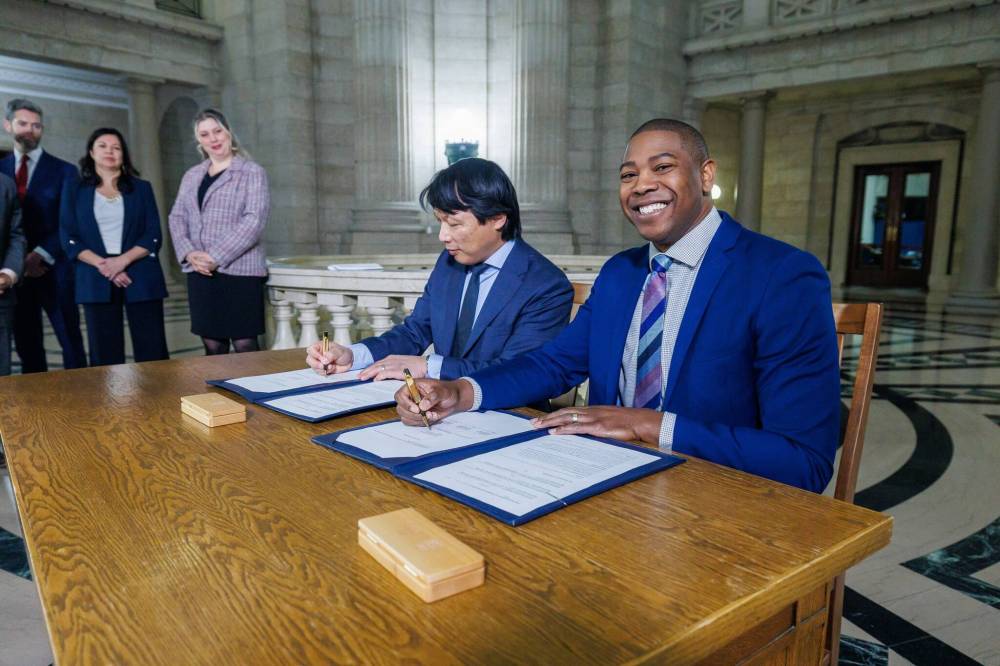
Business, Mining, Trade and Job Creation Minister Jamie Moses (right) and Chris Avery, president and CEO, Arctic Gateway Group sign the memorandum of understanding. (Mike Deal / Free Press)
“This is a formal way to tell Canada we are all working together, to make sure that we’re building something strategic,” Edmundson said after signing the memorandum.
Enhancing Foreign Trade Zone access and usage, and supporting the ongoing development of Winnipeg’s inland port, airport and the Port of Churchill and Hudson Bay Railway are included in the memorandum.
Moving forward, the WAA plans to invest with the Manitoba ports in mind, said president Nick Hays.
“It’s important that we continue to direct our investments in such a way that we’re optimizing for the best outcomes … rather than optimizing in our own silos,” Hays said.
The WAA is eyeing a new 2.6-million-square-foot development adjacent to Winnipeg’s largest airport, according to a submission it sent Ottawa ahead of the federal budget. It’s seeking government money for such a project.
The WAA has spent the past six years developing a 142,500-sq.-ft. cargo logistics campus.
CentrePort is preparing for another 1,800 acres to come online for development later this year. Sewage and water servicing on the port’s Winnipeg side should be done this fall, Edmundson said.
The 20,000-acre development has seen more than $800 million in construction permits issued over the past 15 years, largely within the Rural Municipality of Rosser. It counts more than three million square feet of buildings.
Meanwhile, Arctic Gateway Group has been renovating the Hudson Bay Railway from a washed-out and neglected state. It’s now focusing on upgrading the Port of Churchill.
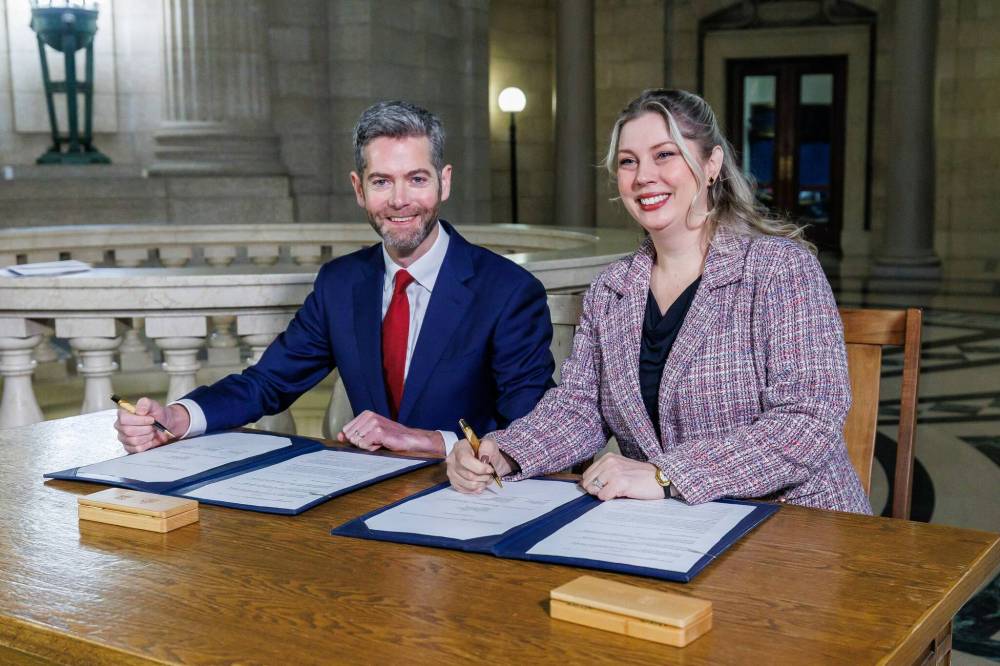
Nick Hays, president and CEO, Winnipeg Airports Authority (left) and Carly Edmundson, president and CEO, CentrePort Canada Inc., sign the memorandum of understanding. (Mike Deal / Free Press)
The new memorandum of understanding is a good signal to businesses inside and outside Manitoba, said Loren Remillard, president of the Winnipeg Chamber of Commerce.
Winnipeg Free Press | Newsletter

“What it says to all those communities is we are more than just a collection of assets,” Remillard said. “(It) is a thoughtful supply chain.”
The agreement bolsters Manitoba’s pitch that Ottawa pursue the Port of Churchill Plus project that expedites the corridor’s expansion, Remillard added.
Arctic Gateway Group has been in talks with the federal defence department, Canadian Armed Forces and Canadian Coast Guard for “a long time now,” Avery said.
Churchill is “a great asset for us to shore up our Arctic and northern defences,” he said.
gabrielle.piche@winnipegfreepress.com

Gabrielle Piché reports on business for the Free Press. She interned at the Free Press and worked for its sister outlet, Canstar Community News, before entering the business beat in 2021. Read more about Gabrielle.
Every piece of reporting Gabrielle produces is reviewed by an editing team before it is posted online or published in print — part of the Free Press‘s tradition, since 1872, of producing reliable independent journalism. Read more about Free Press’s history and mandate, and learn how our newsroom operates.
Our newsroom depends on a growing audience of readers to power our journalism. If you are not a paid reader, please consider becoming a subscriber.
Our newsroom depends on its audience of readers to power our journalism. Thank you for your support.