

Listen to this article
Estimated 3 minutes
The audio version of this article is generated by AI-based technology. Mispronunciations can occur. We are working with our partners to continually review and improve the results.
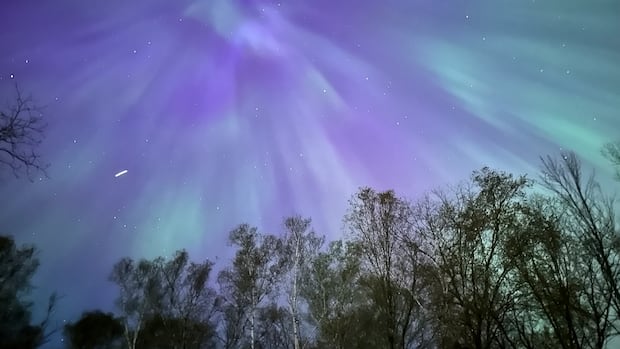
If you’re lucky enough to have clear skies tonight, you might want to go out and look up, as the northern lights could put on a decent show Monday night.
According to the U.S. Space Weather Prediction Center (SWPC), the sun released an X 1.9 flare, followed by a coronal mass ejection (CME). X flares are the most powerful on the solar flare scale.
This flare was somewhat remarkable, however, in that it lasted for several hours, making it more powerful than a typical flare of the same magnitude.
CMEs are large explosions of particles from the sun that travel faster than normal on the solar wind. If Earth is in their path, the particles interact with its magnetic field and can create beautiful northern lights, also known as the aurora borealis (or if you’re in the southern hemisphere, aurora australis).
The good news for northern lights seekers is that Earth just happened to be in the path of the CME.
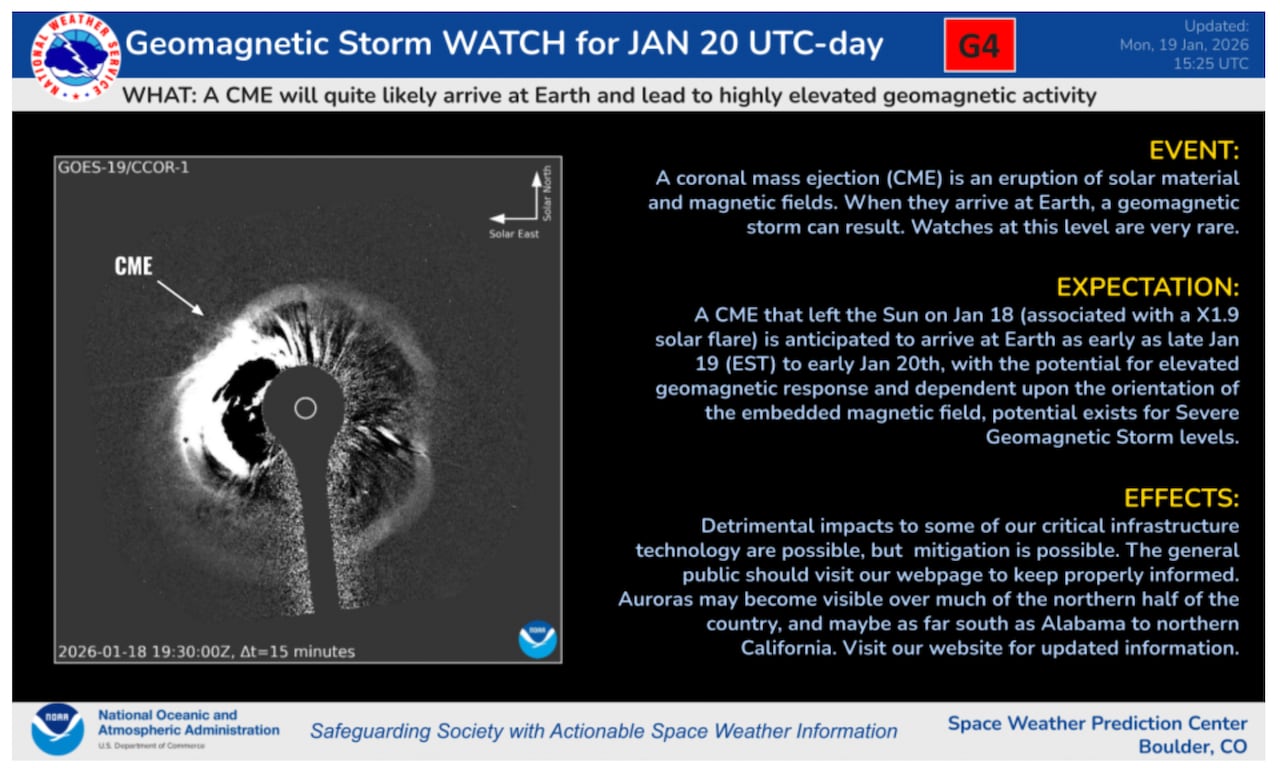 The U.S. Space Weather Prediction Center is forecasting a severe geomagnetic storm following a powerful eruption from the sun. (NOAA/SWPC)
The SWPC said the CME “is anticipated to arrive at Earth as early as late 19 Jan EST to early 20 Jan.”
Geomagnetic storms are disturbances to Earth’s magnetosphere. They are measured on a scale of G1 (minor) to G5 (extreme). The SWPC is forecasting a G4 storm, which is considered severe.
The geomagnetic storms that hit Earth in May 2024 and October 2024, which produced incredible light shows as far south as the Caribbean, were G5s on the scale.
The aurora borealis are most typically seen in the more northern regions of the country. But if things go right — Earth is in the path of the fast-moving stream of particles from a CME, for example — they can be seen farther south.
But one of the big things that has to happen is that the auroral hole — along which the CME’s particles travel — must be dipping south. The further south it dips, the farther south they will be visible. And, of course, the storm needs to hit when we’re in darkness.
Unfortunately, this time of year isn’t the best time to see northern lights, not because the sun is inactive, but because there tends to be more cloud cover.
If you hope to see them, try to get to a dark-sky (and cloud-free) location. Due to the severe nature of this forecast, you don’t necessarily need to be facing north, though it does help if the storm ends up being moderate.
If you want to know if the aurora borealis is visible in your location, you can download apps like Aurora Alerts and Aurora Forecast.