
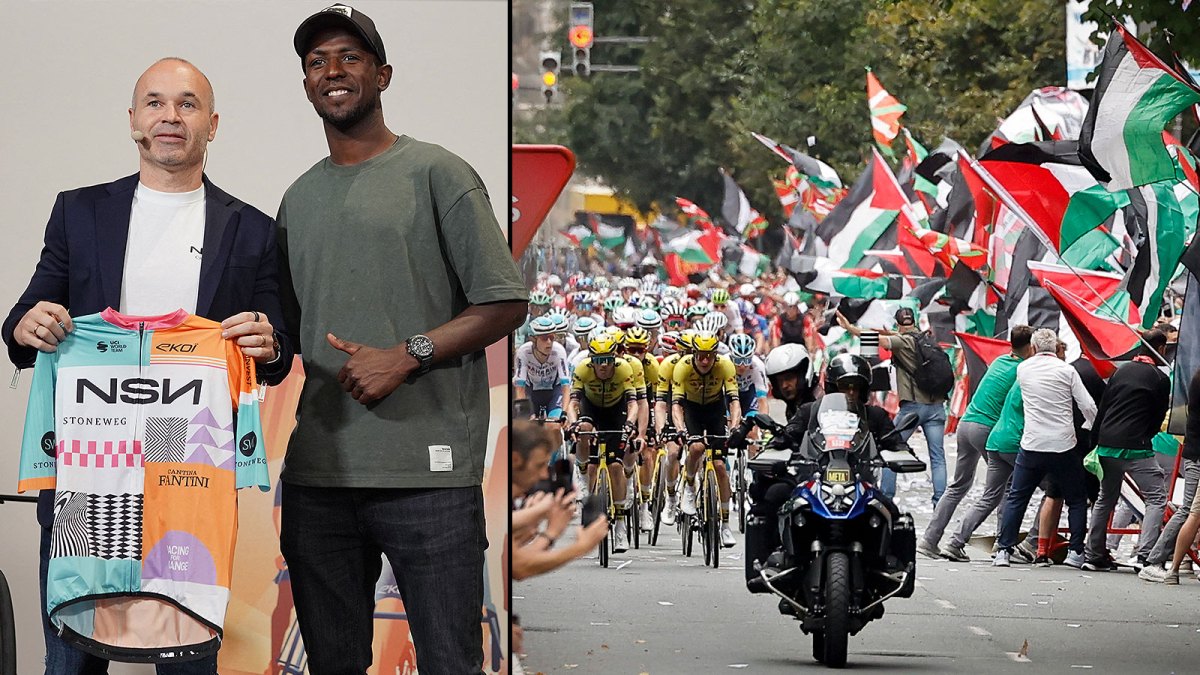
In the middle of the autumn, the organisers of the Tour de France had cause for concern. La Vuelta had just been ravaged by pro-Palestine protests, furious about the participation of Israel-Premier Tech. Multiple stages were neutralised and the riders were forced to host their own podium presentation in private.
With the Grand Départ of the Tour set to take place in Barcelona, and the first two stages finishing on the Montjuic hill overlooking the city, Christian Prudhomme, the race director, could foresee problems. The council in Barcelona was already demanding that Israel-Premier Tech be removed from the 2026 race. “I can’t say that in September or October we were very cool [about the subject],” he said, “because at the Vuelta it was awful for the Spanish organisers.”
A potential reprieve, though, was not far away, and it arrived in an unlikely form: Andrés Iniesta, the Spanish World Cup-winning footballer and Barcelona great. In November, Iniesta, 41, bought Israel-Premier Tech — previously owned by Sylvan Adams, a Canadian-Israeli billionaire — through his sport and entertainment company Never Say Never (NSN), in conjunction with Stoneweg, a Switzerland-based investment company. He rebranded the team as NSN Cycling.

A protester confronts police in Madrid during the 2025 Vuelta, which was subject to repeated disruptions
PABLO BLAZQUEZ DOMINGUEZ/GETTY IMAGES
Adams withdrew his involvement and the team removed their association with Israel, now describing themselves as a Swiss team, with a Spanish structure, based in Barcelona and Girona.
“I think it will be completely different,” Prudhomme said. “The former team is now a Swiss team, it’s another name and there is a well-known former Spanish football player [involved]. Catalonia is very proud to have the Tour.
“We are on the roads, on the streets, that is cycling, that is why cycling is so big. But things have changed and that’s good.”
Iniesta was an integral part of the great Barcelona team that won four Champions League titles between 2006 and 2015, forming an iconic midfield trio with Xavi and Sergio Busquets. He was part of the Spain team who won the European Championship in 2008 and 2012 and scored the winning goal against the Netherlands in the 2010 World Cup final.
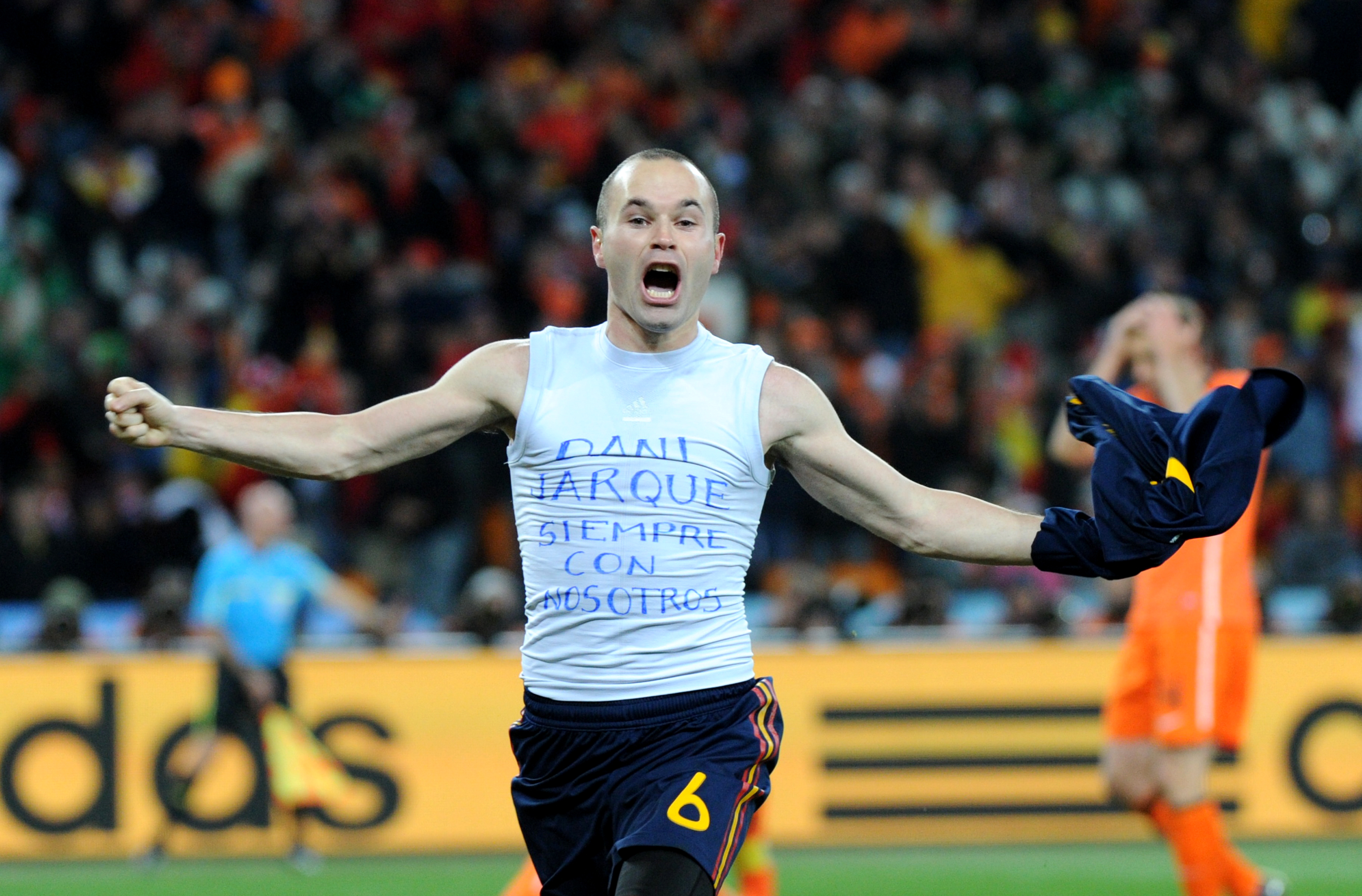
Iniesta celebrates his winning goal for Spain in the 2010 World Cup final against the Netherlands
GABRIEL BOUYS/AFP
His passion for cycling developed as a child, when he would watch the grand tours with his grandfather. Since he hung up his boots in 2024, after spells playing in Japan and the UAE, he has devoted more time to developing NSN, the company he co-founded in 2018, working on projects such as Inter Miami’s pre-season tour, the MotoGP awards ceremony and a Johnny Depp exhibition.
Now he has taken charge of a cycling team for the first time. “I’m excited to dive deeper into cycling, learn more and appreciate the huge amount of work behind every rider,” he said at the team’s launch last month. “The goal for the team is simple: keep growing, enjoy the journey, and show what a united team can achieve.”
As an early illustration of their ambition, NSN signed Biniam Girmay, the Eritrean who won the points classification at the Tour in 2024. The team have five British riders — Ethan Vernon, Steve Williams, Joe Blackmore, Lewis Askey and Jake Stewart — but that contingent no longer includes Chris Froome, 40, who has left the team he joined in 2021 following a serious crash in August, when he suffered a life-threatening heart injury.
Pressure had been building on Israel-Premier Tech to rebrand after the repeated pro-Palestine protests at La Vuelta over the conflict in Gaza. Shortly after the conclusion of the race, the team were barred from competing at the Giro dell’Emilia in Italy over security concerns and Premier Tech, the Canadian company, withdrew its sponsorship in early November, even though the team had agreed to remove Israel from their name.

The Israel-Premier Tech team bus is guarded by police at La Vuelta last year in Bilbao
DARIO BELINGHERI/GETTY IMAGES
The change of ownership to NSN was then announced that month and Adams said that he would be stepping back from day-to-day involvement. Although Adams was present at a team training camp in Spain, Óscar Guerrero, the directeur sportif, said that the former owner was simply bidding farewell. “It was a way of saying goodbye, of making the transfer to the new members, leaving everything in good hands,” Guerrero said.
While there had been sporadic protests against the team before last year’s Vuelta, they came to a head in Spain, including protesters knocking down barriers and occupying the road where cyclists were due to pass on the final stage to Madrid. Before that, Pedro Sánchez, the Spanish prime minister, had expressed his admiration for the protesters.
The upheaval inevitably created doubts over the feasibility of the Grand Départ of the 2026 Tour being held in Barcelona, with the city council demanding that Israel-Premier Tech be excluded from the race. But the subsequent changes to the ownership of the team and the high-profile involvement of Iniesta seem to have eased fears of widespread protest.
Next year the first three stages of the men’s and women’s Tours will be held in the UK, the details of which were announced last week, with the men’s Grand Départ in Edinburgh. It will mark the Tour’s return to this country for the first time since the 2014 Grand Départ in Yorkshire, and British Cycling, the governing body, recognises that free entry and the open access to the course that is unique to road cycling mean that the threat of protests can never be discounted.
“We live in a disruptive world,” Jon Dutton, the chief executive of British Cycling, said. “We deliver the Tour of Britain for men and women and we appreciate that activism, safety and challenges that were perhaps not present in 2014 are now in the forefront of our minds.
“Things will continue to evolve. There was a specific issue in the Vuelta, but it showed that activism at sporting events hasn’t gone away. We must ensure we create the safest experience both for riders and people that come along to watch.”