
GSMArena Team,
19 January 2026.
1. Introduction, specs, unboxing2. Design, build quality, handling3. Our lab tests – display, battery life, charging speed, speaker4. Software and performance5. Camera, photo and video quality6. Final words, our verdict, pros and consMotorola Moto G Power (2026) specificationUser opinions and reviewsReview comments (8)
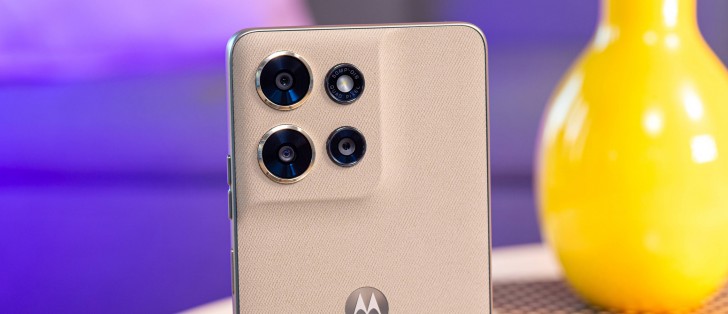
A very clean Android 16 OS
The Moto G Power (2026) boots Android 16 with the proprietary Hello UI on top of it. And if you have used any recent Motorola, you will feel right at home with the G Power (2026). You can check out our Hello UI/Moto AI video, which we did earlier this year for Edge 60, to get a general feel for it.
Motorola only promises two OS updates and three years of security updates with the Moto G series, which is a bit behind the competition, even in the budget space.
All important customizations live in the usual Moto app ‘hub’. Things are neatly organized, with the categories that have a lot of entries. There are some cool predefined themes, too.
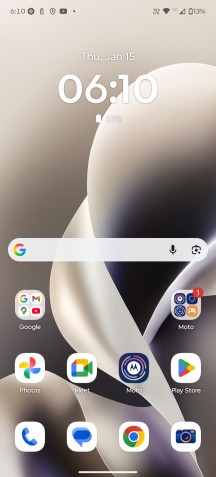
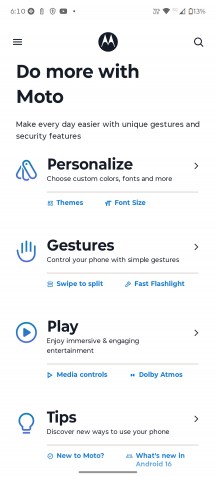
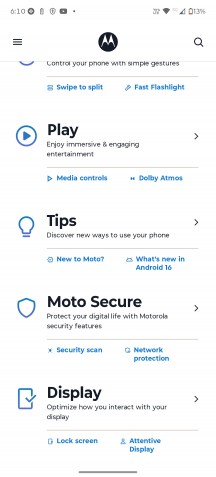
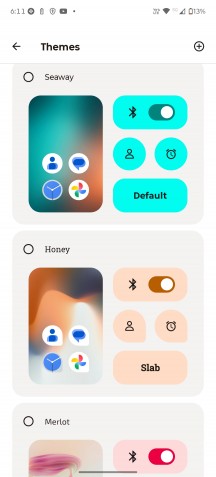
Hello UI and Moto app
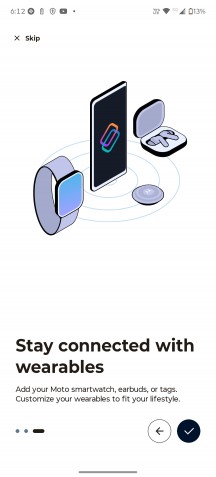
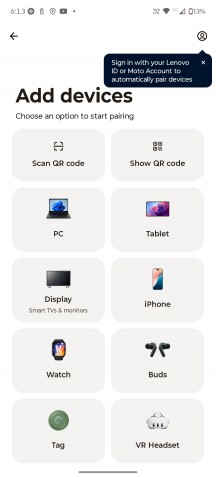
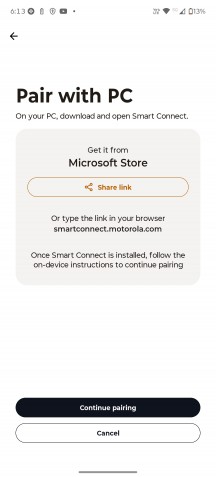
Smart Connect (previously Ready For) is the combined name for the features that involve connecting the phone to a PC, tablet, or standalone displays, be it wired or wirelessly. Streaming, mobile desktop, phone to PC, smart sharing, smart clipboard, cross control and more – all features are here under one roof. We remind you, however, that there is no direct video output over USB Alt mode from the Type-C port.
The Smart Connect app is where you would also pair your Moto buds, watch, VR, and tags.
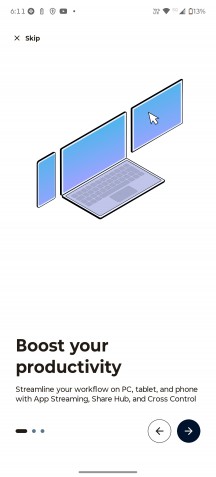
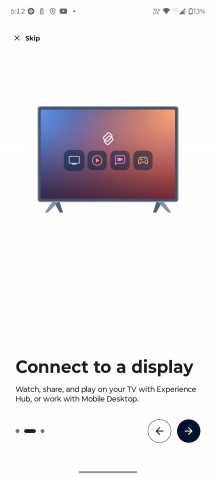
Smart Connect
Moto does AI differently from other manufacturers. You actually have the choice of several different AI models here on one device. That said, Moto’s own Moto AI, as seen on the Edge series, seems to be missing from the Moto G Power (2026). This is likely due to hardware limitations since we believe that Moto AI was, at least in large part, executed on device.
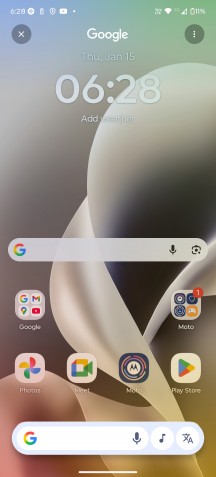
Still, there is no shortage of pre-installed AI tools. Google’s Gemini is here, along with Circle to search. If that doesn’t tickle your fancy, there are Copilot and Perplexity, both pre-installed. That said, unlike the Edge series, there is no dedicated AI button, and you seemingly can’t set an AI assistant to the double-tap the back side gesture.
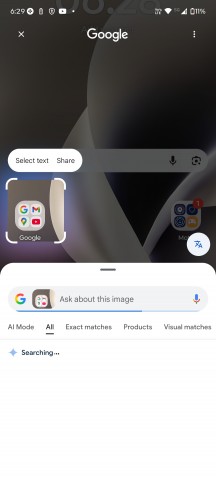
Circle to search
Not surprisingly, some other AI-driver Moto features are also missing from the Moto G Power (2026). Things like Catch me up, Image Studio, Playlist Studio and Pay Attention.
ON the flip side, you do still get a whole load of customizable gestures. Double-tapping the back of the phone triggers Quick Launch. You can set it to open a specific app, start/stop music playback, or go back to the homescreen or the last used app, among others.
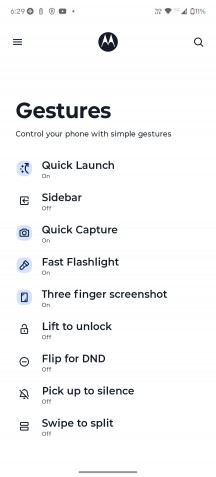
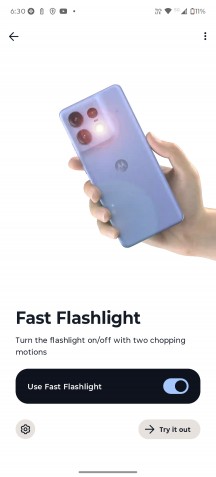
Gestures
As usual, Motorola’s UI also offers several other unique physical shortcuts like this, including the karate chop to toggle the flashlight and the quick wrist twist to start the camera.
Despite its name, the Moto G Power (2026) is ironically not a particularly powerful device. It uses a Mediatek Dimensity 6300 chipset, which is a fairly modern part based on a 6nm manufacturing process, but just not particularly powerful in any way.
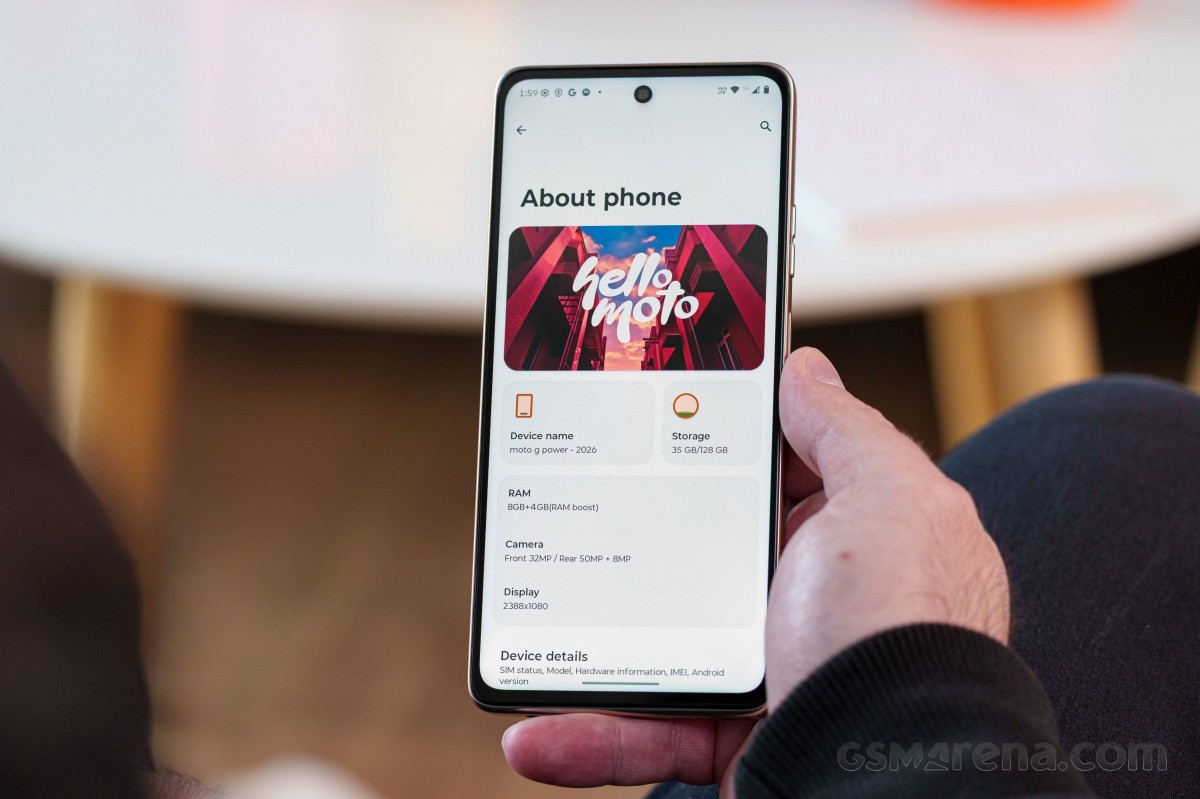
In the CPU department, you are looking at two Cortex-A76 cores, clocked at up to 2.4 GHz and another six Cortex-A55 ones, working at up to 2.0 GHz. These are paired with a Mali-G57 MC2 GPU. Nothing special through and through.
In terms of memory, the Moto G Power (2026) seems to only be available in one single tier with 8GB of RAM and 128GB of UFS 2.2 storage. That’s admittedly pretty light in the storage department, but thankfully, you do get a dedicated microSD memory expansion slot as well.
This is basically and rather unfortunately, the same exact hardware setup from last year’s Moto G Power (2025). Motorola could have offered at least a small performance upgrade in our opinion, since, as things currently stand, the Moto G Power (2026) sits pretty much at the bottom of every performance chart.
In more practical terms, things aren’t great either. Even with its light UI, the Moto G Power (2026) suffers from stutters and slowdowns. Using it is honestly not a great experience.
Thermal-throttling
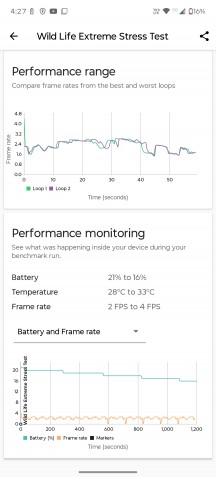
The Mediatek Dimensity 6300 is not particularly powerful, but at least it doesn’t generate much heat either. What heat output is present gets handled quite well by Moto’s thermal solution. The Moto G Power (2026) practically does not thermal-throttle at all, basically losing no performance over time, even with torture-testing.
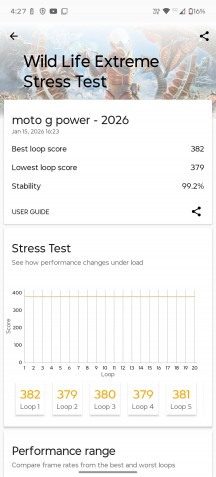
Thermal-throttling
The phone’s surface gets only lukewarm in the process and remains perfectly comfortable to hold.