
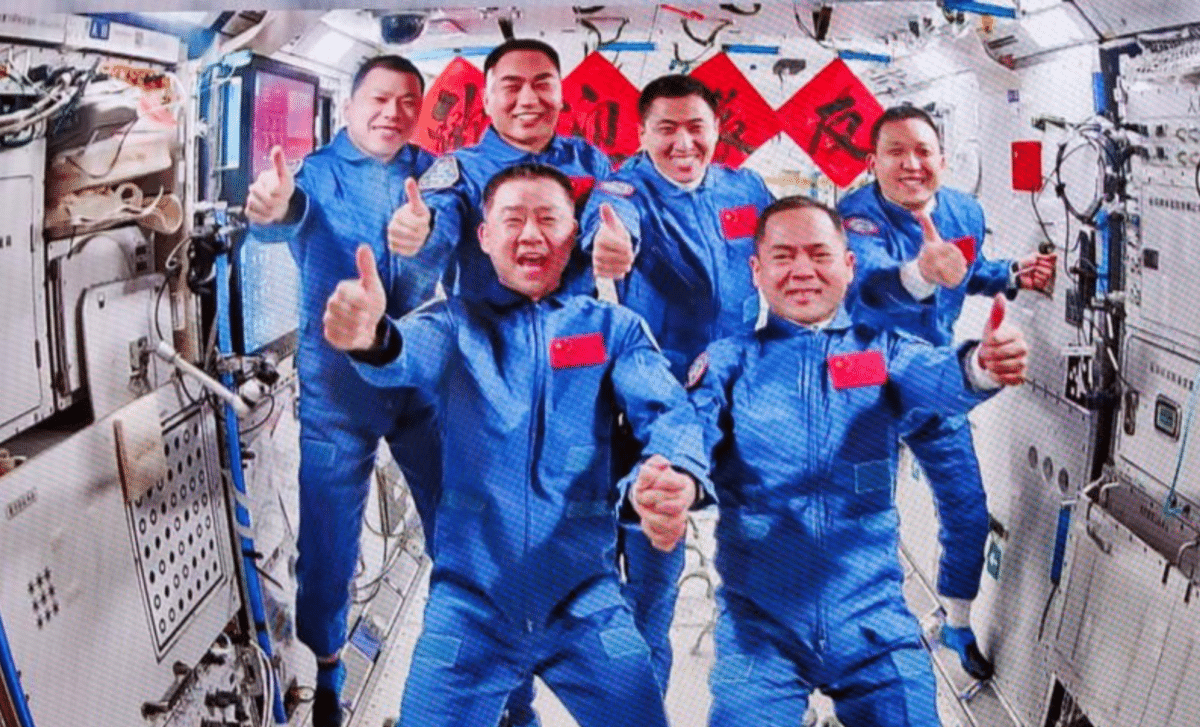
After nearly three months in orbit, China’s Shenzhou-21 crew is accelerating its scientific agenda aboard the Tiangong space station, engaging in a range of experiments that span robotics, biomedicine, physics, and emergency response protocols. The mission, part of China’s rapidly advancing space program, highlights the nation’s increasing ability to conduct complex research in long-duration microgravity environments.
Pushing Orbital Boundaries With Robotics And Medicine
After almost 80 days in orbit, the Shenzhou-21 astronauts, Zhang Lu, Wu Fei, and Zhang Hongzhang, are intensifying their mission objectives inside China’s space station. A major highlight of the past week involved extensive interactions with their long-term artificial companion, the intelligent robot Xiaohang. According to CGTN, these tests, combining touch interaction and autonomous flight, aimed to fine-tune the robot’s responsiveness and behavior in microgravity, gathering crucial data for its future optimization.
Meanwhile, the astronauts are advancing in space medical science, employing a space-based Raman spectrometer to examine urine samples, helping refine indicators for metabolic changes in space. The crew also collected saliva samples to study microbial population shifts within the orbital habitat — samples that will be analyzed post-return to Earth. These efforts highlight China’s growing focus on astronaut health and long-term biological adaptation to life in space.
Probing Origins Of Life And Matter In Space Environments
In a particularly ambitious experiment, the Shenzhou-21 crew contributed to a research project on chirality, which explores how molecular asymmetry, or “handedness”, behaves in space. The goal is to better understand how genetic code structures may have originated under cosmic conditions. By collecting and storing experimental samples, the astronauts are helping trace the patterns of chiral combinations between amino acids and nucleosides. Such work could provide insight into the chemical roots of life itself.
Simultaneously, their continued efforts in microgravity physics included electrochemical optical experiments on lithium-ion batteries, essential for space applications. These tests help advance energy solutions that could support long-duration space missions, satellite technology, and even next-generation spacecraft design.
Space Station Maintenance, Emergency Drills, And Physical Health
Beyond pure science, the Shenzhou-21 mission is reinforcing operational readiness and station maintenance. Astronauts replaced the sampling cover in the combustion science experiment cabinet and handled the disassembly and reassembly of modules within the fluid physics experiment cabinet. These hands-on tasks are vital to ensuring the longevity and adaptability of China’s orbital infrastructure.
The team also participated in a simulated emergency depressurization drill, designed to improve rapid response during low-pressure events aboard the station. Such exercises hone both crew coordination and communication with ground control, further bolstering mission safety protocols.
In terms of physical well-being, astronauts underwent scheduled medical checkups, including hearing assessments, while maintaining a routine of physical exercise, such as running, to mitigate the impacts of extended microgravity exposure on muscle and bone density.
Building A Sustainable Blueprint For Future Missions
As China builds momentum toward deeper space ambitions, the Shenzhou-21 mission exemplifies how a tightly integrated program of robotics, biology, physics, and crew training lays the groundwork for future lunar and interplanetary ventures. The astronauts’ seamless transition between high-stakes experiments and daily life operations reflects a matured space program capable of scaling its ambitions.
From experiments probing life’s molecular blueprint to drills safeguarding the station’s crew, every component of this mission feeds into a broader vision of sustainable, science-driven human presence in space. The depth and variety of tasks executed during Shenzhou-21 reaffirm China’s determination to not just participate but lead in the evolving space exploration era.