
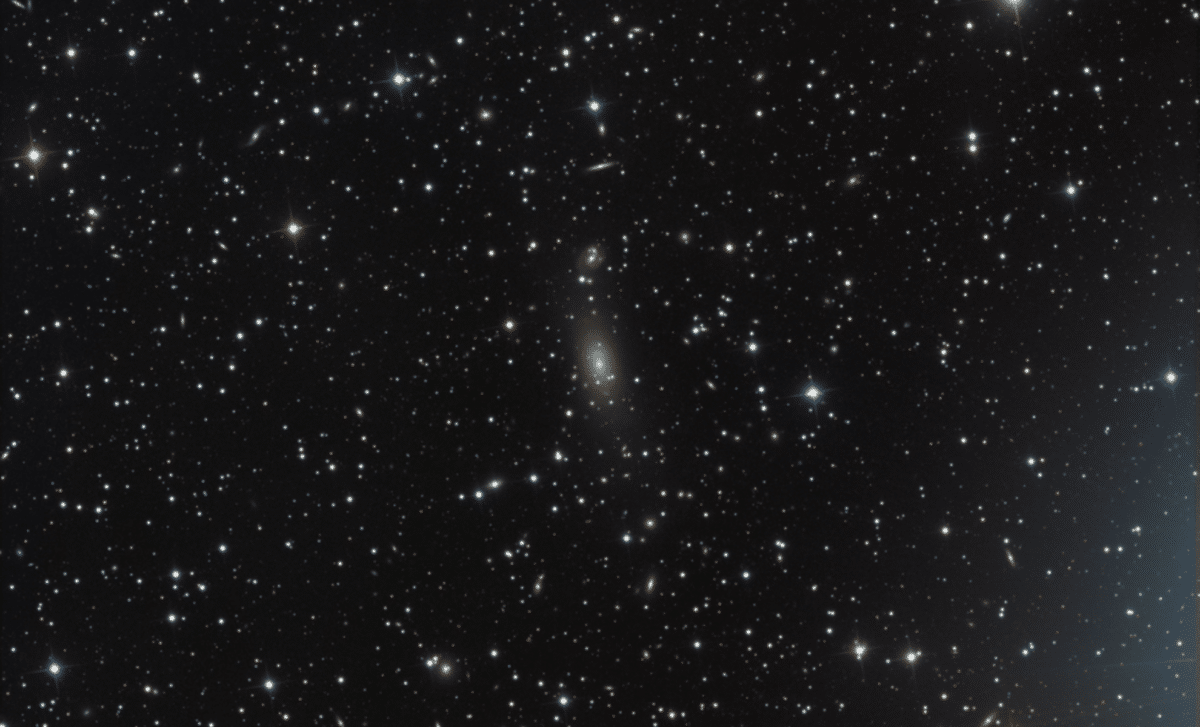
Astronomers using the Einstein Probe (EP) have uncovered subtle but powerful disturbances within the galaxy cluster Abell 3571, revealing new clues about its past collisions and internal dynamics. The findings, published on January 8, 2026, in the ArXiv pre-print server, offer a detailed look into the X-ray properties and structure of this massive system located within the Shapley Supercluster.
X-Rays Reveal A Hidden Layer Of Chaos
Galaxy clusters like Abell 3571 are enormous systems that bind together thousands of galaxies through gravity. Typically, they form through mergers and the gradual accretion of smaller clusters. Earlier X-ray observations suggested that Abell 3571 was relatively calm, a “relaxed” system with a nearly spherical structure and a cool, stable core. But the latest Einstein Probe data tell a different story.
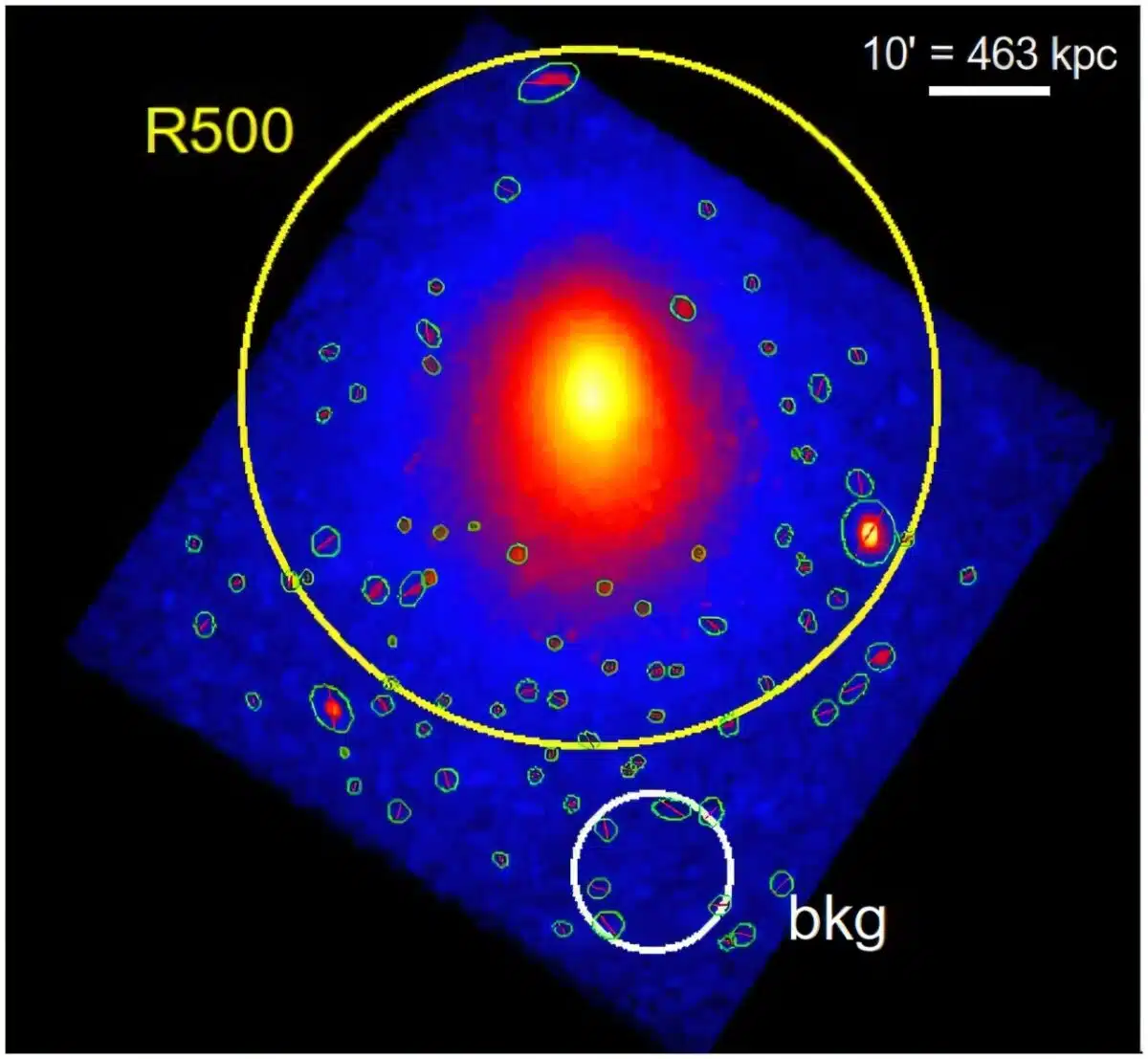 Particle background-subtracted, vignetting-corrected, and smoothed EP-FXT image of A3571 in the 0.3–7.0 keV energy band. Credit: arXiv (2026). DOI: 10.48550/arxiv.2601.04619
Led by Xinyi Zheng of Beijing Normal University, the research team combined EP’s Follow-up X-ray Telescope (FXT) with optical data from the DESI Legacy Imaging Surveys. Their analysis found that while Abell 3571 appears morphologically regular, detailed residual and thermodynamic maps show internal disturbances, hidden ripples in its hot gas atmosphere. These findings suggest that the cluster’s calm appearance hides a more dramatic, turbulent history.
The ArXiv study also identified two areas of surface brightness excesses, one in the north and another in the southwest of the cluster’s center. The southwestern feature shows high-temperature gas, while the northern region is cooler, an asymmetry that hints at the aftermath of an off-axis collision.
Evidence Of A Subtle Galactic Collision
The team discovered that Abell 3571 displays a pronounced north–south asymmetry in both temperature and optical galaxy density. This consistent pattern across multiple wavelengths points to a merger event that likely occurred along the same axis.
“We propose that the structure of A3571 originates from gas sloshing triggered by the off-axis passage of a low-mass subcluster moving from south to north. The sloshing displaces low-entropy gas from the cool core, producing a fan-shaped brightness excess to the north,” the astronomers explain.
This “sloshing” effect, a kind of oscillation in the cluster’s gas caused by a gravitational tug, is a known aftermath of minor merger events. It redistributes gas and temperature, leaving behind subtle distortions that can only be detected through deep X-ray imaging. In Abell 3571, these features are faint but undeniable, implying that the cluster is still settling into equilibrium after a past disturbance.
A Cluster Still Healing From Its Past
The researchers believe Abell 3571 is currently in a post-merger phase, still recovering from the gravitational encounter that caused these distortions. Despite its symmetric outer shell, the cluster’s interior tells the story of an ongoing cosmic recovery process. The high sensitivity of the Einstein Probe’s FXT instrument allowed scientists to detect these delicate shifts in temperature and brightness that earlier telescopes missed.
This discovery reinforces the importance of high-resolution X-ray astronomy in revealing the hidden structure of the universe. It also sheds light on how galaxy clusters, the largest gravitationally bound systems in the cosmos, evolve through repeated cycles of collision, disruption, and stabilization.
Abell 3571, once thought to be a quiet cosmic giant, now appears to be a galactic survivor, its structure still echoing with the remnants of an ancient clash.