
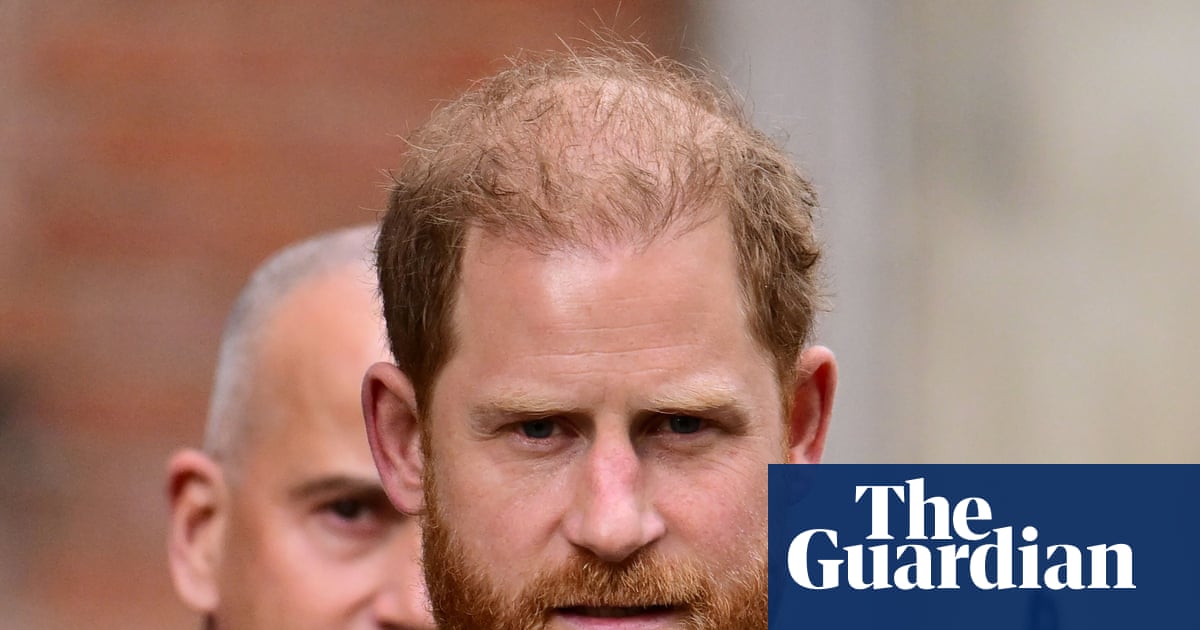
The Duke of Sussex believes he has faced a “sustained campaign” of attacks for having “the temerity to stand up” to the publisher of the Daily Mail, the high court has heard.
Lawyers for Prince Harry made the claim as they set out 14 articles about him they allege were secured using unlawful information-gathering by Associated Newspapers Ltd, which publishes the Daily Mail and the Mail on Sunday.
David Sherborne, the barrister representing the duke and six other prominent figures in the case, claimed flight details and sensitive information that had serious implications for Harry’s security had been obtained unlawfully.
“In his witness statement for the trial, the Duke of Sussex speaks of the impact which this has had on him, the distress, the paranoia and the other feelings that it generated,” Sherborne told the high court in London.
“But given what we’ve seen, is it any wonder that he feels that way, or as he explains, that he feels he has endured a sustained campaign of attacks against him for having had the temerity to stand up to Associated in the way that he has so publicly done?”
The duke’s concern about his treatment emerged as Sherborne set out key parts of the case against the publisher. He highlighted articles he said bore the “hallmarks of unlawful information gathering”.
Harry was again in court to hear the case before he gives evidence on Thursday. The 14 articles relating to the duke were published between 2001 and 2013. Most contained the bylines of either Katie Nicholl, a former Mail on Sunday royal correspondent, or Rebecca English, the Daily Mail’s royal editor.
One article, which cited a “family source”, revealed Harry had been chosen as godfather to the child of his former nanny, Tiggy Legge-Bourke. Sherborne said no one in the wider family had been told, including King Charles.
Nicholl has said the source could have been Elizabeth Anson, a cousin of the queen who was 40 years older than Legge-Bourke, or the socialite Tara Palmer-Tomkinson, both of whom have since died.
Other stories contained details of Harry’s relationship with his former girlfriend Chelsy Davy. Sherborne told the court that the private investigator Mike Behr had been paid £200 in cash by English for a “Chelsy tip”, which included Davy’s exact flight details.
Sherborne said another article published in 2010 contained “specific and intimate details” of Harry’s private life, including his “preferences of where he likes to spend the night”. He said that the details could not “conceivably” have come from a legitimate source.
In a written submission, Sherborne said Nicholl’s evidence was that her indirect source for the information concerning Davy had been the late Garth Gibbs, “an elderly retired journalist who lived alone on the Isle of Wight with a cat and who left South Africa in 1966, 20 years before Ms Davy was even born”.
He said the explanation “stretches plausibility and is to be dismissed accordingly”.
David Sherborne, representing Prince Harry, highlighted articles he said bore the ‘hallmarks of unlawful information gathering’. Photograph: Phil Lewis/Sopa Images/Shutterstock
Associated’s legal team said in written submissions that the stories had been obtained “entirely legitimately from information variously provided by contacts of the journalists responsible, including individuals in the Duke of Sussex’s social circle, press officers and publicists, freelance journalists, photographers and prior reports”.
Antony White, leading Associated’s defence, said the duke’s social circle “was and was known to be a good source of leaks or disclosure of information to the media about what he got up to in his private life”.
He told the court there had been “widespread previous coverage” that played into the articles in question. “These articles don’t appear out of nowhere,” he said. “To a considerable extent, articles build on what has previously been reported.”
White said it was striking that Associated had almost a “full roster” of journalists “lining up to give evidence addressing the allegations against them”. He said the fact that so many would appear, including the longtime Daily Mail editor Paul Dacre, “speaks volumes about the culture” at the publisher.
White said there were “very serious allegations” made against a series of journalists, who would all have to be lying about their activities and knowledge. He said this was improbable.
He said prominent figures at Associated would “emphatically reject” that Associated had carried out unlawful activities to obtain stories. White said an effective ban on the use of private investigators was put in place by Dacre in 2007.
He said the claimants had provided “very little evidence” about unlawful activities carried out by private investigators paid by Associated’s journalists. He also said “in the majority of cases”, there was nothing linking the payment of a private investigator to either the content of a story or the journalist that wrote it.
He said the claimants’ case amounted to “guesswork”.
He also said much of the claimants’ evidence of unlawful activities was drawn from evidence in previous cases against the publishers of the Daily Mirror and the Sun. He said the evidence should not be permissible in the case against Associated Newspapers.
For the claimants, Sherborne also attempted to deal with a claim from Associated Newspapers that they had waited too long to make the claims, stating each had found out they had a serious case against the publisher after October 2016 – the cutoff date for legal action.
He also said the allegation that the claimants’ legal team had engineered “watershed moments” to ensure the action could be brought was as “offensive as it is misconceived and untrue”.
The trial continues.