
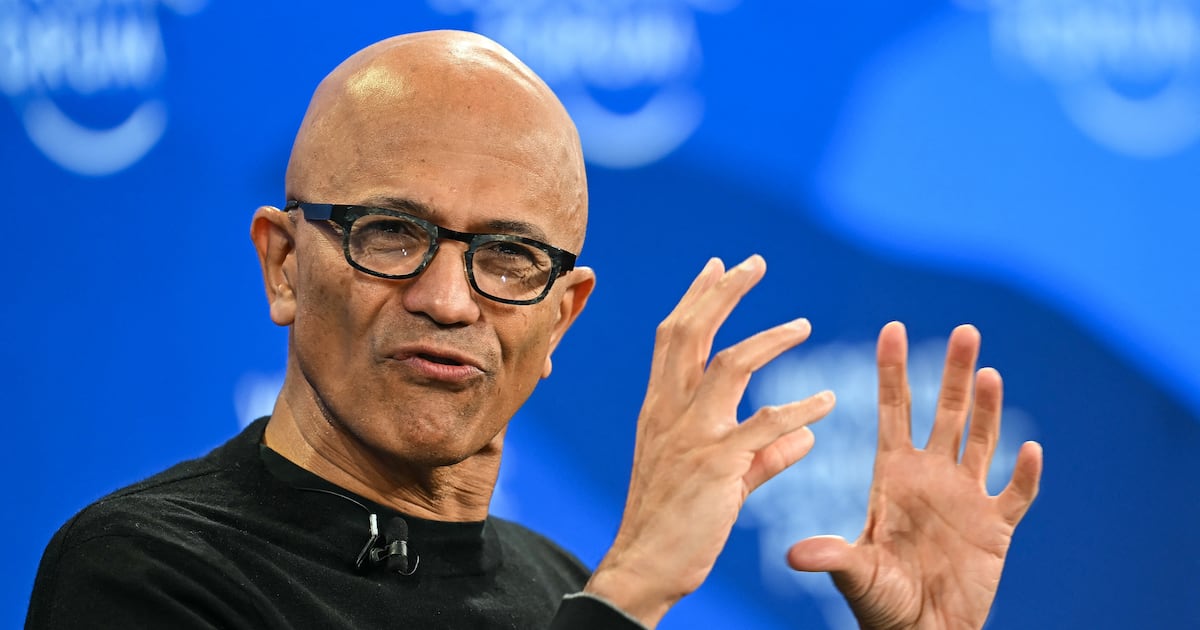
Microsoft chief executive Satya Nadella has warned that artificial intelligence (AI) risks becoming a speculative bubble unless its use spreads beyond big tech companies and wealthy economies.
Mr Nadella on Tuesday said that the long-term success of the fast-developing technology would depend on it being used by a broad range of industries as well as on uptake outside of the developed world.
“For this not to be a bubble by definition, it requires that the benefits of this are much more evenly spread,” said Mr Nadella. He noted that a “telltale sign of if it’s a bubble” would be if only tech groups were benefiting from the rise of AI, rather than companies in other sectors.
However, Mr Nadella said he was confident that AI would prove to be transformative across industries, such as helping to develop new drugs.
“I’m much more confident that this is a technology that will, in fact, build on the rails of cloud and mobile, diffuse faster, bend the productivity curve and bring local surplus and economic growth all around the world,” he said.
The Microsoft chief’s comments came as part of a talk with BlackRock chief Larry Fink on the first day of the World Economic Forum annual meeting at Davos, kicking off the first of several speeches by tech executives, including Google DeepMind chief, Sir Demis Hassabis and Anthropic’s Dario Amodei.
A growing body of data from tech companies, including Microsoft, has shown a global divide in AI adoption rates, pointing to productivity benefits and work applications being concentrated in richer developed countries.
Mr Nadella also reiterated his view that the future of AI adoption would not rely on one dominant model provider, which has driven the tech giant’s decision to work with several AI groups, such as Anthropic and xAI, as well as OpenAI.
Microsoft gained an early advantage in AI through its $14 billion (€11.9 billion) bet on OpenAI, which gave the software group unique access to the ChatGPT maker’s technology and first claim on its data centre contracts.
But after restructuring its partnership with Sam Altman’s start-up in October, Microsoft has dropped exclusivity over its data centre needs and will lose exclusive access to its research and models in the early 2030s.
Mr Nadella said companies would be able to take advantage of multiple models, including open-source ones, or even building their own models using a technique called “distillation” to produce smaller, cheaper versions of powerful models.
“So the [intellectual property] of any application or any firm is, how do you use all these models with context engineering or your data?” Mr Nadella said. “As long as firms can answer that question, they’re gonna be getting ahead.” – Copyright The Financial Times Limited 2026