
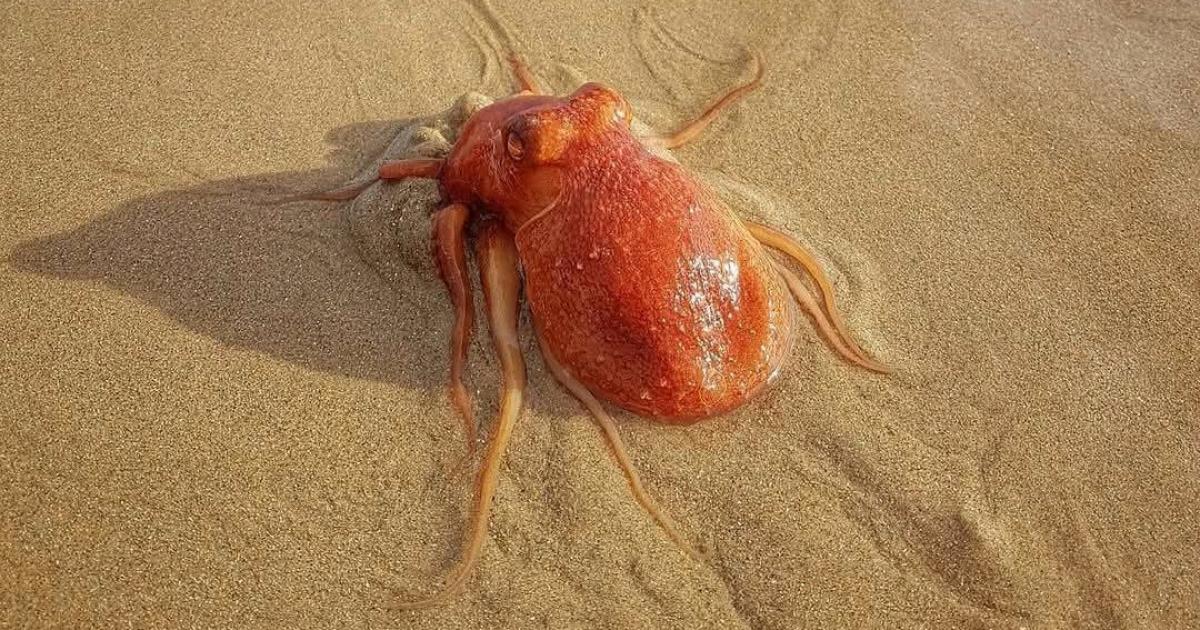
Photographer Gareth Davies, of Hidden Pembrokeshire, came across a common octopus during a walk on North Beach Tenby.
The animal was on the shoreline at low tide and Gareth watched it change colour and start to bury itself in the sand at his approach.
It is unusual to see an octopus on land. (Image: Hidden Pembrokeshire- Gareth Davies Photography)
As the tide came in the octopus went back out to sea.
Although fairly common in our waters, it is highly unusual to come across an octopus on dry land.
“I certainly didn’t expect to come across this beautiful octopus at low tide on North Beach in Tenby,” said Gareth.
“It was fascinating to watch as it began to bury itself in the sand and change colour. With the tide returning quickly, it soon vanished from sight.”
According to the Wildlife Trusts, the common octopus is most common on the south and west coasts of the UK and is seen throughout the year.
The common octopus is a highly intelligent, active predator and has special glands that produce a venom used to incapacitate its prey.
An unusual sighting of a common octopus on North Beach, Tenby (Image: Hidden Pembrokeshire- Gareth Davies Photography)
Crabs are a favourite food and a pile of empty crab shells, called a midden, is normally a sign that a well-fed octopus is somewhere nearby.
The octopus is a master of disguise capable of changing not only its colour but its texture to blend into its surroundings and squeezing into tiny spaces both to escape predators and hide from their own prey.
An octopus will also change colour depending on mood.
Although fishermen and divers often spot them, an octopus on a beach in Wales is an unusual sight, though believed to be becoming more common.
According to the Wildlife Trusts, last year the octopus population experienced a ‘bloom’ -a sudden increase in the population caused by a combination of a mild winter followed by a warm breeding season in the spring. The increase in population and sightings was such that the Trusts christened 2025 ‘The Year of the Octopus’.
The octopus buried into the sand. (Image: Hidden Pembrokeshire- Gareth Davies Photography)
Around 233,000 octopuses were caught in UK waters last year, with fishermen off Cornwall recording 13 times the usual catch.
The Sea Watch Foundation says that, although these sightings are very rare, anyone encountering an octopus crawling across the sand should not to touch or disturb them.