


A scientist claims to have found Heaven (Image: Getty)
Hard science and theology seldom share much overlap, but one former Harvard physics professor is convinced that he’s pinpointed the precise whereabouts of Heaven.
Dr Michael Guillen, who holds a PhD in physics, mathematics and astronomy and previously lectured in physics at Harvard, argues that not only is the universe growing, but the further away an object is, the quicker it’s moving away from us. This is a widely-recognised perspective, founded on observations by the renowned American astronomer Edwin Hubble.
Drawing on Hubble’s research, Dr Guillen states: “Theoretically, a galaxy that’s 273 billion trillion (273,000,000,000,000,000,000,000) miles away from Earth would move at 186,000 miles per second, which is the speed of light.”
Dr Guillen further explains that the position of these impossibly remote, extraordinarily fast-moving objects is known as the Cosmic Horizon. Beyond this threshold exist additional galaxies, but their light hasn’t yet reached Earth, and because of the accelerating expansion of the cosmos, certain areas are retreating so rapidly they’ll remain forever undetectable.
This means there’s an absolute boundary to what astronomers can study, regardless of whatever advanced telescopes we might construct in years to come.

He believes he’s identified Heaven’s location (Image: GETTY)
Most conventional astronomers maintain that there’s nothing particularly special about any potential objects past this limit, apart from the reality that we cannot directly see them. However, Dr Guillen has a considerably different perspective.
Writing in an opinion piece for Fox News, Dr Guillen stated: “Our best astronomical observations – and Einstein’s theories of special and general relativity – indicate that time stops at the Cosmic Horizon. At that special distance, way up there in deep, deep, deep space, there is no past, present or future. There’s only timelessness.”
For Dr Guillen, this region of “timelessness” situated beyond our observable universe’s boundaries represents Heaven’s location. He elaborates: “As a scientist, I understand the importance of definitions. According to the Bible, the lowest level of Heaven is Earth’s atmosphere. The mid-level heaven is outer space. The highest-level heaven is what we’re talking about: It’s where God dwells.”
According to his theory, any matter past the Cosmic Horizon possesses extraordinary characteristics, residing beyond conventional space-time. Dr Guillen maintains these attributes align perfectly with biblical descriptions of Heaven from antiquity.
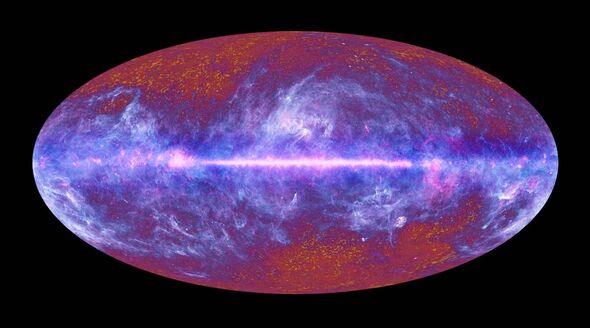
The Cosmic Microwave Background is a relic from the Big Bang (Image: AFP/Getty Images)
Wherever you might stand on Earth, Heaven remains “up” overhead, whilst being entirely unreachable to mortal beings. Dr Guillen says, adding that it houses “nonmaterial, timeless beings,” representing departed souls.
For the majority of the scientific community, however, the cosmic horizon merely represents the boundary of our observable universe. Given light’s finite velocity and the universe’s finite age, distant areas haven’t had sufficient time to transmit signals to us.
Past this boundary, the universe may well continue, yet remains beyond our current observational capabilities. The most ancient “light” detectable to us, representing the faintest remnants of the Big Bang, is now known as the Cosmic Microwave Background – the enormously red-shifted radiation from the Universe’s earliest era.
This primordial light holds tremendous significance as it serves as a form of “afterglow” from the Big Bang itself.
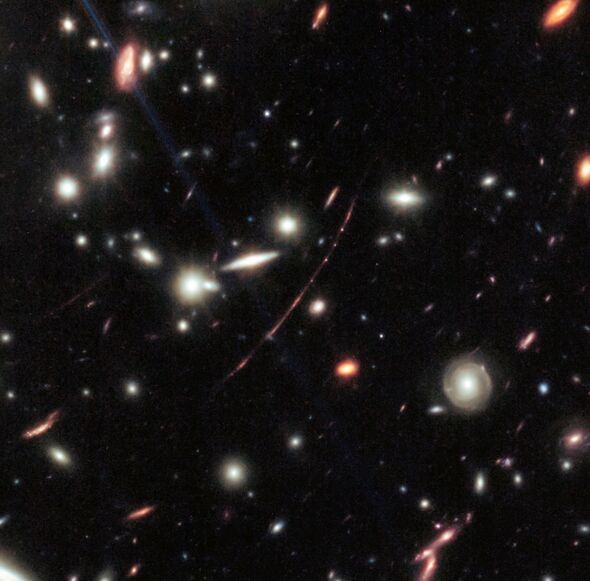
In the future, many of the the trillions of observable galaxies will be invisible (Image: NASA/ESA/CSA/Coe/Pagan/SWNS)
The Big Bang Theory tells us that our universe emerged approximately 13.8 billion years ago from an incredibly hot, compressed state and has continued expanding ever since. During those initial moments, temperatures were so extreme that light couldn’t travel unimpeded; instead, it was perpetually deflected by electrically charged particles.
As cosmic expansion progressed and temperatures dropped, atoms began forming and light could finally traverse space freely. This liberated radiation is what we now detect as the cosmic background radiation.
Across billions of years, the universe’s expansion has stretched this radiation, reducing its energy levels until it transformed into microwave frequencies. Presently, it displays remarkable uniformity across the sky, indicating that the infant universe was extraordinarily homogeneous, with merely minuscule fluctuations.
These minute fluctuations hold particular significance because they eventually developed into the galaxies and galactic clusters we observe today. The 1965 discovery of the cosmic background radiation delivered compelling support for the Big Bang Theory and continues to stand as one of its most crucial pieces of evidence.

Dr. Michael Guillen is an established scientist and science communicator (Image: Getty Images)
In the distant future, an increasing number of galaxies will vanish from our sight. The universe’s expansion is accelerating due to dark energy, propelling remote galaxies away at an ever-increasing speed.
Ultimately, their light will cease to reach Earth, leaving our local group of galaxies isolated in an otherwise dark sky.
Alternatively, as Dr Guillen sees it, this could symbolise Heaven expanding to accommodate its growing population.