
Each cubicle in the England changing room at Twickenham contains a plaque listing the great players in their position, a nice touch designed to remind today’s internationals of their lineage. The most recent specialist inside centre to be honoured from the men’s team is Will Greenwood, who retired from Test rugby in 2004. Therein lies a tale.
For the best part of two decades, inside centre has been a problem position for England. Mike Catt eventually settled as a creative No12 having played in three other positions. Mike Tindall also finished his Test career in the role, having played outside centre in England’s 2003 World Cup-winning team.
For every Billy Twelvetrees and Brad Barritt, who won 22 and 26 caps respectively, there was a Sam Burgess and Ben Te’o imported from rugby league in a quest for heft. Since the 2015 World Cup, England have chiefly utilised players at inside centre who were more comfortable in other positions, whether Owen Farrell, Manu Tuilagi, Ollie Lawrence or Henry Slade.
Open-side flanker was always the other headache for England coaches. There is nobody on that plaque more recent than Lewis Moody, who retired in 2011. But the No7 issue has been solved, to the point where England’s stocks are rich and plentiful. Sam Underhill. Tom Curry. Guy Pepper. Henry Pollock. Ben Earl. Ben Curry. Take your pick.
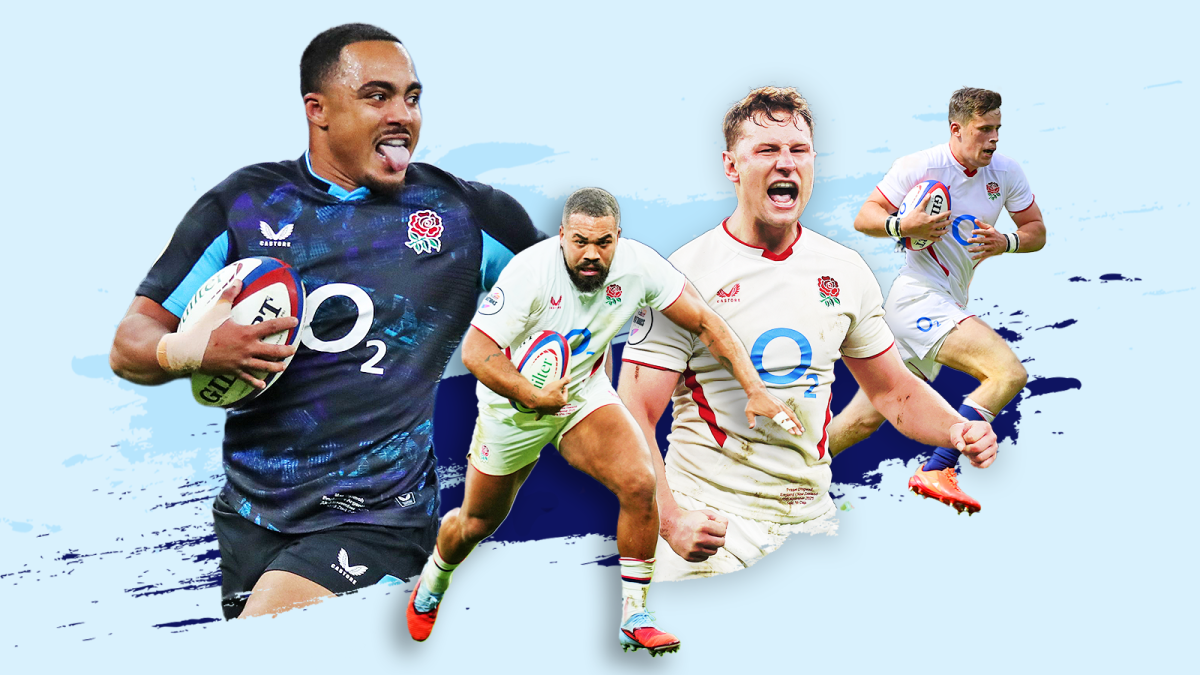
And now England head into the Six Nations with three genuine inside centres for the first time in recent memory, with Fraser Dingwall, Seb Atkinson and Max Ojomoh all vying to wear the No12 jersey against Wales at Twickenham on February 7. Each offers Steve Borthwick, the head coach, something very different, which encapsulates why inside centre is a difficult position to develop.
When Dingwall spoke to The Times in October and selected his identikit player, he chose the power of Damien De Allende, the kick game of Jordie Barrett and the creativity and intelligence of Matt Giteau. It is a position that can be played a multitude of ways, depending on team balance and coaching preference.
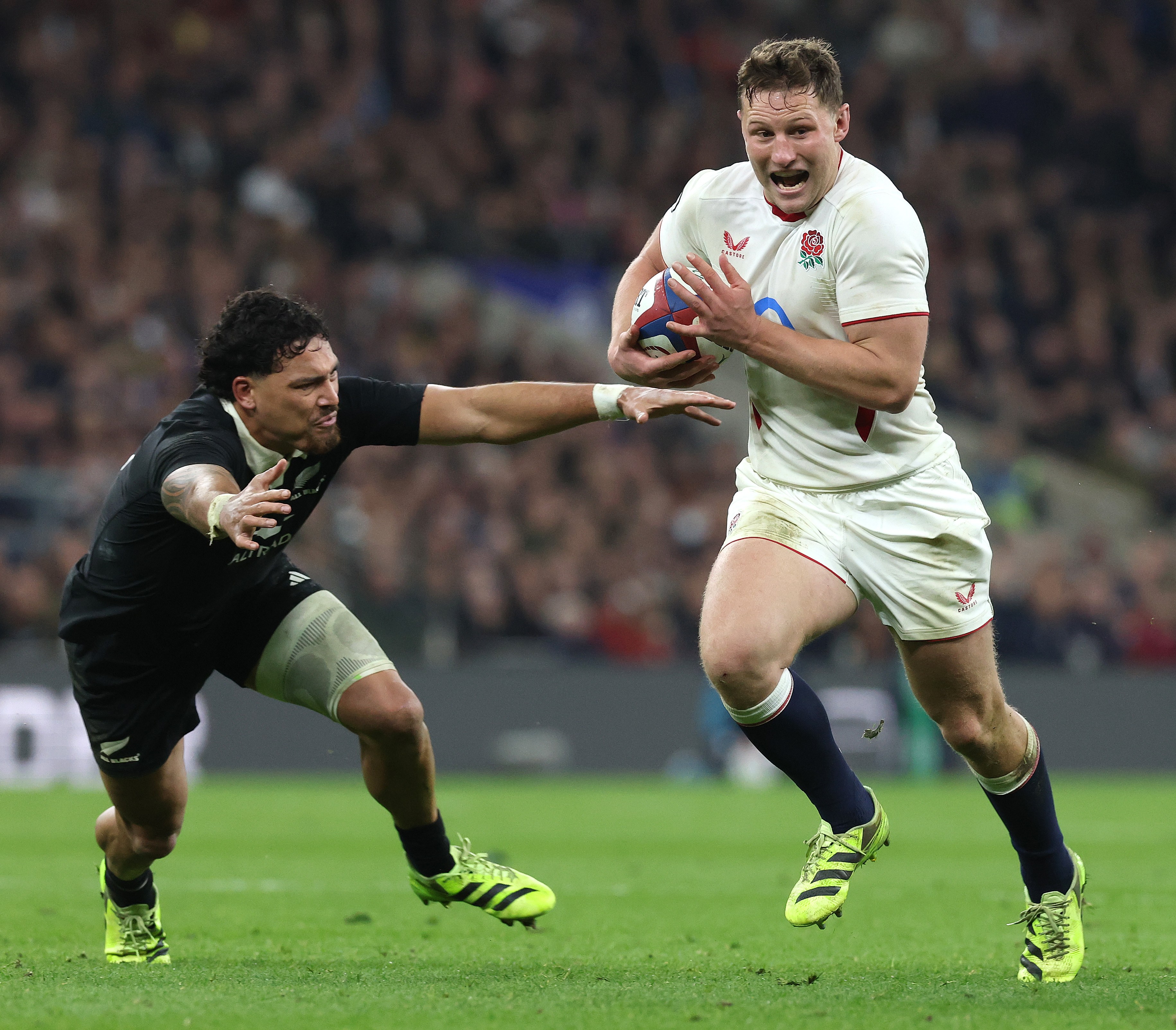
Dingwall, whose communication and vision is much valued by the England management, impressed in the autumn and was made a vice-captain
DAVID ROGERS/GETTY IMAGES
At academy level, the most creative players tend to play at fly half and the most powerful or dynamic athletes, players such as Earl or Pollock, are directed towards the back row. Yet, through the Prem’s shift towards more open, attacking rugby three players have emerged who thrive in that inside centre role but with different profiles.
Dingwall, 26, is the glue player, whose communication and influence on the team vastly outstrips his experience. Atkinson, 23, is a powerful presence with an incredible engine. Ojomoh, 25, is blessed with lovely hands and is the most dangerous in attack. Take your pick.
“I think you can see the nature of the game in the Prem has changed,” Borthwick said. “There was a period where we didn’t really have many No7s around the Prem. Then the nature of the game changed a little bit, and the role and the value of the No7 got prioritised. Now you see just how many we have.
“We had a period where we didn’t have specialist No12s and ball-playing No12s who have that skillset, but now we’re blessed in that we have effectively three of them and also No13s that can play there [in Lawrence and Slade].
“You’re also seeing the ball movement that’s happening in the Prem, so having centres that have that ability to see space and move the ball to space has been valued much more than where it was previously.
“The way the Premiership has altered has certainly meant we’ve got more ball players coming through. Generally in the English game, the attacking side is favoured over the defensive side at the breakdown, which has led to a style of rugby in the Premiership which favours much more the attack.
“That has led to more ball movement, more distributors. That is a super, super strength.
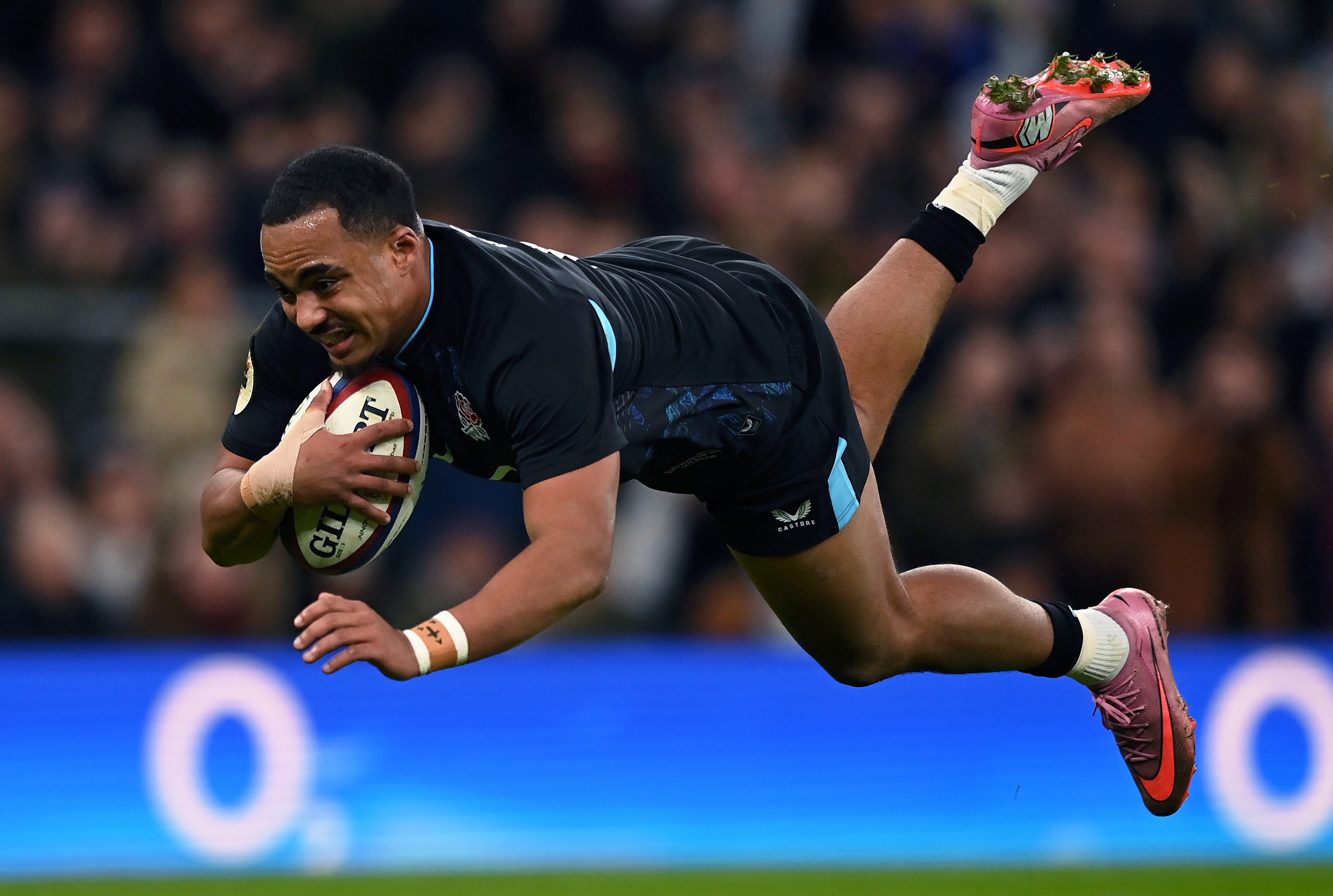
Ojomoh scores on his home England debut against Argentina in a man-of-the-match performance
PATRICK KHACHFE/GETTY IMAGES
“It’s also an adaption the players will have to make coming into Test match rugby next week. The level of competition and amount the defence is rewarded is different at Test level. That’s the same in European competition, the defence is often rewarded a little bit more.”
Ojomoh is the incumbent, having impressed in attack in a man-of-the-match performance against Argentina on his home England debut in November, scoring one try and creating two others; one with an intelligent and perfectly executed cross-kick and the other from an offload out of contact.
“You can see on the attacking side of the ball, Max is outstanding,” Borthwick said of the Bath centre. The unsaid second half of that sentence is that England feel there are areas of Ojomoh’s work off the ball and in contact that still need work. He has a tendency to concede turnovers on the floor which will be feasted upon at Test level.
Atkinson is fit and physical. He was excellent on England’s summer tour of Argentina and he would have started at No12 in the autumn had he not been injured, but the Gloucester centre’s absence opened the door for Dingwall’s return.
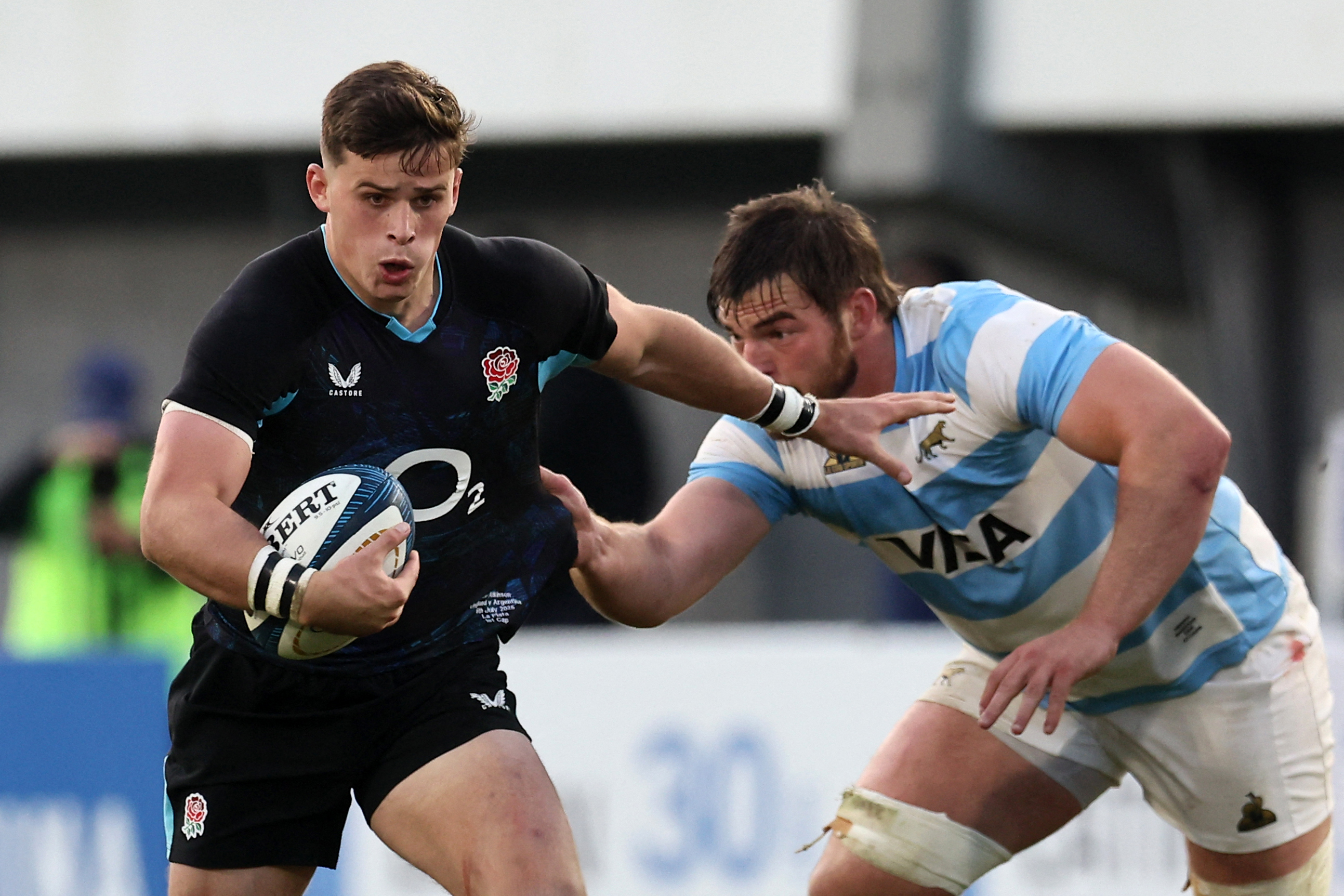
Atkinson’s physicality is his main attribute and he could balance the midfield alongside Slade
ALEJANDRO PAGNI/AFP
Dingwall’s communication and vision is much valued by the England management, even if the others have more obvious skills. The Northampton Saints player was made a vice-captain during the November series.
“He might have a relatively low number of caps, but it feels like he’s been around the team for a long time and feels like he’s a senior player and a calm voice. I like that,” Borthwick said.
In an ideal world, especially with Lawrence injured, Borthwick would start with a midfield partnership of Dingwall and Tommy Freeman, with Tom Roebuck offering a vital aerial presence on the right wing. Freeman will always be an option out wide but Borthwick sees him “very much moving now into the centre”, partly for his carrying and partly because he is deemed to be a better defender when in midfield. Borthwick would also like to have George Furbank at full back, reinforcing further the Saints connection. “He has a great understanding of the backs given the number that come from Northampton so I’m delighted to be able to select him,” Borthwick said.
Furbank has barely played this season, although he is on the bench for Northampton this weekend and would offer England cover at fly half. Freddie Steward is a different style of full back but played in November and his performances for Leicester Tigers confirm he remains next in line.
Roebuck has a nagging toe injury. England are hopeful he will make the Wales game. Should he not, Borthwick could retain Freeman at outside centre, pick Elliot Daly on the left wing and shift Immanuel Feyi-Waboso to the right.
Borthwick could start with Slade as a ball-player at outside centre and push Freeman back on to the wing to chase the contestable attacking kicks which are so important in the modern game. That in turn could open the door for Atkinson to balance the midfield at inside centre alongside Slade.
In many ways, Dingwall is the least fashionable but, for now at least as England try and grow cohesion, he feels the most likely option. But the starting gun in the race for the No12 jersey will fire for the centre trio when England land in Girona for their pre-Six Nations training camp.
“In the past we didn’t necessarily have as many players as we’d have liked competing for places,” Borthwick said. “Now, what I’m looking forward to is seeing these three players train against each other and compete against each other. I want one of these players to grab it and say it’s theirs now.”