
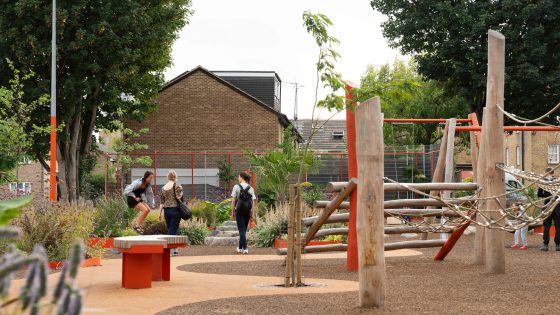
Located in Southwark around the corner from Walworth Gardens, the playground was formerly enclosed by tall timber fencing with few access points. This meant visibility was limited, causing narrow, unwelcoming footways along its perimeter.
Root and Erect, which re-branded from Erect Architecture at the end of last year, was appointed by the London Borough of Southwark to upgrade the public space to make it more appealing to older children.
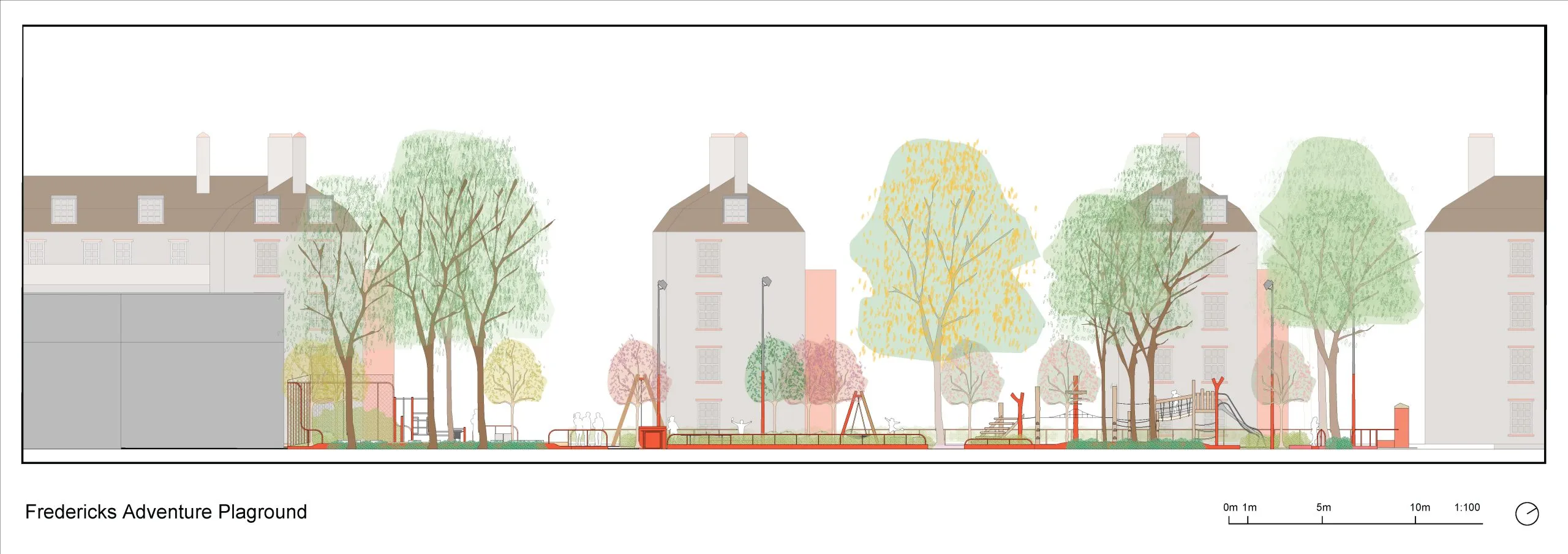
The practice removed physical and visual barriers to the site, opening it to the wider community, while upgrading embedded play equipment and soft and hard landscaping.
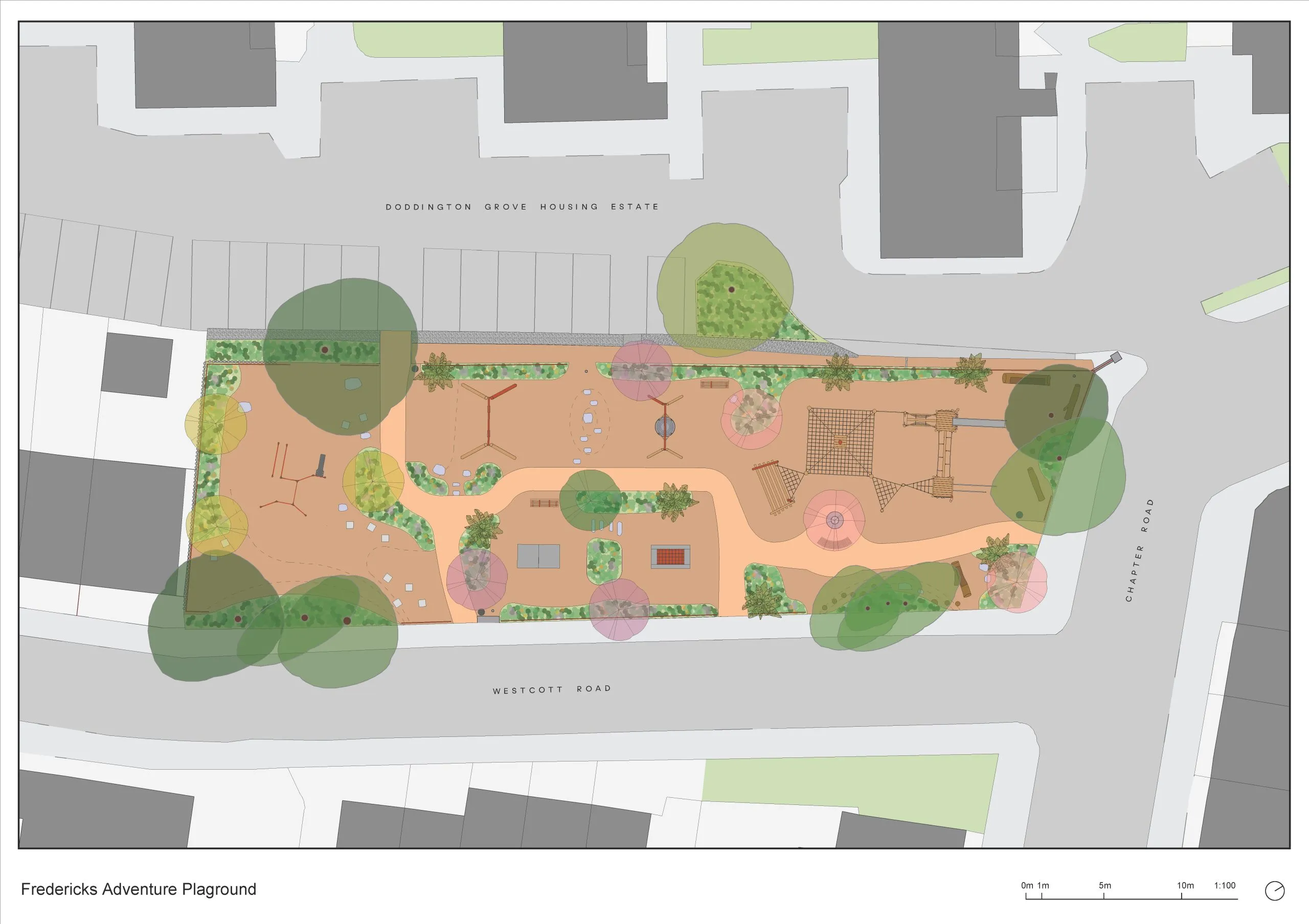
The schemes spatial strategy was informed by research by Make Space for Girls to address the gender imbalance of playing outdoors. A series of distinct but interconnected zones that could be used simultaneously by different groups of people was created.
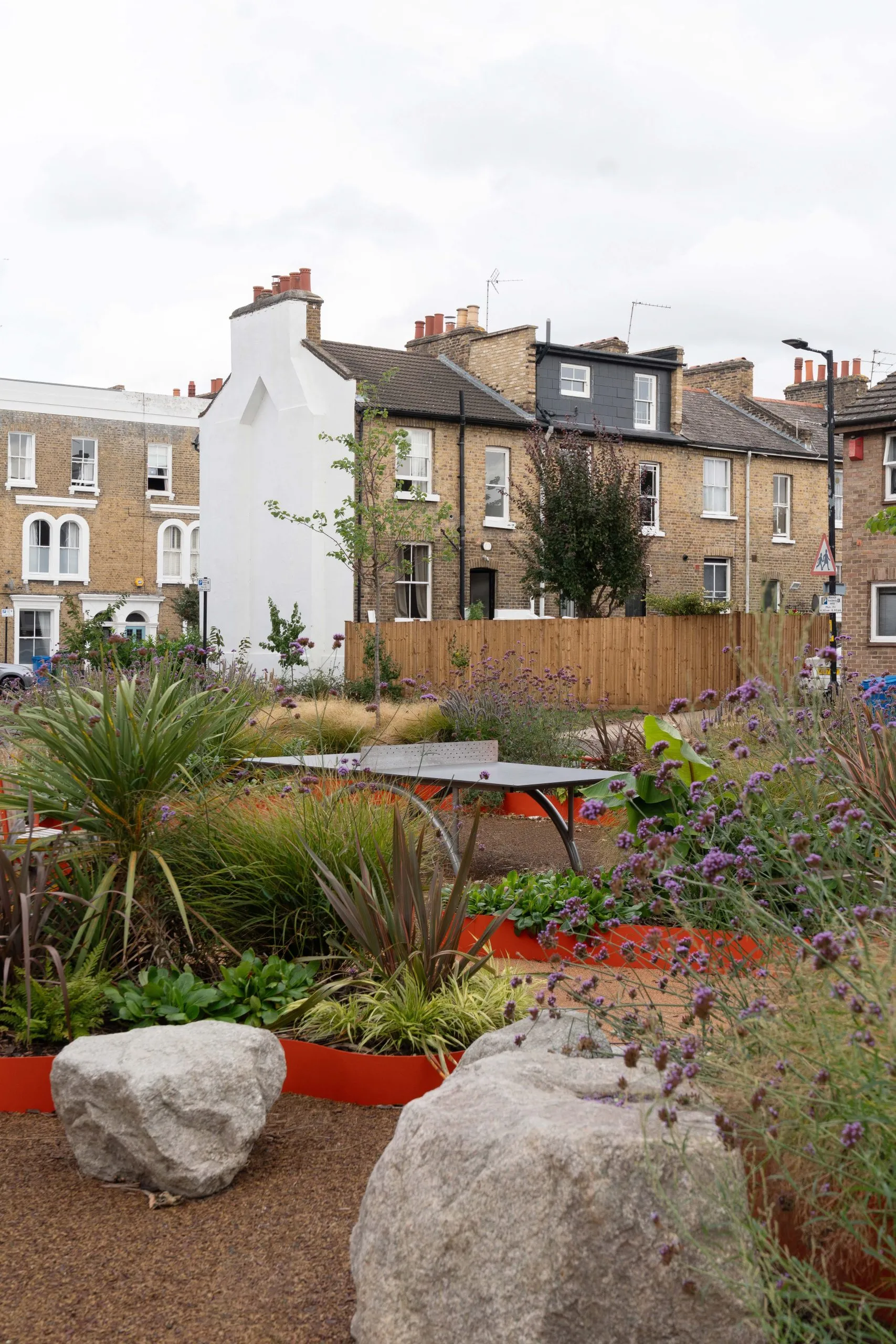
Adding routes in, out and through the site encourages movement and informal social encounters, while prioritising sightlines and opening up passive surveillance from neighbouring homes.
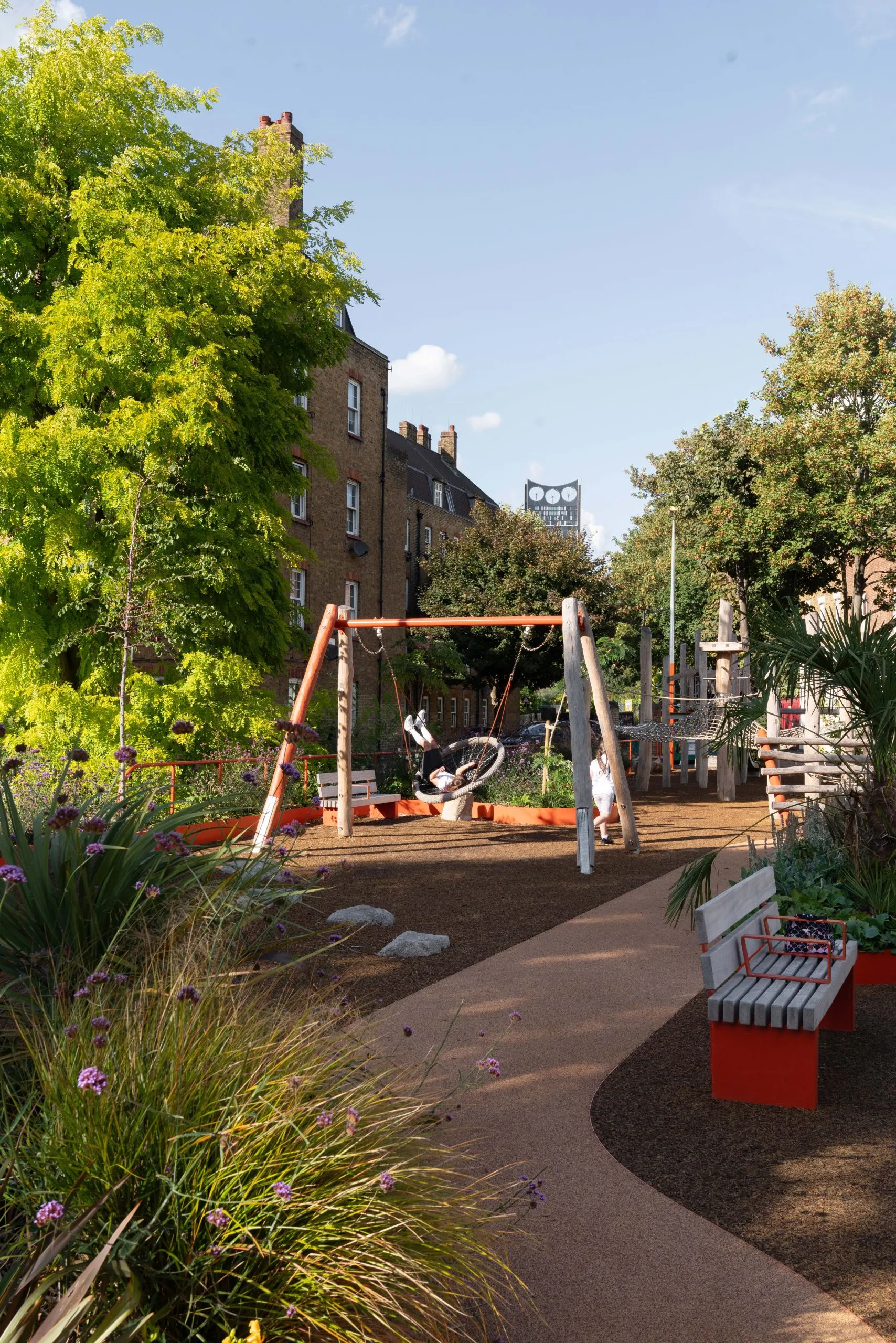
Railings and edgings were used to create soft boundaries, doubling as an architectural feature to give the playground a graphic identity: orange was chosen to embed with the terracotta brickwork of the adjacent Doddington Grove Estate.
Planting has been used to create a deep threshold between playground and the residential street, inspired by the Walworth Garden plant collection. To complement the public realms colour scheme, orange, purple and soft pink plants were selected, with an emphasis on low-maintenance species.
The project went through an in-depth consultation, which included extensive engagement with parents, children and community representatives.
The Hackney-based practice completed an extension to the Grade II*-listed St Mary church in Stoke Newington, which was published in AJ Specification in 2021. The same year, it completed a visitor centre for the London Wildlife Trust at Camley Street Natural Park in King’s Cross.
Architect’s view
The playground was primarily designed for older children, while offering enough diversity to attract a broad range of users to use the space for play, fitness and outdoor socialising. A new landscape embeds off-the-shelf play equipment and integrates the play space into the wider public realm.
To address the gender imbalance of playing outdoors (teenage girls are much less likely to play out) particular consideration was given to the needs of girls during the design process. Research by Make Space for Girls informed the spatial strategy, leading to the creation of distinct yet interconnected zones that could be occupied simultaneously by different groups. Multiple routes in, out and through the site encouraged movement, choice and informal social encounters. In contrast to the former high-fenced enclosure, the new layout prioritised clear sightlines across the entire playground and opened up passive surveillance from neighbouring homes to foster a sense of safety and welcome and enable independent outdoor play.
Railings and edging were used to softly define the boundary in replacement of a fence, creating multiple routes and points of entry. The boundary treatment became a playful architectural feature, which gives the playground a strong identity. The orange colour scheme embeds well with the terracotta brickwork of the adjacent Doddington Grove Estate.
Planting played a central role in defining space and experience. The beds provided a deep threshold and boundary between playground and the residential street. The planting scheme was designed to be bold, echoing by the nearby Walworth Garden plant collection and creating another planted pocket space to allow the public to rest. The scheme used a complementary palette of oranges and purples with softer pink accents to create a strong identity and sense of energy within the playground. Large architectural foliage, evergreen structure and tactile planting were combined in a robust, low-maintenance composition that delivered year-round interest, supported biodiversity and introduced moments of delight within the wider neighbourhood.
Root and Erect
Client’s view
The project was commissioned with the aim of creating an inclusive and engaging, sustainable outdoor space for the local community. From the outset, our priority was to design a playground that not only met safety and accessibility standards but also fostered a sense of belonging.
We appointed Erect Architecture (now Root and Erect), a highly regarded landscape architecture firm, to lead the design process. Their approach was collaborative and innovative, ensuring that our vision was translated into a practical and inspiring design. The process began with an in-depth consultation phase, where we engaged with stakeholders, including parents, children, and community representatives, to understand their needs and aspirations.
Erect developed concept designs that balanced creativity with functionality. They provided clear visualisations and material specifications, allowing us to make informed decisions at every stage. Their attention to detail and commitment to sustainability were evident throughout.
The project progressed seamlessly through design development, approvals, and construction. Erect maintained excellent communication, ensuring timelines and budgets were respected while adapting to any challenges that arose. The result is a vibrant, safe, and inclusive playground that reflects the community’s character and values.
We are delighted with the outcome and appreciate Erect’s professionalism, creativity, and dedication in bringing this project to life.
Grace Adegboyega, project manager, London Borough of Southwark
Project data
Location London Borough of Southwark
Start on site May 2024
Completion October 2024
Construction cost £550,000
Architect Root and Erect
Client London Borough of Southwark
Civil engineer Forshaw Gauld
QS Pellings
Play equipment Jupiter Play
Principal designer Root and Erect
CDM co-ordinator Root and Erect
Main contractor Warwick Landscaping
CAD software used Vectorworks