
SPOILER ALERT: The following review contains mild spoilers.
For decades, the Motion Picture Association’s film ratings system — devised by the American studios to advise parents and avoid censorship — offered clear guidelines on whether the material contained in any given Hollywood release was appropriate for children. The organization was mostly concerned about sex and violence, though it also cautioned audiences about something vaguely described as “adult situations,” which young viewers might find overwhelming or otherwise difficult to process.
The standout of this year’s Sundance Film Festival competition, in terms of both audacity of subject and maturity of execution, “Josephine” is a movie in which the eponymous child (vulnerably embodied by newcomer Mason Reeves) is prematurely forced to deal with adult situations. Inspired by traumatic events in writer-director Beth de Araújo’s own childhood, it’s the story of an 8-year-old girl who witnesses something no child should see — a sexual assault between two strangers — and her ensuing struggle to make sense of a crime she can’t begin to comprehend.
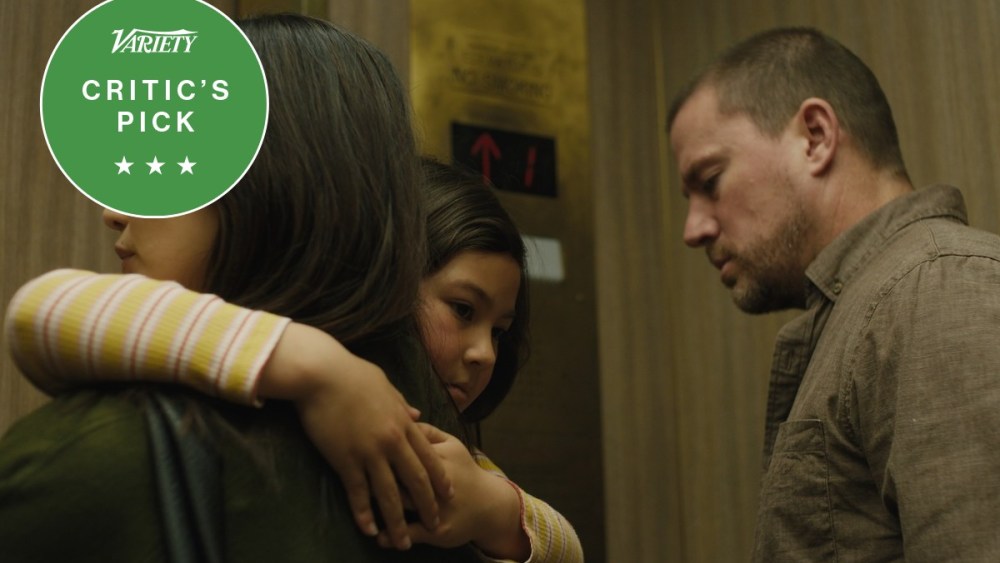
Early one Sunday morning, while running through Golden Gate Park with her father (Channing Tatum), Josephine takes a wrong turn. From her spot on a hill, she happens to observe a strange man following a female jogger into one of the public bathrooms. Then come the screams. When the woman exits, her assailant throws her to the ground, rips off her clothes and overpowers her. Even (or perhaps especially) seen from a distance, the attack is disturbing to watch, and though the culprit is swiftly apprehended, thanks to the quick action of Josephine’s sporty dad, the damage is done.
“Josephine” eventually builds to a big courtroom scene where its title character courageously agrees to testify, but de Araújo seems less concerned with the verdict (which the movie withholds) than she is with recognizing how the experience impacts Josephine, reshaping how she views the world going forward. Developed through the Sundance Labs, de Araújo’s second feature (following 2022’s stunning single-shot thriller “Soft & Quiet,” about white supremacists hiding in plain sight) fits the dominant theme of this year’s festival — coping with trauma — but does so in a psychologically complex way.
As Josephine’s mom (Gemma Chan) eventually tells her daughter, there’s no way to go through life without bad things happening: “It is your responsibility for you to fix your own pain,” she says, and in that advice,
It may sound strange to use the word “subtle” to describe a film that opens with a brutal assault, and yet, the sensitive writer-director excels in constructing a universal human experience out of incredibly specific details (whether drawn from memory, research or her imagination). The moments immediately following the crime are especially powerful, as the filmmaker puts us in Josephine’s place. “Don’t move!” her dad orders — which also happens to be the title of de Araújo’s autobiographical segment for The Moth — before dashing after the perp.
Left behind with a police officer, Josephine must have felt like she was the one being punished, as he locked her in the back of his squad car with the survivor (Syra McCarthy). The moment stretches into a kind of eternity, marked by tactile details: searching for a seatbelt, wanting to console this crying woman, identifying with a bug trapped against the window. In a telling moment, Josephine seems to feel helpful when asked to find the woman’s hair tie among the weeds. And then there’s the long moment, which will haunt her for the rest of the film, in which she locks eyes with the suspect (Philip Ettinger).
Raised in a household that never discussed sex, Josephine has no way of understanding what she’d seen. (Watching the scene a second time, it’s admirable to recognize how de Araújo protected her child star from the truth of what she was playing. Even more impressive is how much Reeves conveys without fully knowing.) As the girl’s ignorance begets further consequences, from acting out at school to the way she looks at unfamiliar men from then on, the filmmaker’s skill comes in embracing a certain ambiguity.
Instead of forcing an interpretation upon her audience, de Araújo trusts us to make sense of her characters’ contradictory, if not downright counterproductive mindsets. For example, no one here has the slightest idea how to handle Josephine after the incident. When she asks her dad, “What was that man doing?” he immediately changes the subject, acting like nothing happened. At home, Josephine’s mom acknowledges the family’s tradition of avoiding tough subjects, describing it as the reason she never goes to her own mother for help as an adult. And yet, she’s helpless to discuss what happened with her daughter, who’s clearly desperate for an explanation.
Overhearing an unfamiliar word (but not knowing how to spell it), Josephine types R-A-I-P into the search engine, researching the concept “of rape” on her own — which anyone can agree is the wrong way to learn. Her mom suggests they bring Josephine to a psychologist (a response a child might misconstrue as some kind of penalty), while her adversity-makes-us-stronger dad enrolls Josephine in self-defense classes. From here on, one of the movie’s more nuanced developments is how the girl gravitates toward — or else rejects — each of her parents at different stages. Arguably the film’s most moving scene occurs between Josephine and her mother in the car, when the child bluntly asks, “Were you ever raped?” and the truth comes indirectly, contradicting her answer, through a single tear.
“Josephine” serves up multiple reasons for audiences to cry, nearly all of which come from moments of solidarity. (The director dealt with her own trauma by volunteering for a crisis hotline, and that experience clearly informs her screenplay.) In her testimonial for “The Moth,” de Araújo describes never getting closure with the survivor of the assault she was privy to as a child. As if to rectify that, she gives Josephine her moment in court, where the girl is cross-examined by a skeptical female lawyer (Dana Millican), as well as a symbolic reunion near the end of the film. In real life, de Araújo’s father warned, “You’re not a welcome memory for her.”
While some might find it triggering, “Josephine” dares to confront the life-shattering intersection of sex and violence in our culture, facing the toughest of “adult situations” with clear eyes.