
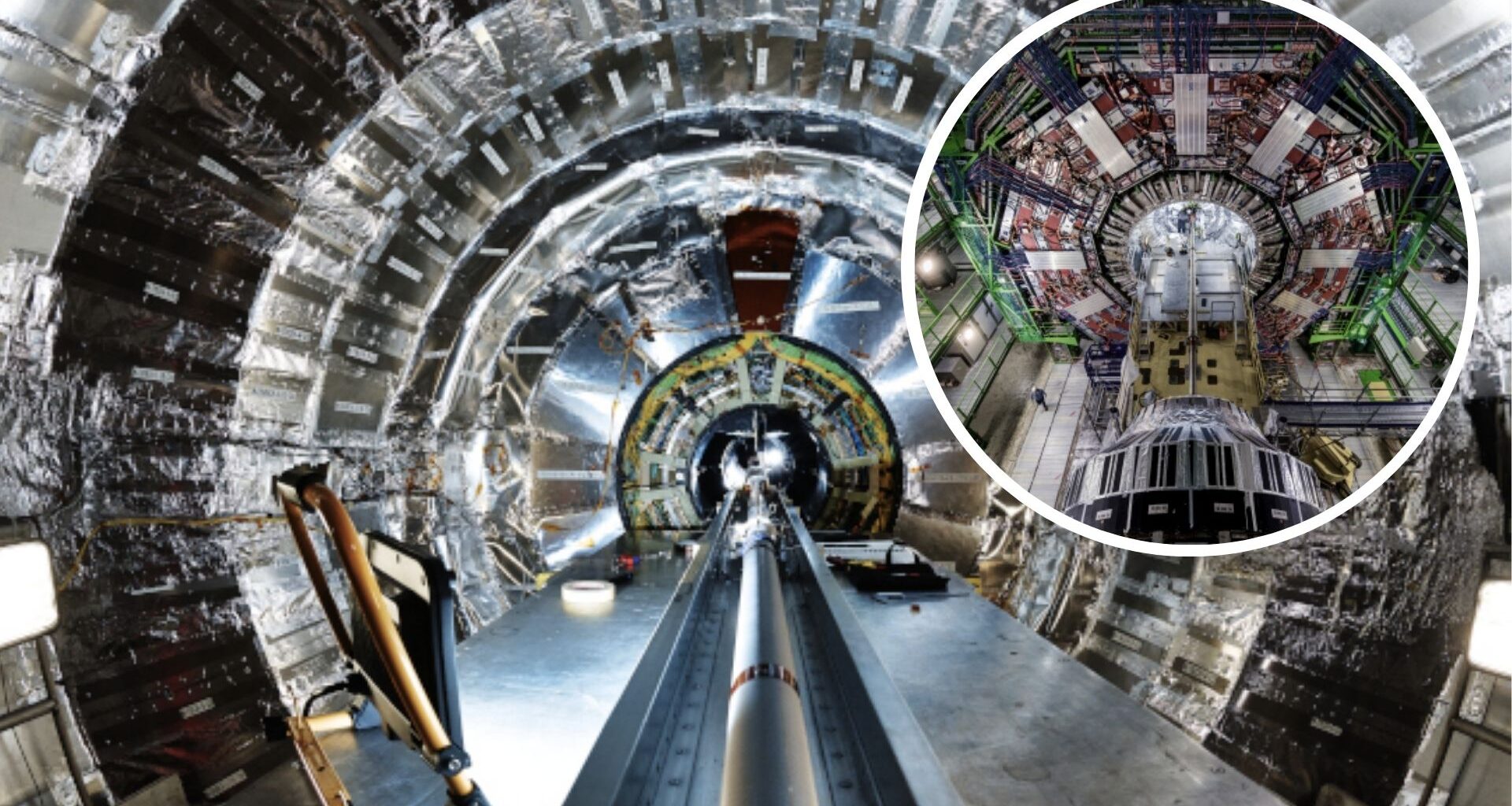
Scientists have found new evidence that a pattern of “flow” observed in particles streaming from heavy ion collisions at the Large Hadron Collider (LHC) reflects those particles’ collective behavior.
The measurements reveal how the distribution of particles is driven by pressure gradients generated by the extreme conditions in these collisions, which mimic what the universe was like just after the Big Bang.
Particles flow collectively from heavy ion collisions
“Earlier measurements revealing that particles flow collectively from heavy ion collisions were central to the discovery of the quark-gluon plasma at the Relativistic Heavy Ion Collider (RHIC),” said Jiangyong Jia, a physicist at Stony Brook University and Brookhaven Lab, where RHIC operates as a DOE Office of Science user facility for nuclear physics research. Jia conducts research at both RHIC and the LHC and led the new ATLAS analysis.
“The new results from ATLAS, while confirming the fluid-like nature of the QGP, also reveal something new because the type of flow we studied, ‘radial’ flow, has a different geometric origin from the ‘elliptic’ flow studied previously, and it is sensitive to a different type of viscosity in the fluid system.”
Findings are supported by measurements at ALICE
The ATLAS findings are supported by measurements at ALICE, another LHC experimental detector, which analyzed the same kind of collisions in a complementary way. ALICE has published its results in the same issue of Physical Review Letters, according to a press release.
“In some ways, these radial flow measurements are completing a story that started the minute RHIC turned on,” said Peter Steinberg, another Brookhaven Lab physicist who has studied both RHIC and LHC collisions and is a co-author on the ATLAS paper.
The earliest data from RHIC, first released in 2001, revealed directional differences in particle flow patterns from Big Bang-simulating collisions of gold ions. Scientists saw an elliptical pattern, with more particles emerging along the reaction plane defined by the direction of the two colliding ions, than transversely perpendicular to it.
RHIC physicists postulated that this elliptic flow was driven by the football-like shape of the overlap region between spherical gold ions colliding off-center. Asymmetric pressure gradients in this oblong fireball would push more particles out along the waistband of the football than toward its pointed ends.
This collective behavior was at first surprising because it indicated that quarks and gluons continue to interact strongly even after being freed from their usual confined arrangements within protons and neutrons. The elliptic flow was so extreme that physicists declared it was coming from a nearly frictionless perfect liquid — one with extremely low shear viscosity.
“In some ways, these radial flow measurements are completing a story that started the minute RHIC turned on,” said Peter Steinberg, another Brookhaven Lab physicist who has studied both RHIC and LHC collisions and is a co-author on the ATLAS paper.
The research is described in a paper published in Physical Review Letters by the ATLAS Collaboration at the LHC. Scientists from the U.S. Department of Energy’s (DOE) Brookhaven National Laboratory and Stony Brook University played leading roles in the analysis.