
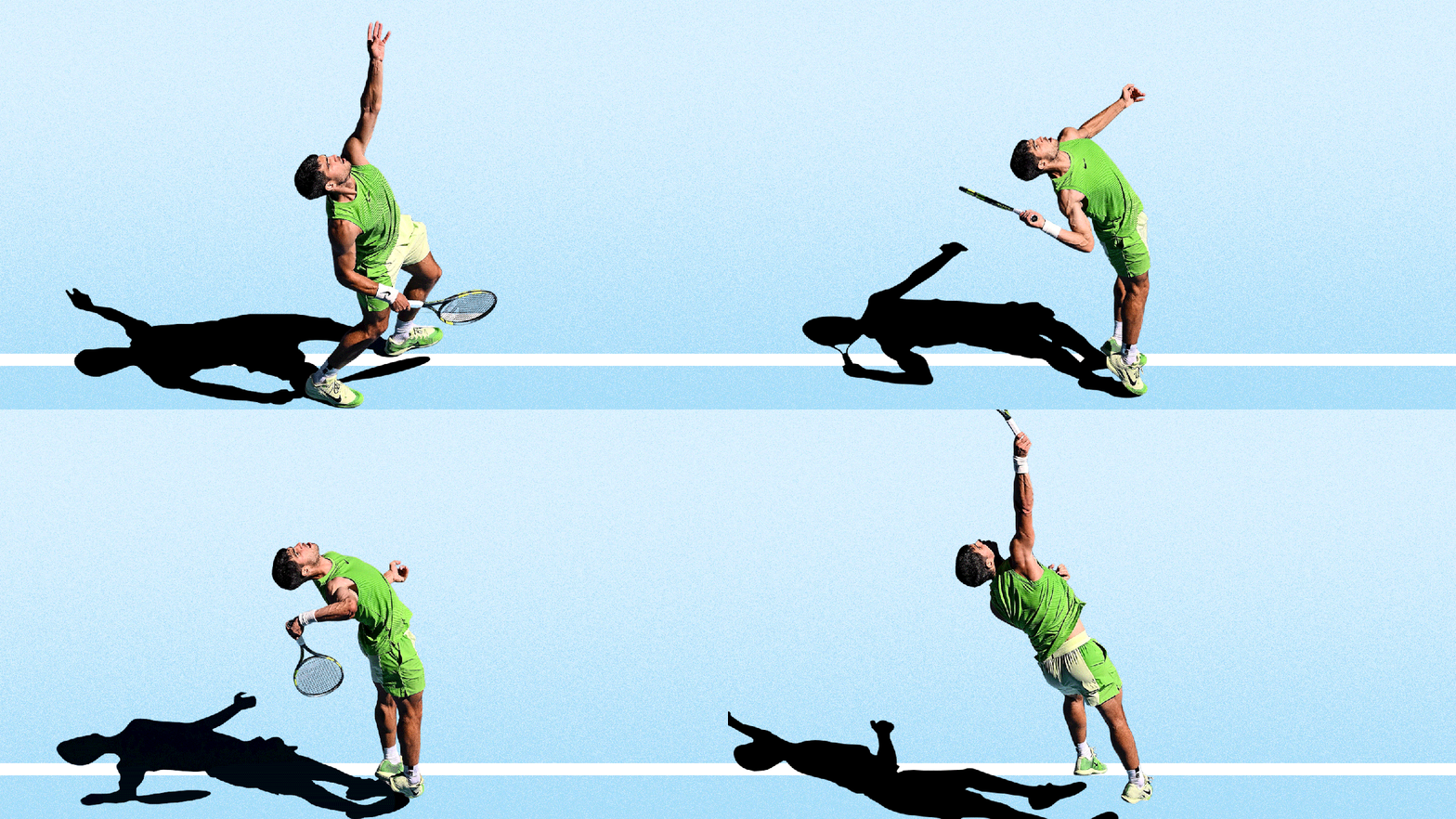
Tennis is a game of fine margins where no two rallies are the same but there is one guarantee for every player: he or she will stand at the baseline, tennis ball in hand and opponent motionless, with the odds of winning the point stacked in their favour. The serve is the only shot over which a player has 100 per cent control.
As a result the elite view it with increasing importance. The world No1 Carlos Alcaraz and the world No2 Jannik Sinner have mopped up the past eight grand-slam singles titles between them and are head and shoulders above the field. Why, then, have they both made changes to their serve for the 2026 season?
Before analysing the technical tweaks made it is important to underline the importance to Alcaraz, 22, and Sinner, 24, of innovation and constant improvement.
It was after the most recent grand-slam final, when Alcaraz beat Sinner in New York, that the Italian acknowledged the need to evolve. “He did many things, he changed up the game. Now it’s going to be on me if I want to make changes or not,” Sinner said in September. “So I’m going to aim to maybe even lose some matches from now on, but trying to do some changes, trying to be a bit more unpredictable as a player, because I think that’s what I have to do, trying to become a better tennis player. That’s my main goal.”
Alcaraz has the same desire to evolve. “I think everyone has to make changes, small details,” he said this week. “For me, the serve is something that I really want to be better at every year.”
If we stand still, they argue, the rest will catch up. Or “figure you out”, as Andre Agassi claimed to have done to Boris Becker. The American’s story goes that he could not beat Becker and desperately needed something, anything, to cling on to if he was to finally beat the German. After hours of analysis, Agassi spotted that Becker stuck out his tongue during his service motion. He soon realised that if Becker’s tongue was in the middle of his lip, the ball was going a certain way and if it was to the side it would go another way. Their head-to-head record finished 10-4 in Agassi’s favour.
There is little chance of cues from Alcaraz or Sinner being worked out simply because they are always refining their technique. So, what exactly have they changed? And why?
Jannik Sinner
Despite being the No1 server on the ATP Tour in 2025, according to Infosys ATP stats, which examines a player’s serve dominance via metrics such as percentage of unreturned serves and first-serve points won, Sinner believes his serve is a “shot where I need to improve”.
Sinner, who has called his long-time coach Darren Cahill “a second father”, has not made wholesale changes to his service motion, instead making refinements that focus on improving his rhythm and tempo.
New footwork
Sinner said that his service rhythm was “too fast at the beginning”. He now raises the toe on his left (front) foot, transferring his weight on to his left heel and moving his centre of mass backwards to begin a rocking motion. This has two key benefits.
First, it helps him to improve his timing, or “rhythm” as he puts it. By rocking backwards he has added a predictable, repeatable motion to his serve routine. It is why triple-jumpers rock before their run-up: so that their launch is part of a motion, rather than the start of one.
Second, by leaning backwards Sinner’s leg muscles stretch slightly. As a result they will store elastic potential energy. It is like pulling an elastic band. Or compressing a spring. As a result he can produce more force, more quickly.
Adjusting the ball toss
Sinner has changed the alignment of his toss and shortened it. His toss used to be out in front of him and to the right. He has brought his toss more in line with his eyeline. “Over the head,” as he puts it. With the ball out to the right, it was difficult for him to hit the right side (far side) of the ball.
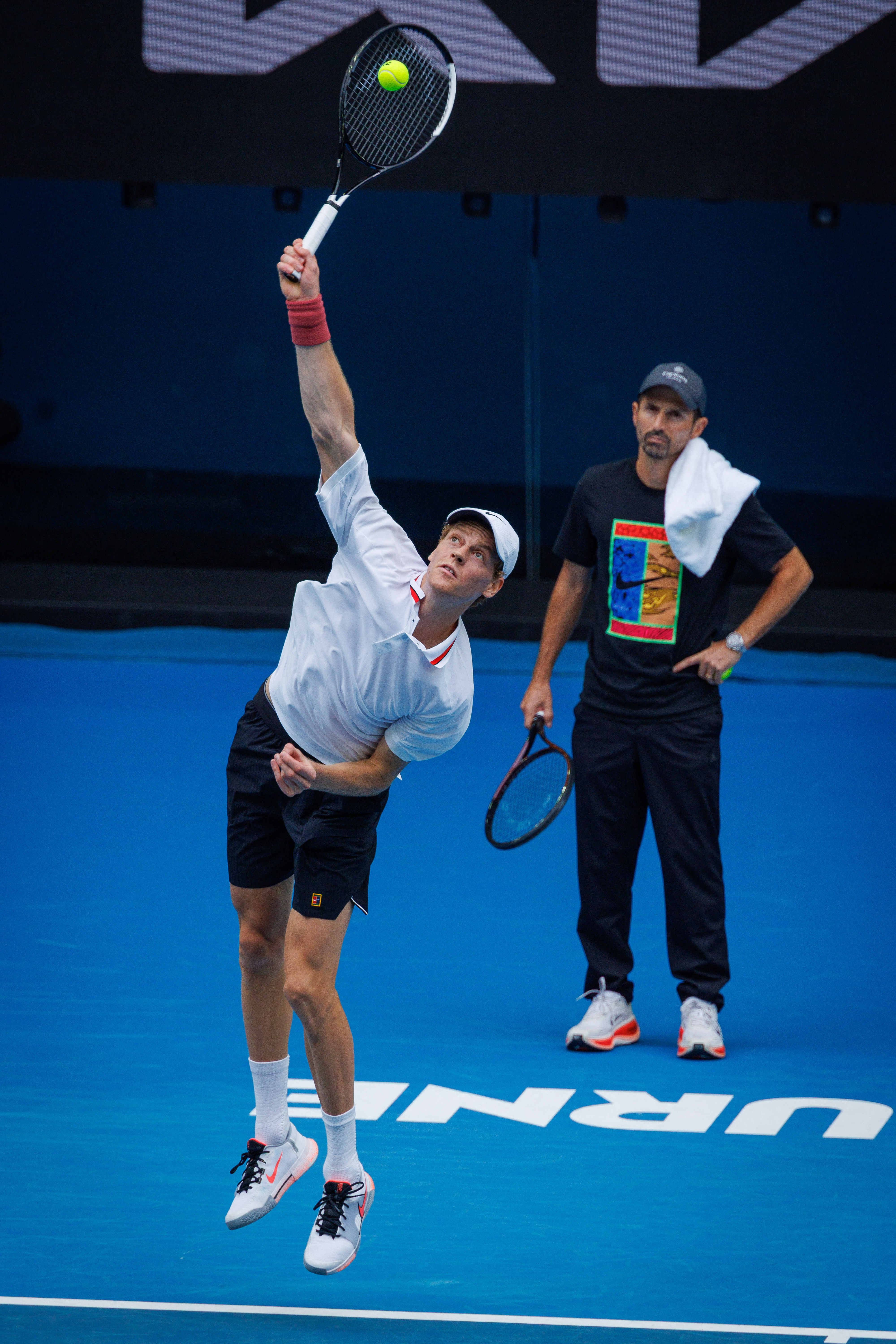
Sinner has adjusted his toss so that the ball is more in line with his eyeline
PATRICK HAMILTON/AFP/GETTY IMAGES
Bringing the ball inline means he can produce slice, flat and kick serves. He admits, though, that he has not yet perfected the new toss.
He has also reduced the height of his toss. This means that he strikes it closer to the apex of the ball toss, when the ball is moving most slowly. These changes make Sinner’s serve more difficult for an opponent to read, according to a former coach of the Italian’s, because there is more that he can now do with the ball and the ball’s lower apex reduces time for judgment.
Carlos Alcaraz
If imitation is the sincerest form of flattery, then Novak Djokovic will have no complaints that the Spaniard’s new serve rings a few bells. “I didn’t think about, or I wasn’t thinking about making the same serve as Djokovic,” Alcaraz said. “But at the end, I can even see the similarities.”
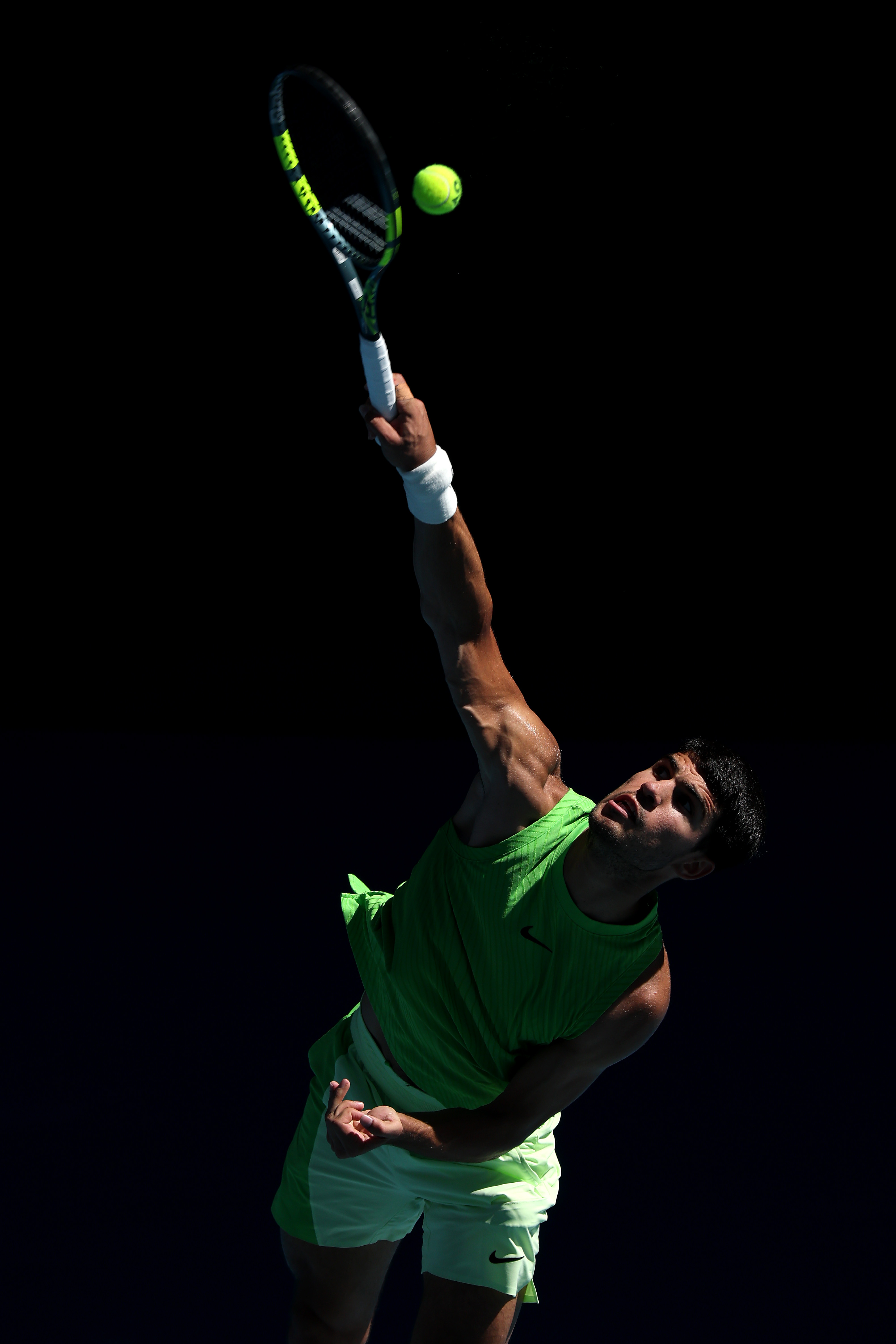
Alcaraz has inadvertently made his serve much more similar to Djokovic’s
CLIVE BRUNSKILL/GETTY IMAGES
“We have to speak about copyrights,” Djokovic joked.
The serve is the shot into which Alcaraz — who split with his coach Juan Carlos Ferrero in December and now works with Samuel López, who formerly coached the Spanish player Pablo Carreño Busta — has been putting the most “attention”. The aim, as with Sinner, is to generate rhythm. Alcaraz said: “Now with this movement on the serve, I just feel really, really comfortable, smooth, really calm and peaceful rhythm.”
Bent arm
Alcaraz used to have quite a straight arm at the start of his service motion. His arm is now bent. This bend allows him to put the load into his shoulder, like a javelin-thrower would. It also creates a shorter lever early in the serve motion, which brings the weight of his arm plus the racket closer to his body, meaning less force is needed to produce the same racket speed. A figure skater, for example, keeps their arms close to their body when spinning for the same reason: less energy is required to produce the same speed.
When his elbow then extends before striking the ball the racket head reaches its top speed late in the movement.
Loose and cocked wrist
Alcaraz drops his wrist, allowing the racket head to lag behind his hand. This creates a “whip-like” effect. The England fast bowler Jofra Archer has a similar “wrist-snap”, which is crucial to him reaching speeds above 90mph. The more links in the moving chain, the greater the acceleration (provided they are all in sync).
Toss
Alcaraz was seen in late December refining his toss by using a mini-basketball hoop as a target. The aim: to develop a repeatable, accurate toss. He said this week that he is no longer using the hoop as he has already achieved what he was aiming for. “I don’t take long,” he said. “I just got it pretty quickly.”
He also now brings the ball to chest-height before beginning his service motion to increase the height of his frame.
All of these technical modifications are designed to improve efficiency. There remains, however, the intriguing question: how do you know when to opt for a certain serve?
“I am aiming to have 60-plus percentage of first serves [in but] at times you need to risk a little bit more,” Sinner said this week. “Tennis is a percentage game. You have to understand what you play, where is the highest percentage where you can win the point, then you go for it in important moments.”
And this is the crux of it: points won across a tennis match tend to be close to 50:50 — Roger Federer won 54 per cent of points across his glittering career — but what separates the likes of Sinner and Alcaraz from the rest is that they peak for those “important moments”. If you can rely on your serve, it becomes a much simpler sport.