
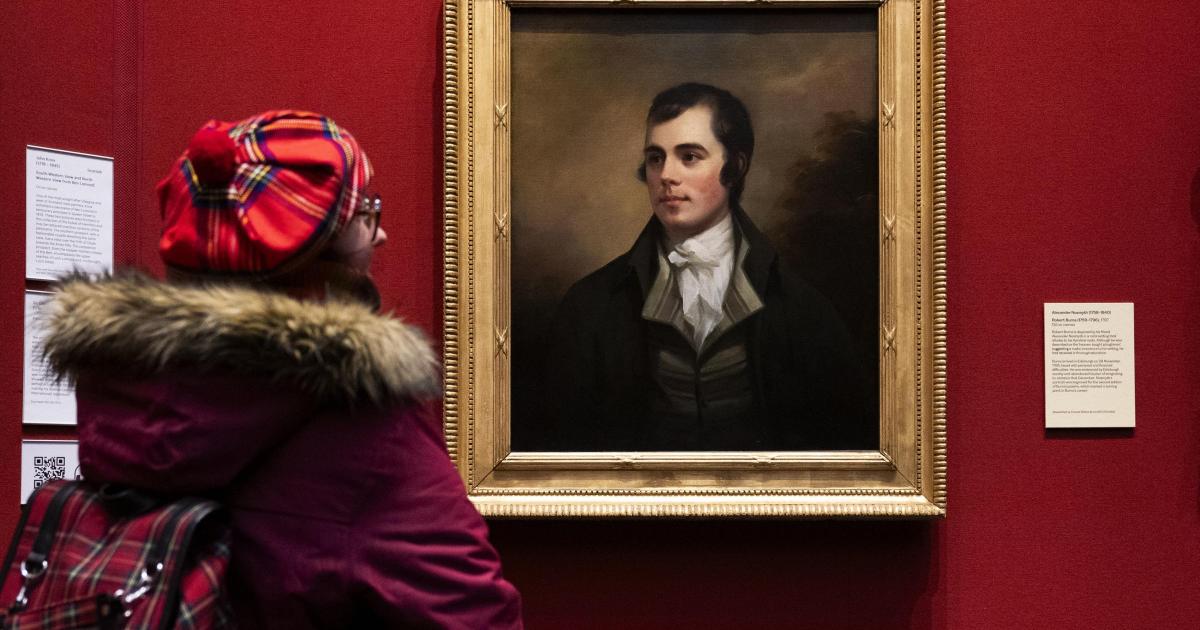
The painting, by the renowned Scottish portrait artist Henry Raeburn – who was Burns’s contemporary, was found during a house clearance and put up to auction for £300-£500 in March 2025.
Dr Bill Zachs, the director of Blackie House Library and Museum in Edinburgh and a long-term Burns scholar and enthusiast, ultimately bought the painting for £68,000 believing it could be the elusive missing artwork.
It has since been cleaned and examined by experts, who confirm that it is the lost Raeburn portrait.
Dr Bill Zachs pictured alongside the Raeburn (left) and Nasmyth portraits of Robert Burns (Image: Nick Mailer)
It will be available to view free of charge at National Galleries Scotland: National, on the Mound in Edinburgh, from January 22, to celebrate Burns Night.
Commissioned in 1803 at a fee of 20 guineas by the publishers Cadell & Davies, the painting was to be engraved for future editions of Burns’s books. However, it had not been seen since.
In 1924, TCF Brotchie, the director of Glasgow Art Galleries and Museums, wrote that the painting’s discovery would be “an event bordering upon the sensational”.
The Raeburn attribution has been confirmed by James Holloway, former director of the Scottish National Portrait Gallery; Dr Duncan Thomson, former keeper of the Scottish National Portrait Gallery; Helen Smailes, senior curator of British Art at the National Galleries of Scotland; Lesley Stevenson, senior paintings conservator at the National Galleries of Scotland; and Dr Bendor Grosvenor, art historian.
Zachs, who is the owner of the painting but has leant it to the National Galleries, said: “This week at Burns Suppers in Scotland and around the world we toast the immortal memory of the poet.
“Now we have a new immortal visual memory – a once lost painting by Sir Henry Raeburn, the Scottish great portrait artist, that depicts Robert Burns not just as a genius poet but as a celebrated (and handsome) Scotsman whose significance would endure ‘till a’ the seas gang dry’.”
Stevenson said: “Raeburn’s expressive, seemingly effortless brushwork, the characteristic warm palette, soft, atmospheric lighting and sensitive rendering of the instantly recognisable Robert Burns, are a joy. This is a significant discovery and one we can all celebrate.”
Gerard Carruthers, the Francis Hutcheson professor of Scottish literature at the University of Glasgow, said: “A lost likeness of Burns and a new Raeburn to boot: this really is two red letter days in one.
“There have been rumours of the portrait’s existence over many decades, but the recent detective work to authenticate has been simply outstanding.”
Raeburn did not have Burns sit for him, but based his work on the 1787 portrait of the Bard by Alexander Nasmyth (above).
Burns, who died in 1796, had achieved such immense popularity by 1802 that publishers Cadell & Davies decided to commission a new version of Nasmyth’s original.
One of Scotland’s most celebrated painters, Raeburn – a leading portraitist of the late 18th and early 19th centuries – was drafted in.
Over the years correspondence between Raeburn and Cadell & Davies, regarding both the commission and the delivery of the painting, came to light.
This proved the existence of the artwork, although with no clues as to where it ended up. One letter dated 22 February 1804 from Raeburn reads: “Nothing could be more gratifying to me than the approbation you express of the copy I made.”