

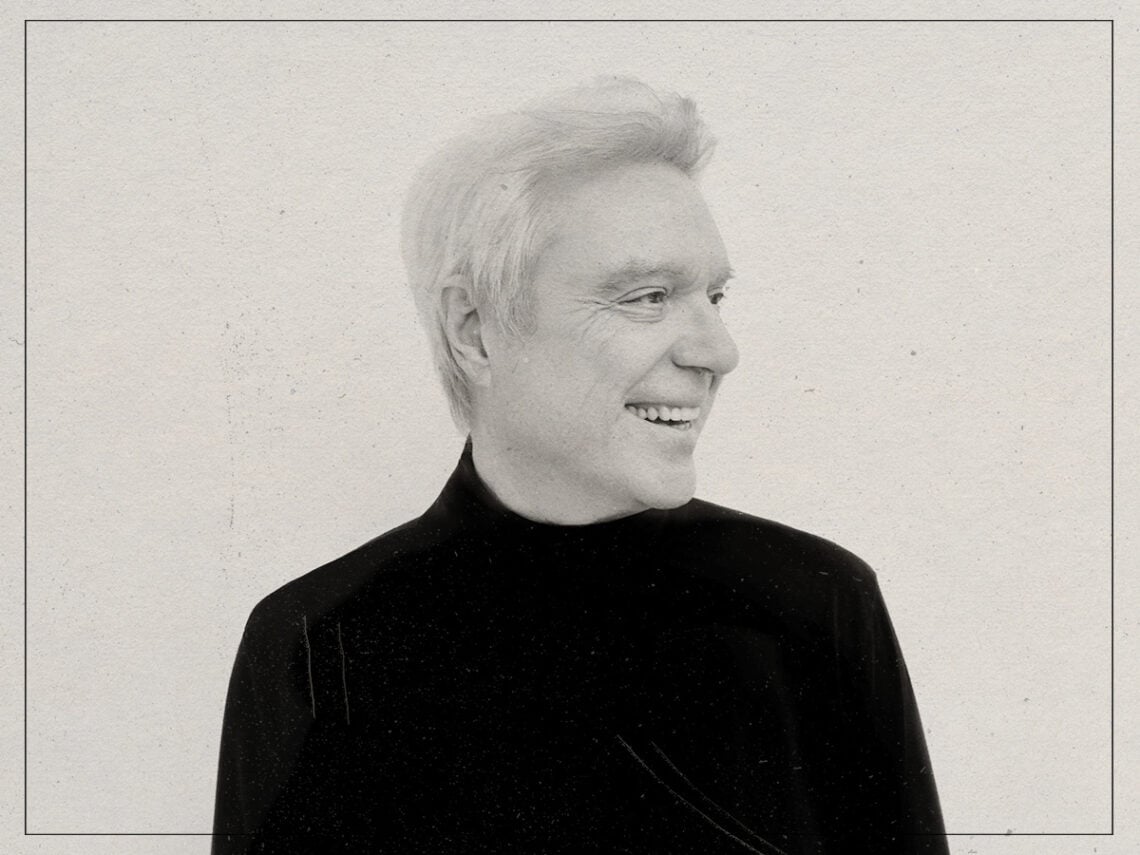
(Credits: Far Out / Shervin Lainez)
Sun 25 January 2026 8:00, UK
When Brian Eno and David Byrne announced they were going to release a collaborative album, the music world knew it was about to get existential really fucking fast.
The former was a master in constructing ambient melodies fitting for existentialism, where questions about our own human form and the endless expanse of space seem to just fall with every prod of a synthesiser.
Then there is Byrne, who perfected the art of narrative juxtaposition. Over the top of futuristic, upbeat melodies, he consistently questioned the state of modern life. Alluring us with its sonic temptations with one hand, before pulling it away to expose the reality with another, his music consistently had a grip on the cruel dichotomy of modern life.
On their 2004 record Everything That Happens Will Happen Today, the pair set out to create a soundscape fitting for their meta-analysis. Combining the primal worlds of gospel music with electronic futurism, they created something that was appropriately conflicting for their narratives.
Eno explained, “When we started this work, we started to think we were making something like electronic gospel: a music where singing was the central event, but whose sonic landscapes were not the type normally associated with that way of singing. This thought tapped into my long love affair with gospel music, which, curiously, was inadvertently initiated by David and the Talking Heads.”
But naturally, Eno only had a grip on the instrumental element of that. Crafting a catalogue of interesting soundscapes, he hadn’t yet figured out a narrative direction it could follow, which is where the observational genius of Byrne came in.
Byrne recalled that he and Eno “had dinner one night, and then the next afternoon, I popped round his office/studio to hear what he’d been up to. Just before we parted I recall Brian mentioning that he had a lot of largely instrumental tracks he’d accumulated and since, in his words, he ‘hates writing words; I suggested I have a go at writing some words and tunes over a few of them and we see what happens. I put it to him that if he didn’t like the result, that would be that.”
But given Eno’s hesitation to put his own creations to words, Byrne had to conjure up something obscure enough to warrant his inclusion, and so he did away with conventional lyrical tropes of love, heartbreak and even politics. Instead, he faced inward and, in doing so, captured Eno’s attention.
On the standout track ‘Strange Overtones’, Byrne delivered what Eno described as “a song about writing a song”. It fit perfectly with the wobbly instrumental arrangement Eno had crafted, and subsequently felt like a sonic vortex into the inner walls of the very song.
On one verse, Byrne even sings, “This groove is out of fashion / These beats are 20 years old,” in what was a self-referential nod to the pair’s place in the music industry. Perennial pioneers of sound, yet in 2004, found themselves staring down the barrel of an antiquated oblivion and responded with a song that will endure the test of time.
Related Topics