
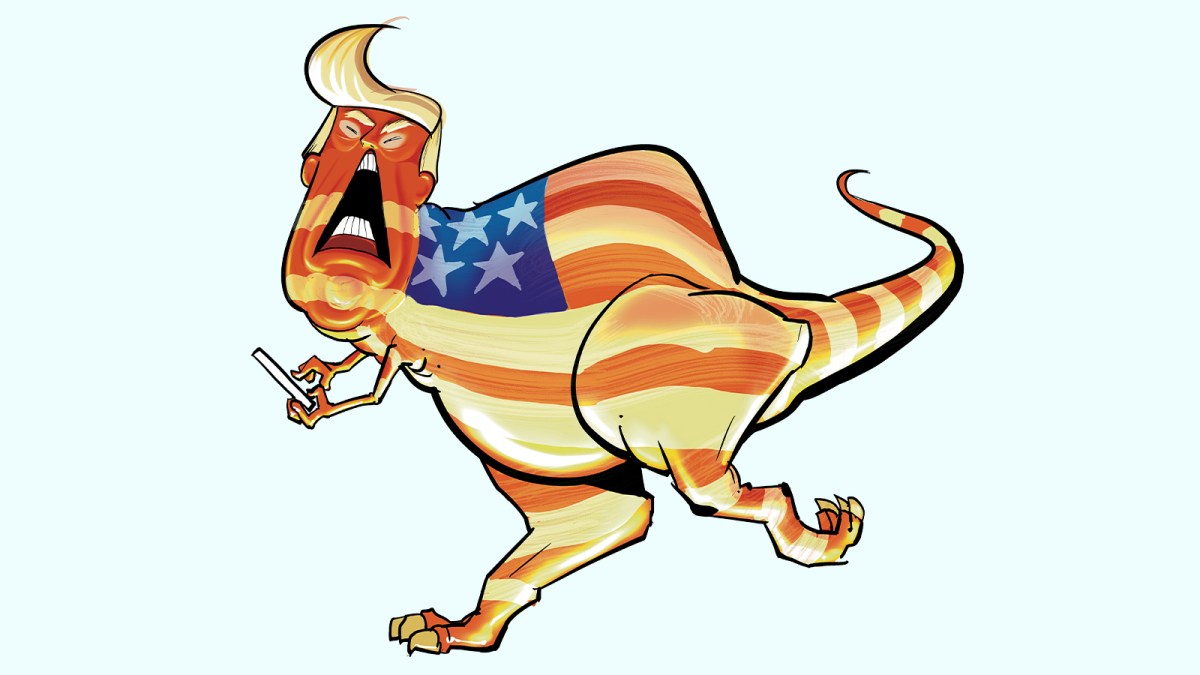
Late in the evening in the Swiss Alps last week, a member of the US delegation had an epiphany. “Next year, Davos should be in DC,” declared a figure close to the administration. “We’re the main show,” they added, pointing to the crowd of Americans making themselves at home. If Donald Trump had made the ski town the centre of the world this time, why not next time just do it from home?
On grabbing attention, they had a point. All eyes were on the US president in Davos as he threatened (and then made peace with) Nato countries over Greenland, posed with autocrats on stage as he launched his “board of peace” and claimed in an interview (to the fury of Sir Keir Starmer, veterans and Prince Harry alike) that in Afghanistan Nato sent “some troops” but “stayed a little back, a little off the front lines”. Even the speeches that drew praise — such as Canadian prime minister Mark Carney’s — were responses to the president’s actions. Now the world is once again recalibrating in response to Trump’s chaotic diplomacy with Europeans, saying things need to change.
Nowhere is a more fitting symbol for the schism than the elite ski town where he spent just over 24 hours. In theory, the point of Davos is to discuss the world economy. In practice, it is a place where the rich and powerful meet each other in a town so remote and expensive that protesters have no chance of crashing the party (though one enterprising citizen journalist did manage to chase Trump’s peace envoy Steve Witkoff down the street last week asking questions about Russian money).

President Trump speaking in Davos last Wednesday
AP PHOTO/MARKUS SCHREIBER
• Trump in Davos — as it happened
It is where financial power meets political power. The idea is to pack dozens of meetings in a day, with delegates from the world over, and then marvel at how long it would have taken to meet them individually.
Access depends on where you are in the pecking order. But however important you were last week, you spent it waiting on one man: Trump. While he has made the trip before, this time he arrived with a new sense of purpose — not as an outsider but as the main guest, with the largest ever US delegation in town to prove it.
USA House sat in a former 19th-century church, built by tuberculosis sufferers drawn to Davos’s high-altitude air. Inside, American flags lined the walls, alongside glossy posters of the first lady, promoting a documentary about her due to be released this week, and a large metal statue of a bull, which an organiser explained was a symbol of “wealth and strength”. At night, they headed to “Studio 64”, a wood-panelled Swiss restaurant transformed into an American bar and dancefloor.

Journalists try to ask Trump questions as he walks upstairs at the World Economic Forum in Davos
AP PHOTO/EVAN VUCCI
In the affiliated lounges (with American eagles on the signs), sponsored by US corporations, even the coffee carried branding: cappuccinos topped with latte-art stars and stripes. It was a small but telling detail. The Trump presence in Davos was not just political or diplomatic, but commercial, performative and relentlessly on-message, blurring the lines between statecraft, campaigning and promoting a brand.
Even the unimpressed stopped and dropped plans for Trump. Gavin Newsom, the California governor who is favourite to be the Democratic presidential candidate, found himself stageless when his appearance at USA House was cancelled. The Trump administration refused to comment on whether it was their decision. A few hours earlier, Scott Bessent, the US treasury secretary, had described him as “Patrick Bateman meets Sparkle Beach Ken”.
One man welcome at the US base was Nigel Farage, who made his own Davos debut. After denouncing the globalists, he was Bessent’s pick for dinner that evening, where The Sunday Times understands they discussed the Chagos Islands and Diego Garcia military base.
Business attendees saw their schedules change at Trump’s whim. His speech ran past an hour — and went well beyond the themes pre-briefed. While Trump does use an autocue (criticising the UN last year when it broke), his team say he likes to go off script as the mood takes him.
The big question being asked in the mountains was whether all this could be the pinnacle: is this Trump’s zenith of power — and what role will America play after?
The US president has kickstarted the year expressing might in Venezuela and aggressive rhetoric on Greenland. Unlike in his first term when there was an expectation he would change the world but then limited action, he seems more determined, strident and willing to move. European leaders look on in horror, fearing he has become more erratic and strong-minded in the past few months. They ask what could be behind it.
• America First has exposed Davos Man’s delusions
As the White House national security strategy laid out last year, Trump believes US foreign policy should focus on the western hemisphere — defining America’s backyard as from Greenland and the Arctic down to the Panama Canal, Latin America and the Pacific. The new 2026 national defence strategy, released overnight on Friday, confirms this direction. The Pentagon document proposes that China will no longer be the top priority, with the focus on defending the homeland and the western hemisphere with the Pentagon to find “credible options to guarantee US military and commercial access to key terrain from the Arctic to South America, especially Greenland, the Gulf of America, and the Panama Canal.” As for Europe, peace in Ukraine is “Europe’s responsibility first and foremost” with the US to provide “critical but more limited US support” as it urges US allies to help with “burden sharing”.
Who is driving this? These days, Trump’s deputy chief of staff, Stephen Miller, who leads on immigration and was in attendance at Davos, is seen as particularly influential, including on the president’s speech last week. In the Pentagon, Elbridge Colby, the defence policy chief, is playing a leading role on foreign policy. His 2021 book The Strategy of Denial: American Defense in an Age of Great Power Conflict made many of the arguments that are in these documents now.
Unlike during his first term, Trump’s team is here to serve and enable him — rather than put up guardrails or tell him things he doesn’t want to hear. His inner circle have been picked for loyalty and many share his views. Trump still dominates, even if he is often influenced by the last person he spoke to. The Greenland idea was put to him in his first term by Ronald Lauder, Estée Lauder’s son and heir.
And when it comes to what Trump cares most about, many Republicans believe legacy is on his mind. It’s a thread that binds much of the past week: expanding the map of America through Greenland, creating a board of peace that he may never leave and bringing an end to the Ukraine war one way or another.

Volodymyr Zelensky with Trump in Davos
AFP
Yet for all the displays of power, the past few days have shown the limits, even for him. Greenland was talked down in his Davos speech, and a compromise is now in the works after Trump admitted he couldn’t just take it. Members of the administration argue this is still a win for the president, who comes up with big demands and loud claims resulting in the world moving towards him and accepting what might have seemed unreasonable previously as a sensible compromise.
But it’s not clear he could have pressed ahead without Congress (where the Republicans have a working majority of one) stepping in and a voter backlash. Recent polling suggests little appetite for a Greenland takeover or purchase.
At a drinks reception in Davos, one Democrat said they hoped Trump would put an offer in for Greenland (rumoured to be in the region of $700 billion). Why? Then they could campaign on using that huge amount of money to address the bigger domestic concern of affordability.
In a sign that Trump’s top team sense the risk of devoting too much time to overseas concerns, the president’s chief of staff, Susie Wiles, told the travelling press on the flight over to Davos that, upon return, there would be a new domestic focus, with Trump about to spend air miles travelling across America rather than leaving it. It comes as some question whether the emphasis on foreign policy is getting too much: his poll rating is now lower than any second-term president has seen at this stage aside from Richard Nixon.
• After the Trump chaos, are investors pulling back from the US?
It will start this week when Trump heads to Iowa. White House figures say journalists are going to be spending most of the rest of the year exploring real America as a result of the domestic push. Others point out nervously that Iowa has been the first stop in the primaries since 1972.
There is a growing fear within the Republican Party that they could lose the midterm elections in November. Public First research data for The Sunday Times on how Americans see the state of the country going into the new year gives a mixed picture.
More than twice as many Americans thought last year was good than those who thought it bad. But this was largely driven by income. Only 39 per cent of those earning less than $50,000 had a good year, compared to 70 per cent of those earning more than $100,000. But when asked about Trump’s impact on policy and the economy, the picture changes. Americans are more likely to say the country and the economy have grown worse since last year — 47 per cent compared to 34 per cent who say it’s got better.
The hope in the White House is that the economy will rocket in the first half of this year. And here there is encouragement. The majority of Americans are optimistic about their financial futures, with 54 per cent expecting they will personally be better off by this time next year. This was consistent across income levels. But the cost of living is still a struggle for a large minority of voters. The biggest financial concern is groceries (47 per cent), followed by housing costs (33 per cent) and utilities (30 per cent) while almost one in four Americans struggle to keep their homes heated all winter (23 per cent).

Trump during the World Economic Forum
AFP
It’s this that the coming battle will be fought on, rather than barbs traded on the snow over Greenland.
Davos offered a fitting backdrop, compressing the world into a single, glittering village and showing how completely it now revolves around one man. For a week, the global elite waited, recalibrated and adjusted their language for him.
The danger for Trump is that momentum can feel like inevitability until it doesn’t. Power, like altitude, can disorientate. And the same forces that carried him up the mountain can just as quickly pull him back down.
Heading back to my accommodation one night I took a taxi. Driving through the dark, we realised halfway up that we’d taken a wrong turn and it was not a road but a ski slope. We spent about 15 minutes reversing in a Tesla. “Everything must come down eventually,” explained my driver, calmly.
Katy Balls will present The State of It: USA, a new podcast from The Times and Sunday Times, alongside Gerard Baker, starting on Wednesday, January 28
Katy Balls has been shortlisted for multiple awards including best comment journalist and political commentator at the British Journalism Awards. Katy moved to the US last year to lead our Washington bureau.