

Food inflation rose to 7.71% in December from 7.36% a month earlier, while non-food inflation remained elevated at 9.13%.
TBS Report
25 January, 2026, 11:05 am
Last modified: 26 January, 2026, 10:51 am
Illustration: Ashrafun Naher Ananna/TBS Creative
“>

Illustration: Ashrafun Naher Ananna/TBS Creative
Bangladesh’s overall inflation rate edged up further in December, driven mainly by a faster rise in food prices, according to the Economic Update & Outlook (January 2026) released today (25 January) by the General Economics Division (GED) of the Planning Commission.
TBS Highlights
“>
TBS Highlights
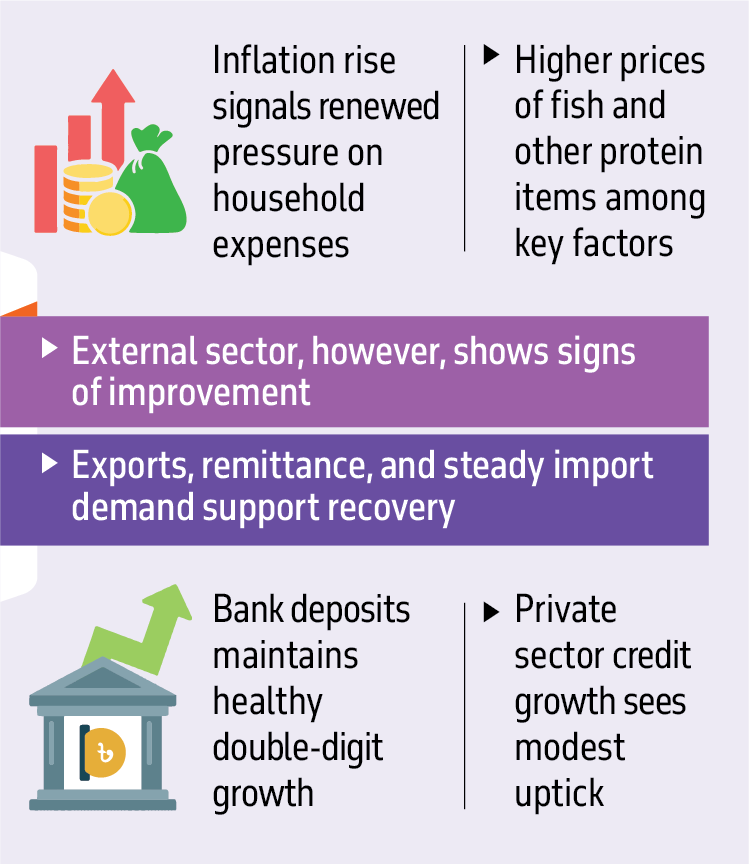
General inflation increased to 8.49% in December, up from 8.29% in November, reflecting renewed upward pressure from the food basket amid persistently high non-food inflation.
Food inflation rose to 7.71% in December from 7.36% a month earlier, while non-food inflation remained elevated at 9.13%, indicating continued cost pressures beyond food items.
The GED report says the acceleration in food inflation during the month was largely led by higher prices of fish and other protein items, although rice inflation continued its downward trend across all categories, offering some relief to consumers.

Keep updated, follow The Business Standard’s Google news channel
Despite inflationary pressures, the report highlighted several positive developments in the broader economy. External sector stability improved, supported by export recovery, strong remittance inflows and resilient import demand.
At the same time, bank deposits maintained double-digit growth, while private sector credit growth showed a modest uptick in November, according to the report.
On the fiscal front, the government has finalised the FY2025–26 Annual Development Programme (ADP) in line with budget priorities, aiming to support growth and social development.
The report also highlights the launch of the SDG village piloting initiative by the GED to advance localisation of the Sustainable Development Goals.
As part of the pilot phase, three villages – Telikhali in Khulna, Sonar Para in Kurigram and Mitingachori in Rangamati – have been selected to implement an integrated, village-level development framework.
The initiative will involve baseline surveys, need-based interventions, resource mobilisation, and a monitoring and evaluation framework, with lessons expected to inform scaling up in other lagging regions.
The initiative aims to operationalise national SDG priorities at the grassroots level by addressing multidimensional development gaps in a coordinated and inclusive manner.
According to the GED report, the SDG village piloting initiative will be implemented through baseline surveys, need-based interventions, resource mobilisation, and a monitoring and evaluation framework.
The lessons and experiences from the pilot villages are expected to scale up sustainable development programmes in other villages and lagging regions of the country.