
Researchers have assembled the most detailed view to date of how dark energy has shaped the cosmos, using six years of deep-sky observations. Drawing from the Dark Energy Survey (DES), scientists traced the distribution of matter and the universe’s expansion across billions of years, bringing them closer to understanding the force behind cosmic acceleration.
The data, gathered by the Dark Energy Camera (DECam) on the Víctor M. Blanco 4-meter Telescope in Chile, includes information from 669 million galaxies observed over 758 nights between 2013 and 2019.
This force, which makes up roughly 68% of the universe, remains unexplained. With its multi-method strategy and massive data pool, the survey marks a significant step in unraveling one of astrophysics’ most persistent mysteries.
Combining Four Cosmic Tools
To map the effects of dark energy, the DES team used four key probes. The first is Type-Ia supernovae, bright stellar explosions used to measure cosmic distances. According to a study avaliable on arXiv, these objects were instrumental in the original discovery of dark energy and continue to serve as reliable indicators of expansion.
Next, scientists used weak gravitational lensing, which occurs when massive objects distort the path of light from background galaxies. This subtle warping, according to DES researchers cited by NOIRLab‘s statement, helps trace the distribution of dark matter and its interaction withdark energy.
They also examined galaxy clustering, looking at how galaxies group across space and time, and incorporated baryon acoustic oscillations, density waves left over from the early universe. These oscillations serve as a standard ruler for measuring cosmic distances and provide additional context for how the universe evolved.
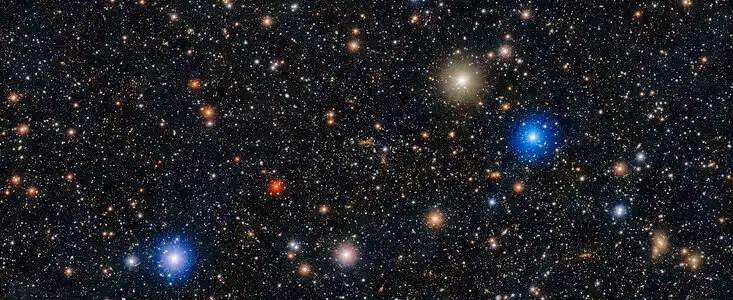 A stunning view of deep space captured by the Dark Energy Camera (DECam). Credit: NOIRLab
Mismatch in Matter Distribution
The findings support the Lambda Cold Dark Matter (ΛCDM) model, which assumes dark energy stays constant over time, and the wCDM model, which allows for some evolution. In both cases, the DES results aligned with predictions about how the universe expands.
But when it came to how matter clusters in the current universe, the data told a different story. The degree of clustering observed didn’t match what either model forecasted. This mismatch has become more pronounced with the latest data, hinting at a possible tension between theory and observation.
“This was something I would have only dared to dream about when DES started collecting data,” said Yuanyuan Zhang, a DES researcher at NOIRLab, in a statement “And, now the dream has come true.”
Despite the models’ broad consistency with the data, the matter clustering discrepancy remains unresolved and may point to new physics or gaps in current models.
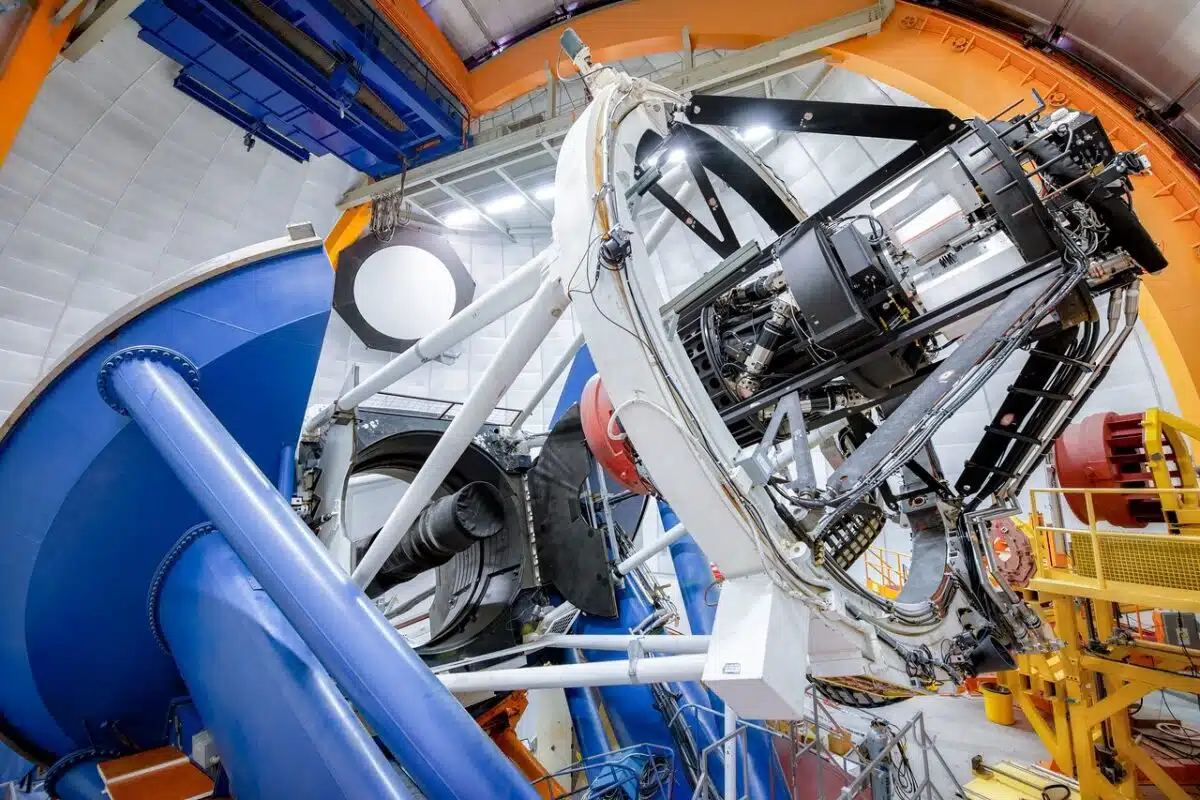 The Víctor M. Blanco Telescope, home to the Dark Energy Camera used to map the universe. Credit: Noirlab
Rubin’s Turn to Map the Dark
The DES effort is set to merge with observations from the Vera C. Rubin Observatory, which will conduct the Legacy Survey of Space and Time (LSST) over the next decade. This new survey aims to map 20 billion galaxies, far exceeding DES in scale. As stated by Chris Davis, National Science Foundation Program Director:
“Rubin’s unprecedented survey of the southern sky will enable new tests of gravity and shed light on dark energy.”
The combination of datasets from DES and Rubin is expected to offer clearer answers to the questions that current models leave open.