
Support Frock Flicks with a small donation! During Snark Week and beyond, we’re grateful for your monthly pledges for exclusive content via Patreon or your one-time contributions via Ko-fi or PayPal to offset the costs of running this site. You can even buy our T-shirts and merch. Think of this like supporting public media, but with swearing and no tax deductions!
Late 20th-century men seem to be rather insecure about wearing tights (and shoes) — at least Hollywood and all the other forces that make historical costume dramas must think so.
Because if you look at frock flicks before the 1970s, if it’s set in a historical era, like the 16th century, when men wore breeches, tights, and shoes, the male actors would often wear a reasonable facsimile of that onscreen.
 If Paris Were Told to Us (1956) – Set in the 1530s. Photo by Keystone-France/Gamma-Keystone via Getty Images.
 Young Bess (1953) – Set in the 1540s.
 Diane (1956) – Set in the 1540s.
 La Princesse de Cleves (1961) – Set in the 1550s.
Now this movie with Errol Flynn has it both ways, but it makes sense — Essex bursts into court unannounced, riding straight from battle through London, still wearing boots.
 The Private Lives of Elizabeth and Essex (1939) – Set in the 1590s.
Later, when he’s just hanging around court, he wears proper shoes.
 The Private Lives of Elizabeth and Essex (1939) – Set in the 1590s.
Then there’s the last gasp of tights and shoes with the ol’ BBC…
 Elizabeth R (1971) – Set in the 1590s.
But sometime in the 1970s or ’80s, film and TV productions decided that manly men in tights was a joke, and Real Men(tm) wouldn’t show leg unless it was encased in leather, particularly tall leather boots (although contractually obligated leather pants were another option!).

Nowadays, breeches, tights, and shoes have been relegated to male characters who are considered effeminate (aka gay) or old or very young, weak (physically, mentally, or in status/power), or are being made fun of / the butt of jokes.
If I had time, I’d love to write a scholarly article about what this all means with regard to images of masculinity and society in the late 20th century, but I have a day job and this is Snark Week, so I’m just going to give the basics and point out how silly it all is. Because, my dudes, in the 16th century, a guy who showed off his well-turned calf was considered super macho and incredibly sexy, and the best way flaunt it was with tights and shoes! Tall boots cover up all that hot stuff.
More practically speaking, tall boots were worn for specific tasks, like riding, hunting, fighting, etc. — the kind of activities where a man needed to protect his legs from the elements. Otherwise, he’d wear shoes or maybe low boots. The higher status and wealth of the man in the 16th century, the more he’d wear fancy shoes made of highly decorated leather and show off his fine silk or wool stockings.
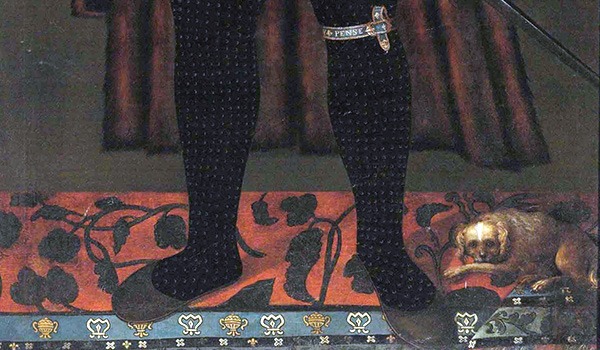
 1540-47 – Detail from portrait of Henry VIII by Hans Holbein the Younger via Wikimedia Commons.
Compare the detail of Holbein’s portrait with this closeup from the Field of the Cloth of Gold. The event happened in 1520 and was a meeting between King Henry VIII of England and King Francis I of France. Henry is on horseback in gold, wearing boots. But not all the other riders are wearing boots — Thomas Grey is carrying the Sword of State in front of the king, but he wears shoes. All the soldiers walking around the riders are wearing shoes.
 c. 1545 – Detail from The Field of the Cloth of Gold by the British school, at the UK Royal Collection.
Going down further the social ladder, these peasants plowing the field have simple shoes, and one has bare legs.
 c. 1524 – Leaf from Book of Hours by Master Jean de Mauléon, Walters Art Museum.
Heading back up the social classes, this fine fellow has a resplendent red outfit with matching tights and shoes.
 1530-50 – Portrait of a Man in Red, German or Netherlandish school, in the UK Royal Collection, via Wikimedia Commons.
This woodcut of the queen hunting and picnicking out in the woods shows her gentlemen well-dressed in their full breeches, stockings with tied garters, and slashed shoes.
 1575 – The Noble Art of Hunting at the British Library.
High-status men might be shown riding with or without boots:
 c. 1580s-90s – Equestrian portrait of Henri IV of France, at the Condé Museum.
A military man didn’t have to wear boots either:
 c. 1593 – Robert Radcliffe, Earl of Sussex, probably by Marcus Gheeraerts the Younger, at the Royal Armouries.
Fellas could just hang around in their fabulous outfits, featuring tights and shoes.
 c. 1560s-70s – The Three Coligny Brothers by Marc du Val, via Wikimedia Commons.
 c. 1598. The Browne Brothers, by Isaac Oliver. © Burghley House Collection, Lincolnshire, UK.
The point is that men wearing boots was not as common as frock flicks would have you think! It’s just a recent cliché to look butch or whatever.
Tights and Shoes as Costume Clichés
When movies and TV shows do show 16th-century men wearing tights and shoes, the characters tend to fall into a few derogatory categories, in spite of the garments being historically accurate and fashionable.
Old Men
Only when Henry VIII is aging, fat, and less mobile than his formerly spry self, then frock flicks give him shoes. The otherwise excellent Wolf Hall fell into this trap.
 Wolf Hall: The Mirror and the Light (2024)
Firebrand was all about how old and decrepit Henry was by this point, so of course he’s wearing shoes, not boots.
 Firebrand (2023)
And while Jonathan Rhys Meyers rocked boots through most of the series (scroll down!), at the final episodes where Henry’s near death, he gets shoes.
 The Tudors (2007-10)
A slight variation is where movies show the supposed-to-be hot young lead character in boots, surrounded by older supporting characters all wearing shoes.
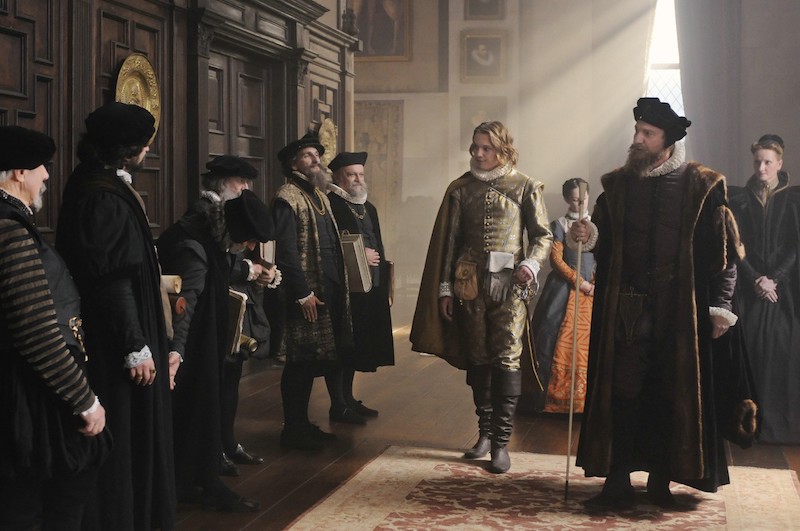 Anonymous (2011)
Little Boys
Dumpy old men wear tights and shoes, and so do useless little boys. You think they’re in positions of power? Hah, not with that footwear.
 Becoming Elizabeth (2022)
He’s not the heir yet, just a spare, and a particularly dweeby kid at that.
 The Serpent Queen (2022)
Weak Men
All of these characters are weak in some way, through age or status. In Wolf Hall, Richard Rich wears boots to prosecute Thomas More, who, as the victim, wears shoes.
 Wolf Hall (2015)
Young dweeby Henry grows up to be just as dweeby as King of France, where he’s under the thumb of his mistress Diane de Poitiers — he’s wearing her colors (albeit, in zebra stripe) at his own coronation.
 The Serpent Queen (2022)
Men as Jokes
If historically accurate fashion isn’t making a man look weak, it’s making him look funny, according to modern movies and TV. Perhaps no show makes this more clear than Blackadder II, where the important, imperious lead character wears high leather boots:
 Blackadder II (1986)
And the completely silly supporting character, who’s always the butt of the joke, he wears tights, garters, and shoes:
 Blackadder II (1986)
That makes for a clear joke, and I love the series, but I can still point out how it’s not accurate fashion! As someone who spends most of his life hanging around court begging for the queen’s attention, Lord Edmund Blackadder has no historical reason to wear those boots.
All the 16th-Century Bad Boys in Boots
OK, those are the tropes that modern frock flicks use to judge men wearing tights and shoes in the 16th century. When men are supposed to look cool, sexy, powerful, and manly according to modern flicks, they get tall boots! Historical accuracy be damned, we can’t wear shoes.
 The Tudors (2007-10)
Henry VIII in The Tudors is more committed to boots than to his wives. He wears them for Anne Boleyn‘s coronation:
 The Tudors (2007-10)
His wedding to Jane Seymour:
 The Tudors (2007-10)
And his wedding to Catherine Parr:
 The Tudors (2007-10)
High and low status gents wear boots in Wolf Hall — from Henry and his courtiers for dancing:
 Wolf Hall (2015)
To the unfortunate musician Mark Smeaton:
 Wolf Hall (2015)
In the sequel, Henry starts off wearing boots, before his health goes downhill.
 Wolf Hall: The Mirror and the Light (2024)
Costume designer Joanna Eatwell told Tatler in an interview:
“I always try and use the boots, because I think it’s more masculine, and in Henry’s court men were stamping around getting on and off horses. I don’t see it as a slip-on shoe time.”
Oh not you too! After all the gorgeous historical work she’s done, even Eatwell falls into the trap.
I kind of expect it in a flick with whacked-out costumes like The King’s Favorite — where, in her review, Kendra asked, “are those vinyl pants under over-the-knee boots? Or just parti-colored leather/vinyl pants?” I can’t tell either, but I know they aren’t what they should be.
 The King’s Favorite aka Diane de Poitiers (2022)
It’s hard not to call out this guy for so many costume offenses, but if you can look past the open shirt, look down and you’ll see his big ol’ boots.
 The Virgin Queen (2005)
At least two out of three of the queen’s men here are wearing boots, including Robert Dudley.
 Mary Queen of Scots (2018)
These dudes just stepped out of court to yell at each other. Unless there’s a scene on the cutting room floor where they changed shoes, I don’t get it.
 The Princess of Montpensier (2010)
Sir Walter Raleigh wasn’t the privateer (aka pirate) like Drake — in fact, Raleigh was landed gentry with court connections even before his military exploits. So he’d know better than to wear boots during a private audience with the queen. But I guess this is supposed to be sexy, right?
 Elizabeth: The Golden Age (2007)
King Philip ll of Spain would really know better, especially at court with the Infanta.
 Elizabeth: The Golden Age (2007)
I’d like to make excuses for this guy because he’s a time-traveler:
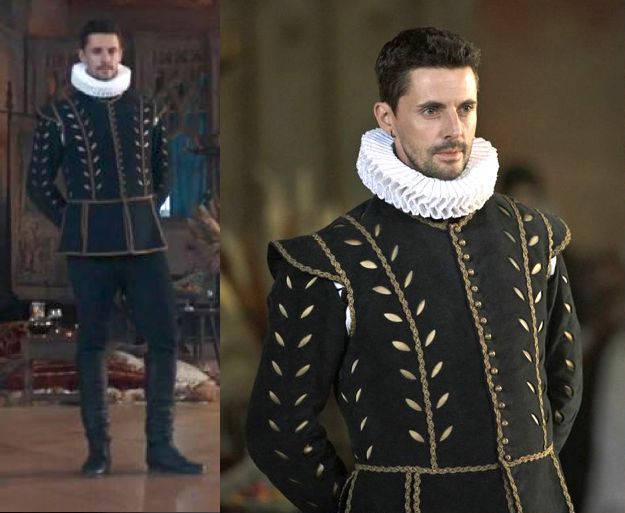 A Discovery of Witches (2021)
But I don’t think any of the men in that show, like Christopher Marlowe here, have correct shoes either.
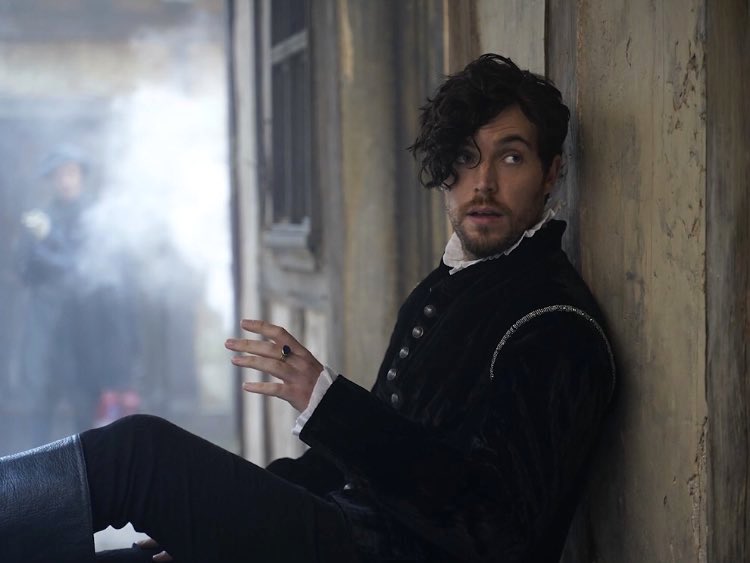 A Discovery of Witches (2021)
What About Later Men in Boots?
While the 16th century is my focus (and my favorite), this fashion issue extended over the next couple centuries until men’s trousers were regularly worn past the knee. Movies and TV shows set in the 18th century often fall prey to the “tights are not manly / boots are butch” tropes, so you get mishmashes like this:
 Brotherhood of the Wolf aka Le Pacte des Loups (2001)
Yes, there are horse-riding scenes in Brotherhood, but no, this is not one of them. The white silk coat with gold braid trim is a hint.
Likewise, in The Great, Peter isn’t riding a horse, nor are his pals. But they wear some kind of stretchy pants tucked into tall boots, even though this is an era when knee breeches were standard-issue for upper-class men at European courts. Only the servant has correct breeches, tights, and shoes for the 1760s
 The Great (2020-23)
And holy fuck this guy is a wreck. Get your filthy boots off the settee, loser!
 Lady J (2018)
Lastly, a fashionable rake like Lestat de Lioncourt who wears an embroidered court coat and waistcoat would also wear the matching breeches with tights and shoes. Like this:
 1774-93 – French court suit, at the Met Museum.
Not whatever stupid pants and tall boots Tom Cruise has here:
 Interview With the Vampire (1994)
Around 1800, men started wearing long pants more commonly, so tights and shoes were no longer fashionable and became a relic worn for extremely formal court functions and sometimes by servants in livery. That perception of old-fashioned / formal somehow skipped the golden age of Hollywood costume designers, yet it lives on today to annoy me.
Do you prefer men in tights and shoes or are you OK with boots?
Like this:
Like Loading…
More Frock Flicks
Post navigation