
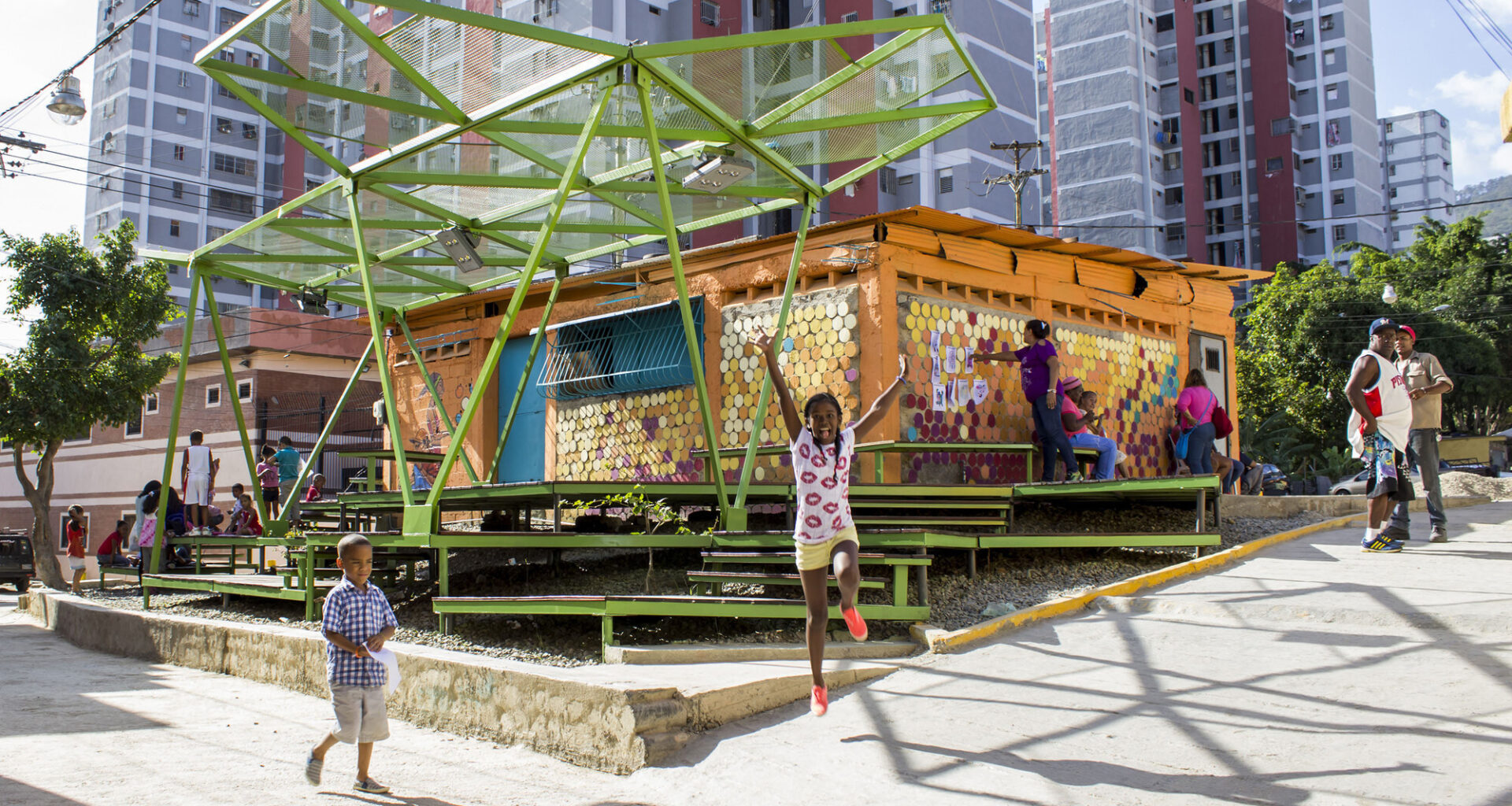
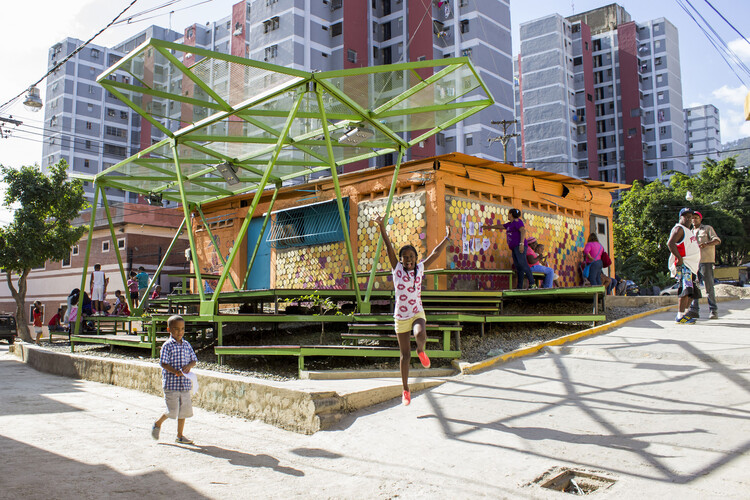
 How the “Espacios de Paz” project is transforming community spaces in Venezuela. Pinto Salinas — Oficina Lúdica + PKMN. Image Courtesy of PICO Estudio.
Share
Or
https://www.archdaily.com/1037901/from-the-courtyard-to-the-neighborhood-latin-american-lessons-on-collective-placemaking
In Latin America, encounters do not necessarily arise from grand architectural gestures or monumental urban plans. They emerge from the in-between, from intermediate spaces: the courtyard, the veranda, the sidewalk, the shared corridor. These areas, often considered residual or informal by the traditional architectural discipline, are precisely where everyday life builds bonds.
From this Latin American culture comes a spatial logic in which daily life is organized in a relational and expansive way. Practices such as sitting at the front door, occupying the sidewalk, and playing in the street produce a lived city that extends beyond the formal limits of design.
More than the result of infrastructural shortcomings, the occupation of these intermediate spaces expresses a culture that values encounter and improvisation. The Latin American city is thus built less as a finished object and more as a cultural process in constant transformation, where everyday use continually redefines the meaning of space.
Related Article “The Citizen Urbanism Claims an Alternative Urban Model From Latin America”: Ocupa Tu Calle’s Lucia Nogales
From this perspective, the collective construction of place is not limited to the design of form or the definition of programmed uses, but involves creating conditions for relationships to happen spontaneously. An experience of collectivity that reveals that space only gains meaning when it is appropriated, cared for, and socially negotiated.
The Courtyard as a Social Device
Within the architectural repertoire, spaces of encounter take shape in different atmospheres, and one of them is the courtyard. As an opposite to the “full,” the courtyard’s void represents the freedom of unprogrammed appropriation. In the Latin American climate, which often favors outdoor activity, the courtyard mediates the transition between the intimate and the collective, sheltering throughout the day children at play, adults in conversation, moments of rest, and celebrations.
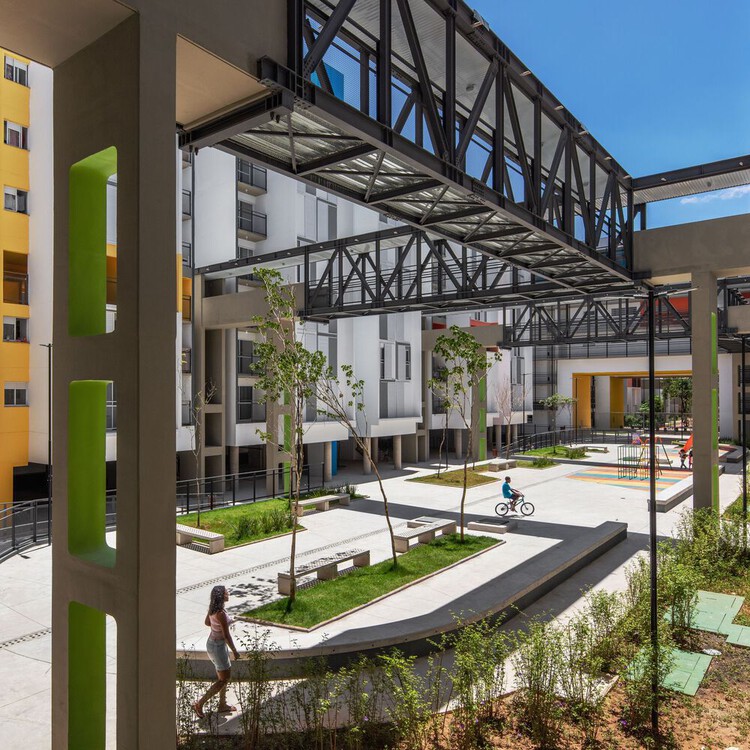 Conjunto Habitacional Heliópolis Gleba G – Fase 2 / Biselli Katchborian Arquitetos Associados © Nelson Kon
This multiplicity of uses reveals an architecture that is not organized by rigid programs, but one that accepts—and even encourages—the overlap of life. Authors such as Herman Hertzberger have long argued that “incomplete” or ambiguous spaces are those that best accommodate everyday appropriation, precisely because they do not determine in absolute terms how they should be used.
Far from being a contemporary typology, the courtyard has been present in Latin American culture since the earliest Indigenous settlements. In many original communities, the organization of the village is structured around a collective central space—a clearing, a yard, or a patio—that articulates dwellings and concentrates rituals, assemblies, and festivities. This space is neither residual nor secondary; it is the heart of the village’s social, political, and symbolic life.
Present in contemporary architecture as well, the courtyard—as in the Heliópolis Housing Complex by Biselli Katchborian Arquitetos in São Paulo—demonstrates its capacity to structure everyday life beyond residential function. Inserted into a dense and consolidated urban fabric, the complex is organized around courtyards and indeterminate voids that expand the possibilities for informal coexistence, strengthening social bonds and the collective recognition of place.
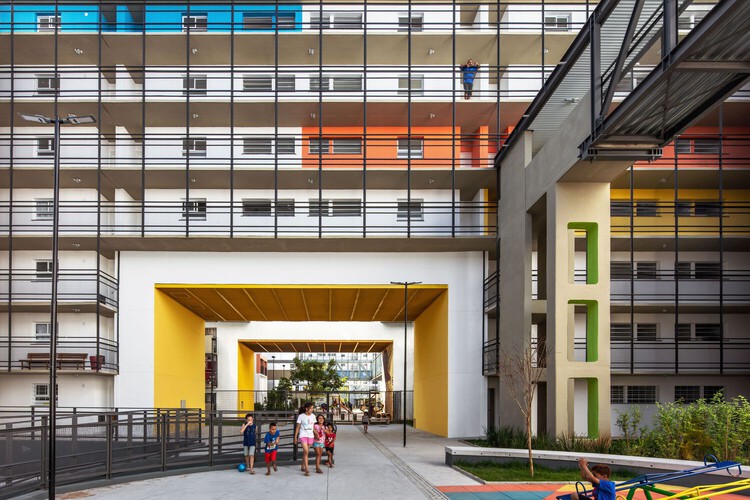 Conjunto Habitacional Heliópolis Gleba G – Fase 2 / Biselli Katchborian Arquitetos Associados © Nelson KonFrom the Domestic to the Urban
Devices of belonging and encounter, however, do not stop at the limits of the building. They expand and transform into shared backyards, common corridors, and improvised squares. The Latin American neighborhood often operates as an extension of architecture itself, dissolving rigid boundaries between private and public.
In this context, community facilities take on a central role as mediators between institutional space and everyday use. Colombia’s library-parks exemplify this condition. Projects such as the León de Greiff Library Park by Giancarlo Mazzanti and the Remedios Educational Park by Relieve Arquitectura function less as isolated buildings and more as social infrastructures embedded in the logic of the neighborhood.
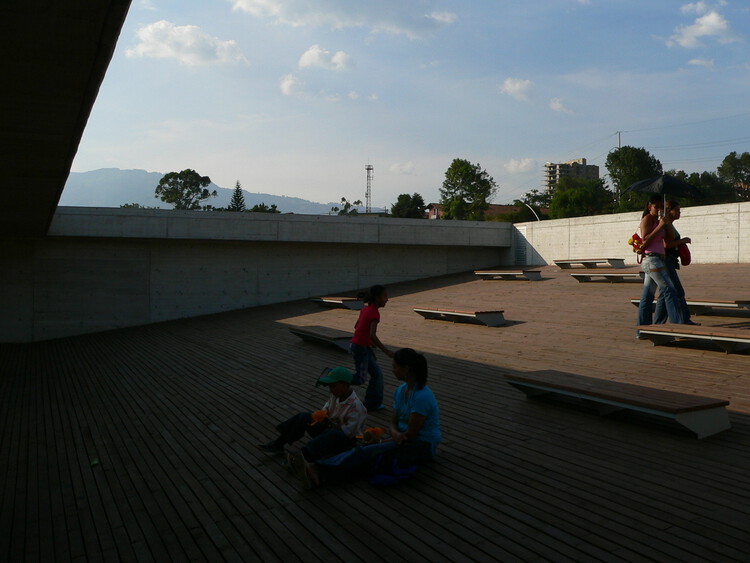 Parque Biblioteca León de Greiff / Giancarlo Mazzanti © Sergio Gómez
In these projects, architecture does not close in on itself. Courtyards, platforms, plazas, stairways, and voids articulate with the street and extend public space into the building, while returning cultural programs to the daily life of the surroundings. This approach resonates with Raquel Rolnik’s critique of the excessive commodification and regulation of urban space and her defense of the right to the city as the right to appropriation, use, and permanence. By inserting themselves into popular territories and dialoguing with existing dynamics, these Colombian cultural facilities not only provide access to culture but also reinforce local social networks and expand possibilities for collective life.
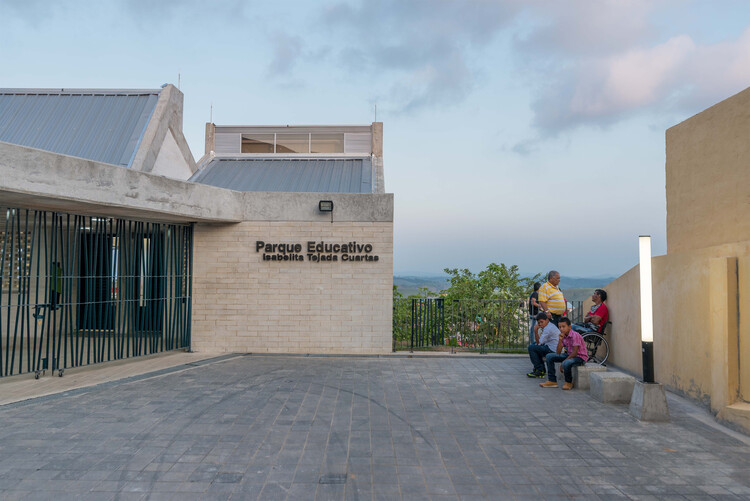 Parque Educativo de Remedios / Relieve Arquitectura © Isaac RamírezThe Common as Practice, Not Form
Beyond architectural examples themselves, the collective construction of space in Latin America is deeply anchored in subjective foundations. “Building a place” here is an open process. It is not about achieving an ideal configuration, but about sustaining spatial, social, and political conditions so that space can be continually reinterpreted by its users. This openness implies accepting conflict, overlapping uses, and transformation over time as constitutive parts of common space—not as failures, but as its very reason for being.
In everyday Latin American life, this logic appears in initiatives such as Venezuela’s Espacios de Paz, where, through community participation, vacant lots and unregulated dumping areas are transformed into places of coexistence, generating new social dynamics. It is a practice that dialogues with collaborative and citizen-led urbanism, in which common space is not only designed but also built and maintained collectively.
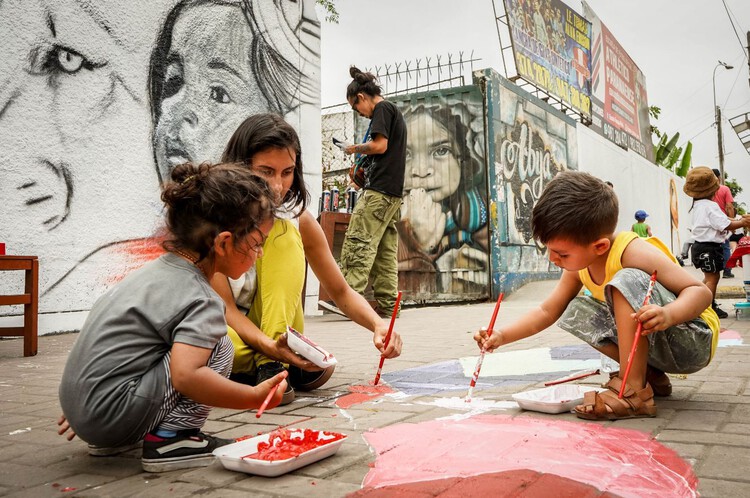 Ocupa Tu Barrio – Paseo de la fama Inka. Imagem © Arturo Diaz QuirozInformality as Spatial Intelligence
A large portion of Latin American urban settlements are labeled as “informal.” Yet what is often described as informality reveals, in practice, a sophisticated spatial intelligence. Far from representing a lack of order, informality expresses negotiation, adaptation, and inclusion, operating through everyday use and shared experience. In Latin America, these processes show how urban space is produced collectively, in direct response to the needs of life in common.
This reading finds a key reference in Paola Berenstein Jacques’s book A Estética da Ginga, in which she proposes understanding the informal city through lived urban experience. Ginga is not a style, but an embodied spatial logic: a way of continuously adjusting space, where everyday life becomes an instrument of urban production.
By shifting the focus from finished form to process, Jacques repositions informality as a field of learning—one capable of continuous adaptation, overlapping uses, and the collective invention of provisional solutions. An example is the Fog Water Collection System built collaboratively by a local community and architects in Colombia, where a simple infrastructure responds directly to environmental conditions and everyday needs. More than a technical object, the system reveals how collective making and informed improvisation can improve space and quality of life.
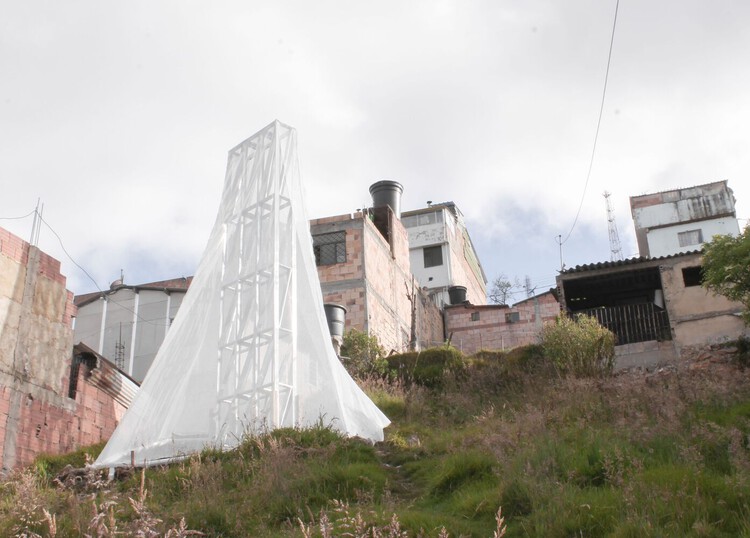 Fog Water Collection System / Alsar Atelier + Oscar Zamora + César Salomón + SCA © Alejandro SaldarriagaLessons for Global Cities
Even acknowledging that many of these strategies emerge in contexts marked by structural deficiencies and the absence of the state, the core lesson lies in recognizing the value of openness, incompleteness, and continuous adaptation as spatial qualities. Whether in courtyards that host overlapping uses, architectures that extend into the neighborhood, community practices that build the common, or informal solutions that respond directly to everyday life, a less normative and more relational conception of the city emerges. Here, space does not precede use—it is built with it.
In this sense, Latin American lessons point toward a way of designing that moves away from formal imposition and toward support. These are architectures and cities that sustain possibilities. From the courtyard to the neighborhood, from the domestic to the urban, an ethical spatial stance is revealed—one in which everyday life is not secondary, but the very foundation of how space is made.
This article is part of the ArchDaily Topic: Coming Together and the Making of Place. Every month we explore a topic in-depth through articles, interviews, news, and architecture projects. We invite you to learn more about our ArchDaily Topics. And, as always, at ArchDaily we welcome the contributions of our readers; if you want to submit an article or project, contact us.