
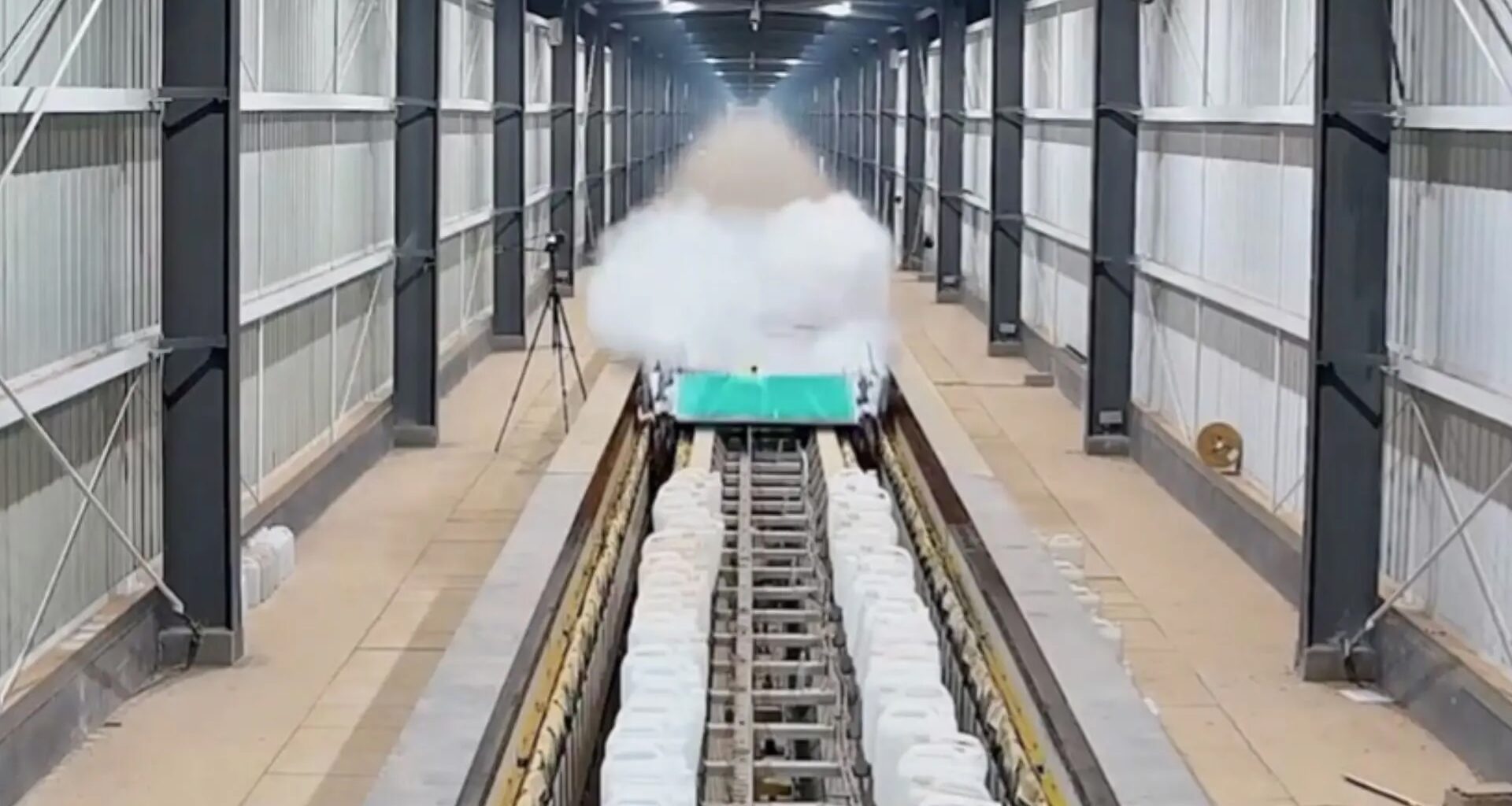
In 2023, China’s ‘electromagnetic sledge’ system became the first large-scale electromagnetic launcher to break the sound barrier. During initial test runs, it accelerated test vehicles weighing one ton at speeds faster than Mach 1.
With the system now operating in the eastern Chinese city of Jinan for over two years, scientists have provided new insight into the technologies making it possible, a report from the South China Morning Post (SCMP) reveals.
The sonic boom barrier
With the new electromagnetic rail system, engineers overcame a persistent barrier to reliable supersonic performance. Namely, the sonic boom China’s electromagnetic sledge generates at ground level is powerful enough to destroy traditional sensors, the SCMP report states. At supersonic speeds, this is incredibly problematic. Even a tiny miscalculation due to missing data could mean disaster.
“When linear induction motors operate at supersonic speeds—around 340 metres (1,120 feet) per second—at altitudes below 100 metres and temperatures below 30 degrees Celsius (86 Fahrenheit), unsteady aerodynamic forces caused by shock waves can create severe disturbances to the mover,” the scientists wrote in their paper. “This disruption can interfere with speed and position sensing devices, ultimately causing failures in motor speed control.”
Now, in a new paper published in the Transactions of China Electrotechnical Society, researchers led by Xu Fei from the Chinese Academy of Sciences’ Institute of Electrical Engineering described a new sensorless speed estimation method for supersonic electromagnetic launch systems. According to the team, this sensorless approach makes safe operation of the electromagnetic sledge possible.
Achieving reliable supersonic electromagnetic launches
While nations like the United States and the former Soviet Union spent decades attempting to overcome the challenge of reliable supersonic electromagnetic launches, their efforts ultimately fell short.
For context, the electromagnetic aircraft launch system (EMALS) deployed on US Navy carriers like the USS Gerald R. Ford propels aircraft to roughly 78 meters per second—far below supersonic thresholds. Conventional approaches to improving speed focused on installing additional hardware, such as external sensors. However, these components proved too vulnerable to the extreme conditions, including intense shock waves and aerodynamic disturbances at low altitudes.
The Chinese team pursued an alternative strategy. Rather than relying on fragile external devices, they engineered a sensorless technique that effectively allows the sledge system to derive speed information directly from subtle variations in the electrical signals of its own segmented power coils.
As the sledge accelerates along the track, it sequentially energizes adjacent electromagnetic coils. Impressively, the researchers found that minute, transient voltage fluctuations in these segments encode precise velocity data. They developed an algorithm that fuses readings from multiple neighboring coils, filters out shock-induced noise and distortions, and performs real-time self-calibration.
The method generates two independent speed estimates from different electrical perspectives, then intelligently weights and combines them for optimal accuracy. In real-world tests, the scientists achieved speed tracking within 1.1% error at velocities up to 370 m/s—sufficient for stable supersonic control.
Besides the world-first maglev sledge system, the Jinan facility, operated by the Chinese Academy of Sciences’ Institute of Electrical Engineering, also supports advances in hypersonic flight, next-generation aerospace materials, and innovative space launch systems.