
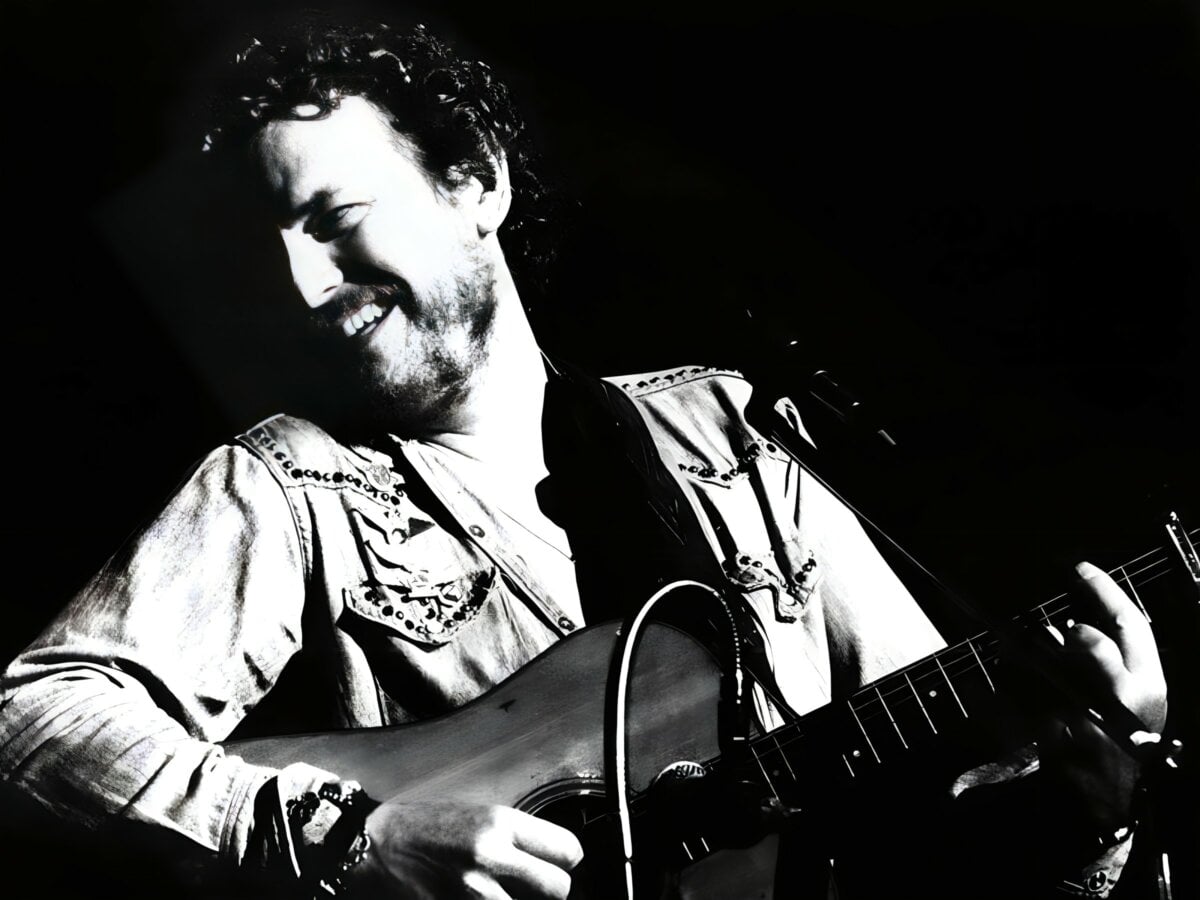
(Credit: Alamy)
Tue 27 January 2026 17:09, UK
Were it not for a highly publicised involuntary manslaughter charge following the death of John Belushi, Cathy Smith might be best remembered by the Gordon Lightfoot hit ‘Sundown’. Smith, a backing singer and occasional drug dealer, provided Lightfoot with ample inspiration for the track throughout their tumultuous relationship, and one of his biggest hits was informed by their rocky relationship.
Smith was well-known in rock circles for providing Levon Helm, Rick Danko and Richard Manuel, soon-to-be members of The Band, with backing vocals in the early 1970s. Around the same time, she and Lightfoot got involved, becoming both his mistress and muse. But in 1974, Lightfoot lifted the lid on the reality of their relationship in the bluesy ‘Sundown’.
What turned out to be one of Lightfoot’s most lucrative songs was also the darkest, touching on an almost obsessive jealousy he felt during their three-year relationship. Despite being married to another woman at the time, Lightfoot once fired his opening band, The Good Brothers, for flirting with her, admitting he was “sometimes crazy with jealousy” throughout their time together.
In 1975, he explained the paranoia he experienced informed a lot of the ‘Sundown’ lyrics. “All it is, is a thought about a situation where someone is wondering what his loved one is doing at the moment,” he said. “He doesn’t quite know where she is. He’s not ready to give up on her, either, and that’s about all I got to say about that.”
He bottled those emotions in the lyrics: “I can picture every move that a man could make / Getting lost in her lovin’ is your first mistake / Sundown, you’d better take care / If I find you’ve been creepin’ ’round my back stairs.” He gradually revealed more details about its writing over the years, making the admission in 2008 that it was written while his then-girlfriend was at a bar with his friends.
He’d spent a week sat at his desk on a songwriting roll, but his mind kept drifting to her being at the bar. “I was hoping that no one else would get their hands on her, because she was pretty good-looking,” he said. “That’s how I wrote the song ‘Sundown’. And as a matter of fact, it was written just around sundown, just as the sun was setting, behind the farm I had rented to use as a place to write the album.”
Although Smith’s involvement in John Belushi’s death eclipsed the controversy of their relationship, Lightfoot’s stark retelling of it remains one of his most emotionally frank offerings. He summed it up best by describing it as a “back-alley kind of tune”, never shying away from his own role in the affair. “It’s based on infidelity,” he admitted. “I’ve seen both sides of that.”
What gives ‘Sundown’ its lasting power is not just its candour, but its restraint. Lightfoot never names names, never offers excuses, and never attempts to soften the edges of his jealousy. Instead, he allows the unease to sit unresolved, letting the listener inhabit the same anxious headspace that produced the song. It is confessional without being indulgent, a portrait of obsession rendered with the quiet discipline that defined Lightfoot’s songwriting at its best.
In that sense, ‘Sundown’ stands as a reminder that some of the most enduring songs come from moral grey areas rather than clean narratives. Lightfoot does not present himself as a victim or a hero, only as a man caught in the contradictions of desire, guilt, and possession. Long after the surrounding scandals have faded into footnotes, the song remains, its tension intact, still flickering like the dying light it was written under.
Related Topics