
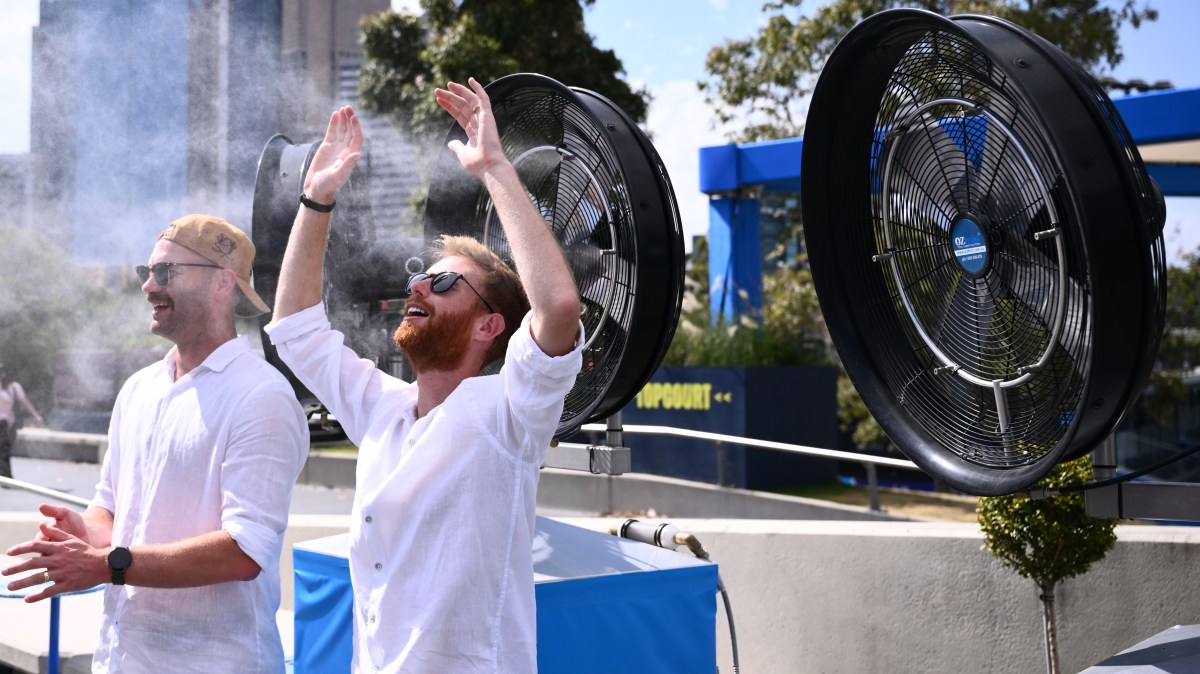
Melbourne Park became a ghost town on Tuesday as scorching 43C heat meant tens of thousands of tennis fans stayed at home while bushfires ravaged rural areas in the state of Victoria.
Having hosted on average 95,592 visitors per day this year — including four days on which more than 100,000 people came through the gates — only 43,750 attended the first day of quarter-final action at the Australian Open.
Singles matches began at 11.43am with temperatures at 33C before it climbed to 42.7C at 4pm and remained as high as 39C until 9pm. Rod Laver Arena, where the four men’s and women’s last-eight matches were played, was at full capacity, but the rest of the grounds, usually home to live music, games and vibrant bars, were deserted. With temperatures set to drop to 24C, the A$39 (about £20) grounds pass ticket is likely to prove popular once again on Wednesday.
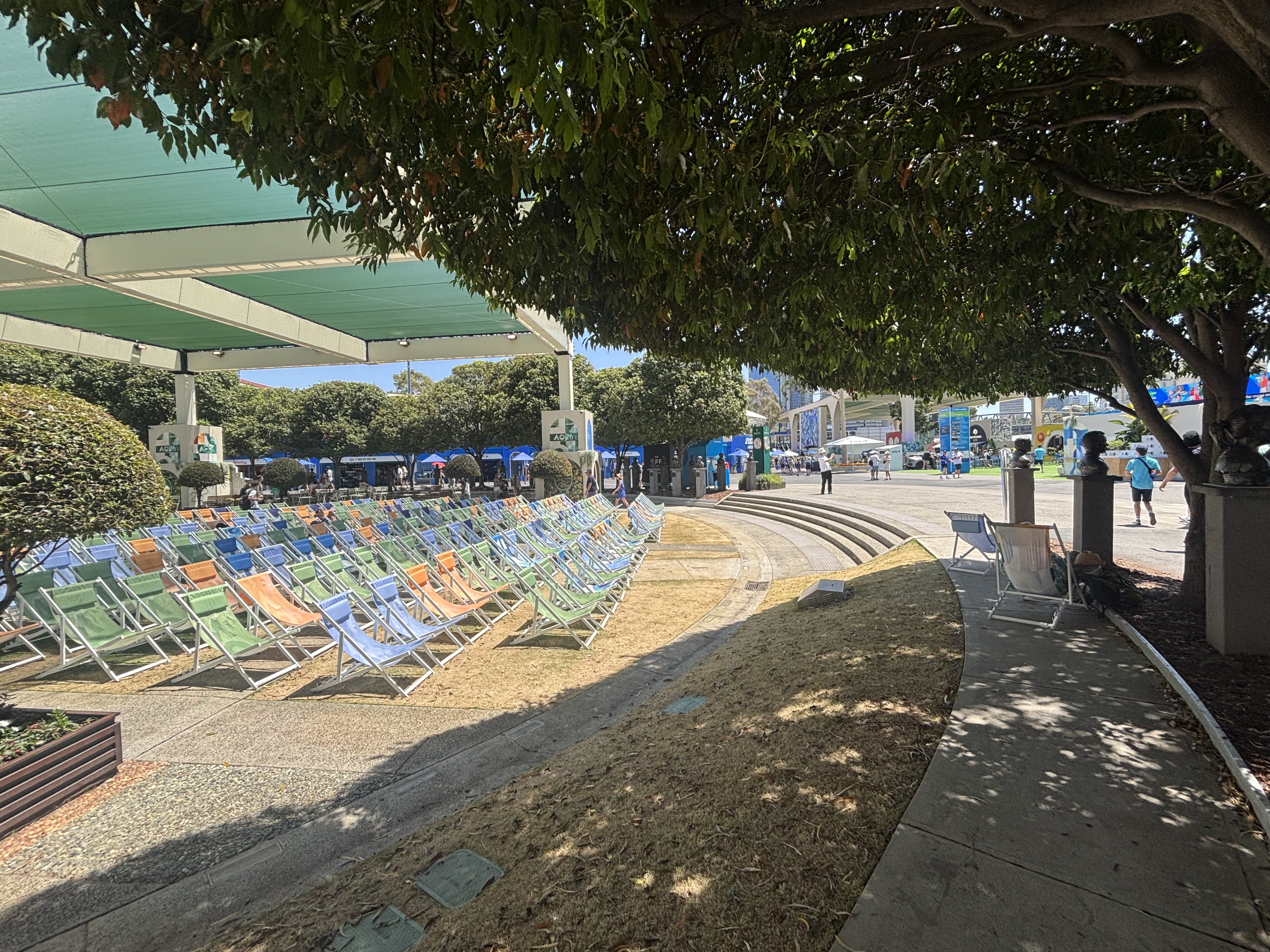
Melbourne Park was eerily quiet as fans stayed home to keep out of the sun
WILLIS BENNETT
Areas in the northwest of the state reached 48.9C — the highest temperature on record — and out-of-control bushfires destroyed properties in the Otways, 100 miles west of Melbourne.
“It is 1pm and I have served two or three people, I have sold about ten Lemon Aces,” said a member of bar staff named Vishesh. “Whenever it is too hot, people are not willing to come outside. Locals are not willing to come out. No one wants to faint, get skin burn.” A smoke-haze warning was given in the evening and the UV index peaked at 12, which is “extreme”.
Despite the world No6 and home favourite Alex de Minaur facing Carlos Alcaraz, it was the Australian Open’s Extreme Heat Protocols that were dominating conversation. The Heat Stress Scale, which was implemented in 2019 to ensure fair and consistent playing conditions, ranges from one to five, with cooling interventions in place at each threshold. Four climate factors — air temperature, radiant heat, humidity and wind speed — are measured from a variety of locations at Melbourne Park.
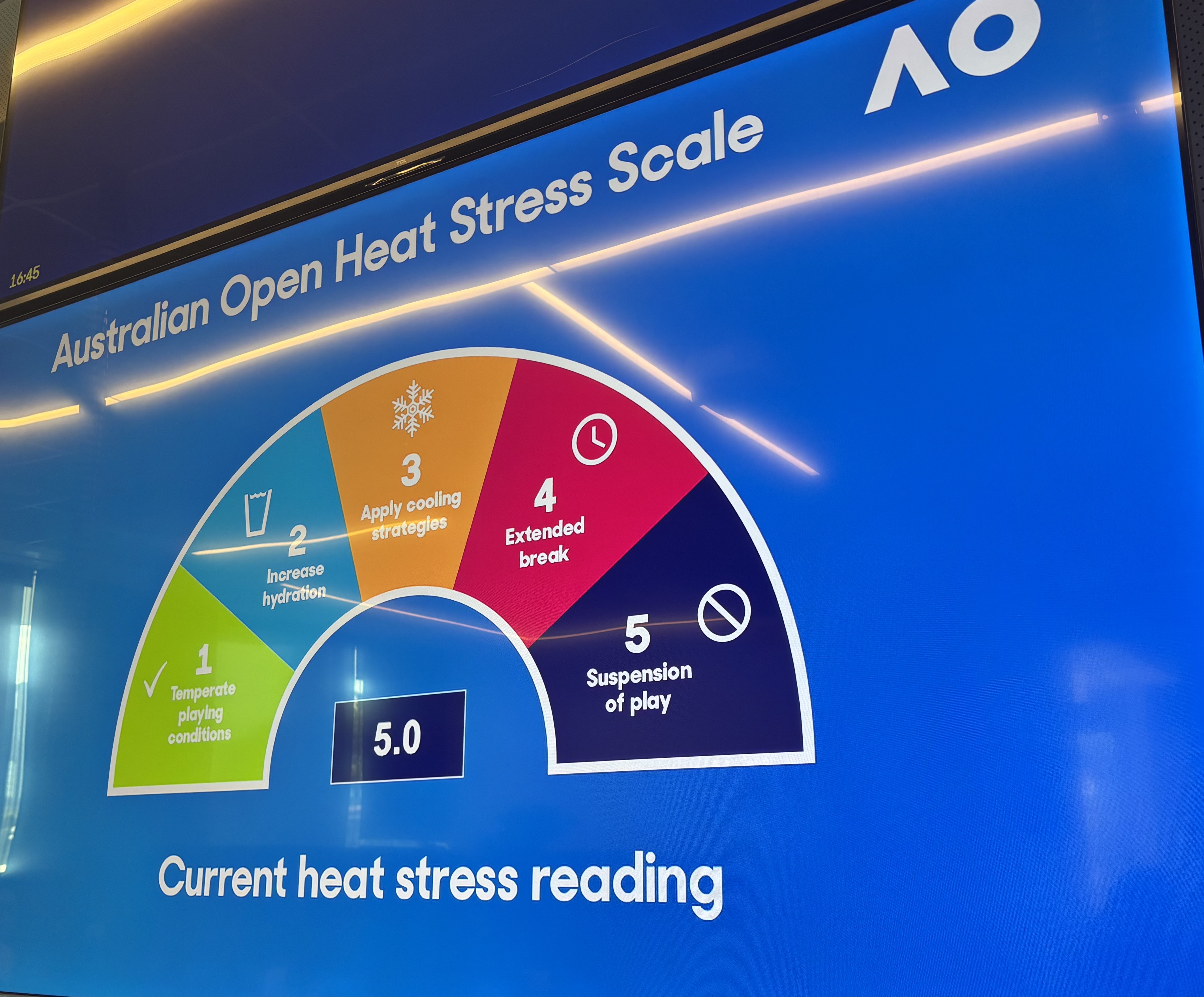
The heat stress scale reached level five in the early afternoon
WILLIS BENNETT
Level five was first reached at 1.30pm, resulting in a suspension in play on all courts. Action resumed on Rod Laver Arena and Margaret Court Arena once the roofs had closed. Play did not resume on any outside courts until 7.30pm, when temperatures dropped below 40C. By contrast, at Wimbledon, a ten-minute break is permitted when the temperature reaches 30.1C
When Aryna Sabalenka and Iva Jovic began the day’s quarter-final schedule, the scale read 2.5. When they had finished, 89 minutes later, it was 40.6C and, with the scale at 4.6, the suspension of play was imminent. Alexander Zverev’s victory against Learner Tien began under the roof on Rod Laver Arena.
The five levels of the Heat Stress Scale1. Temperate playing conditions2. Increase hydration (reached at 10.30am)3. Apply cooling strategies (12.14pm)4. A ten-minute break for players; they can stay on court or use a designated cooling room or shower (12.50pm)5. Suspension of play; show court roofs are closed (1.30pm)
Australian Open organisers confirmed the previous day that temperature-forced changes would be in place. The gates opened early at 9am, while action on Margaret Court Arena was opened to grounds pass holders. The Wheelchair Championships were postponed for 24 hours, while ballboys and girls had reduced rotations, increased recovery times and were given access to unlimited fruit, water and icy poles loaded with electrolytes.
John Cain Arena, one of the three show courts with a roof, became a rescue shelter; the second-largest stadium housed no tennis, but its air-conditioned concourse was sought after. At 2pm, Shake Shack — making its debut in Australia with two pop-ups — had a longer queue than Rod Laver Arena, and staff members were being briefed before a potential resumption late in the day.

Shake Shack makes hay while the sun shines as play was suspended in the afternoon
WILLIS BENNETT
“Take your time. Sit in the air-con. And tonight, be patient, take it slow. And remember the sunscreen,” the meeting’s leader said. Corienne, a member of staff born in Enfield, north London, but living in Brisbane, had been on John Cain Arena on Saturday too, when it was about 38C. “Saturday I was in the sun, helping with tickets. Today I’m here. It’s too cold to be honest, I didn’t bring my jacket,” she said.
Rob, a local lad, had the right idea: he was sitting in a deckchair in the shade with a refrigerated apple. “I’ve got the best spot in the grounds,” he said. Having clocked my accent he informed me: “I’ve done plenty of walking in the UK. I did the coast-to-coast hike; from Cumbria to Robin Hood’s Bay in Yorkshire. But sitting in this [pointing to the sun] is something different.”
Even the most popular fan-game on the grounds was empty. Rally Alley, where a punter is tasked with volleying tennis balls into odd-shaped holes to score points and win prizes, usually opens at 9am and has about 70 players per hour until the grounds close after 10pm. “The line every day has been ridiculous. But no line today,” Amelia said. “It’s empty. It’s kind of scary.”