
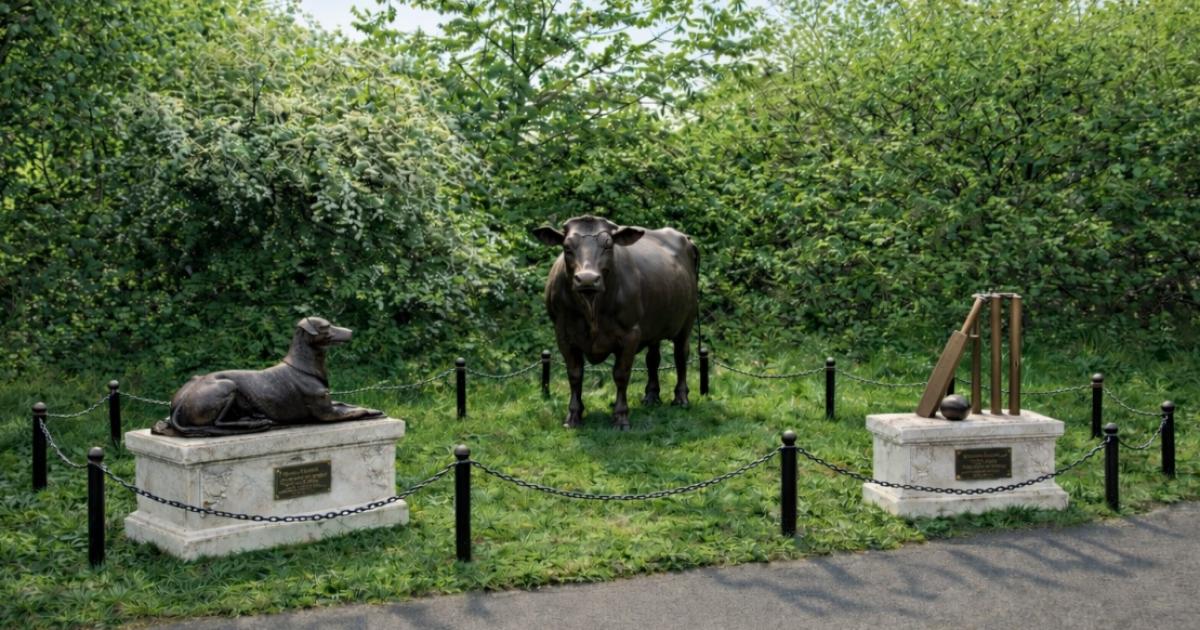
The installations, a cow, a cricket bat with stumps and a greyhound, will ‘greet’ visitors to the town as they are earmarked for land near a highway.
The application for the three distinctive pieces will be discussed by Bolton Council‘s planning bosses.
The three sculptures proposed are considered to have ‘local cultural relevance’.
The location of the sculpture within Westhoughton (Image: Bolton Council)
The sculptures will be located near the old greyhound track, on land ‘just South of Cricketer’s Way’.
Cllr David Wilkinson said: “Hopefully they’ll be there for some time for people.
“Greyhound racing can be a bit controversial nowadays, but the sculpture can be looked at as a memorial for the dogs not a glorification of dog racing.”
One sculpture will feature a seated greyhound, ‘cast in bronze and painted black’, mounted on a natural white marble plinth with an overall height and length of 1.2m and 1.5m respectively.
This sculpture is designed to commemorate the greyhounds that ran at the old Westhoughton dog track.
In recognition of the town’s cricketing history there will be a bronze sculpture of a cricket bat, stumps, and ball, mounted on a natural white marble plinth with an overall height and length of 1.5m and 1m respectively.
The largest sculpture is the cow sculpture, mounted directly on the ground and measuring 1.3m in height by 2.2m in length.
The cow is to be installed as a celebration of a Westhoughton folk legend, which states that a Westhoughton cow once got its head stuck in a five barred gate.
The farmer, deeming the gate more valuable than the cow, decided not to cut the cow out of the gate in the traditional way, but instead decapitated the cow – a legend Westhoughton shares with Tideswell in Derbyshire.
According to the planning document, this legend accounts for the nickname ‘Keawyeds’, meaning ‘cow heads’, which is traditionally applied to Westhoughton residents, as well as the designation of Westhoughton itself as ‘Keawyed city’.
Digital mock-ups of the proposed Westhoughton sculptures (Image: Bolton Council)
The sculptures are being created using ‘section 106’ money – money which developers promise to dedicate to public works and infrastructure as part of a deal they make with a local authority.
Section 106 money used to include a provision for public artworks, which is where the money for the new sculptures came from.
The developments which funded the works were the building of Sainsbury’s in 2010 and the development of Hewlett Way.
As the original agreement stipulated that these funds were to be used to the creation of public art, the council cannot use them for anything else.