

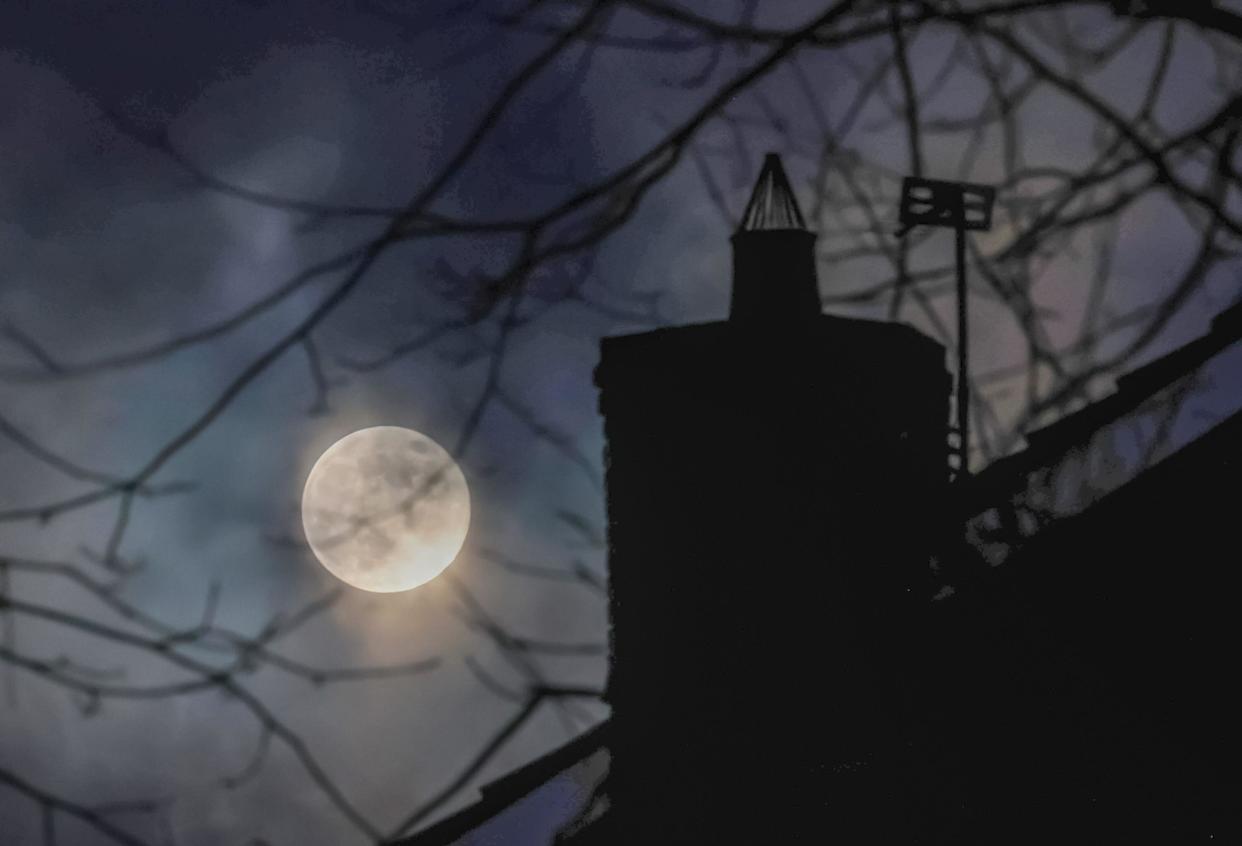
Last month’s wolf moon rises over Co Down, Northern Ireland.
(CAZIMB)
As we reach the end of January, February’s first full moon is set to rise, with the “snow moon” marking the last full moon of meteorological winter.
The next moon to follow is the “worm moon”, named because thawing soil means that worms are set to emerge again.
Full moons are when the moon appears as a perfect circle in the sky, with the full side of the moon that faces the Earth lit up by the sun.
When can you see the snow moon in the UK?
The full moon peaks at 10.09pm UK time on Sunday 1 February.
The snow moon will appear full early on Sunday morning, rising low in the west, according to Sky at Night.
The moon will rise in the east just after sunset, with Regulus, the brightest star in Leo, visible just below.
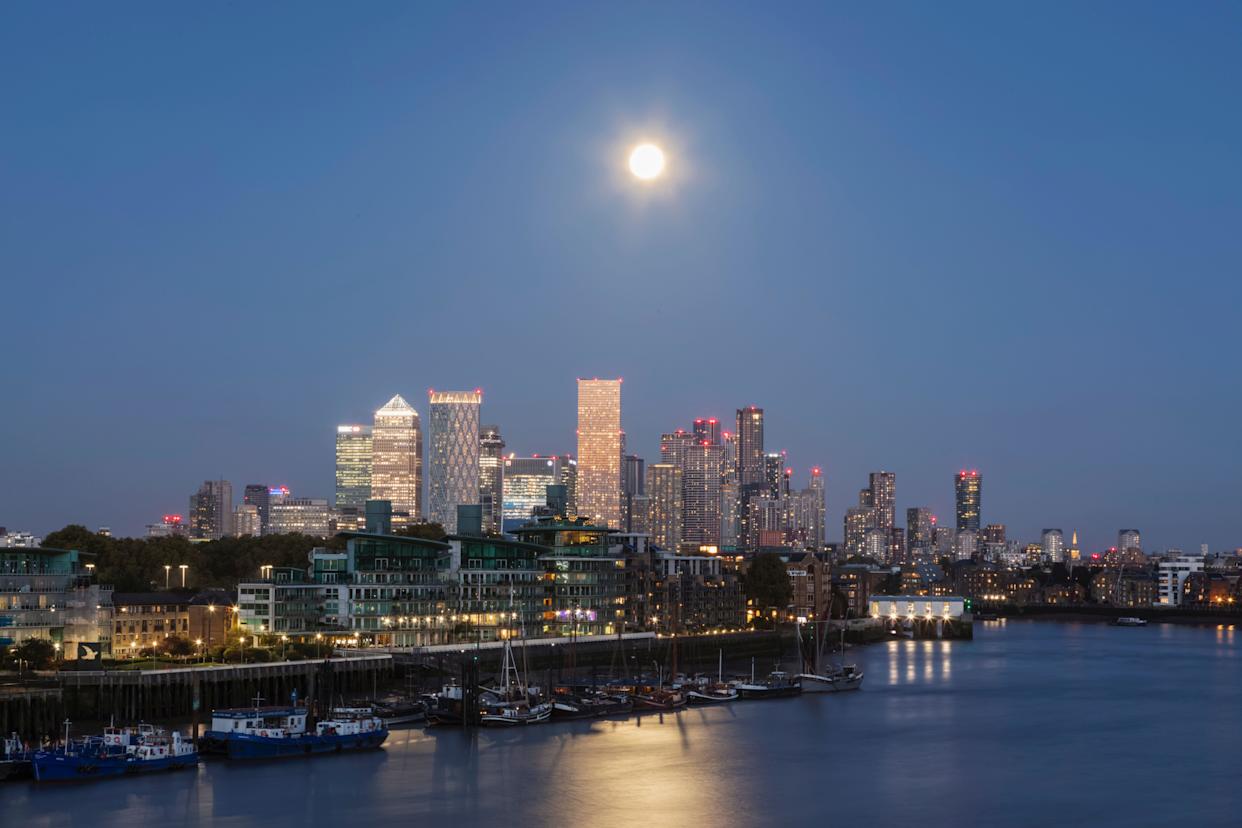
Full moon over Docklands and Canary Wharf skyline in London.
(Steve Vidler)What is a snow moon?
Terms such as “snow moon” have become more popular in recent years, but it’s simply a term for February’s full moon.
It’s also sometimes known as the hunger moon, due to its position in the depths of winter.
The names that are commonly used for full moons today (such as cold moon, wolf moon and harvest moon) come to us indirectly from Native American traditions.
NASA’s Gordon Johnston wrote: “In the 1930s, the Maine Farmer’s Almanac began publishing [Native American] names for the full moons, tying these names to the European months.”
The term snow moon comes from the traditional name for February’s full moon.
Johnston wrote: “As the midwinter Moon or the second full Moon of Winter, the Native American tribes of what is now the northern and eastern United States called this the Snow Moon or the Hunger Moon.
“It was known as the Snow Moon because of the heavy snows that fall in this season (NOAA long-term monthly averages for the Washington, D.C. area show January and February nearly tied as the snowiest months of the year). Bad weather and heavy snows made hunting difficult, so this Moon was also called the Hunger Moon.”
What is a full moon?
Full moons happen when the sun and moon are on opposite sides of Earth, with the sun lighting up the moon.
The moon produces no visible light of its own, so we can only see the parts of the moon that are lit up by other objects.
There is a full moon every 29.5 days, roughly once a month (in fact, the word “month” comes from the word “moon”).
Because our months don’t correspond exactly to the cycle of the moon, there are sometimes two full moons within a month (with the second known as a “blue moon”).
When is the next full moon?
The next full moon is the worm noon on Tuesday 3 March at 11.38am – days after the end of meteorological winter on the last day of February.