
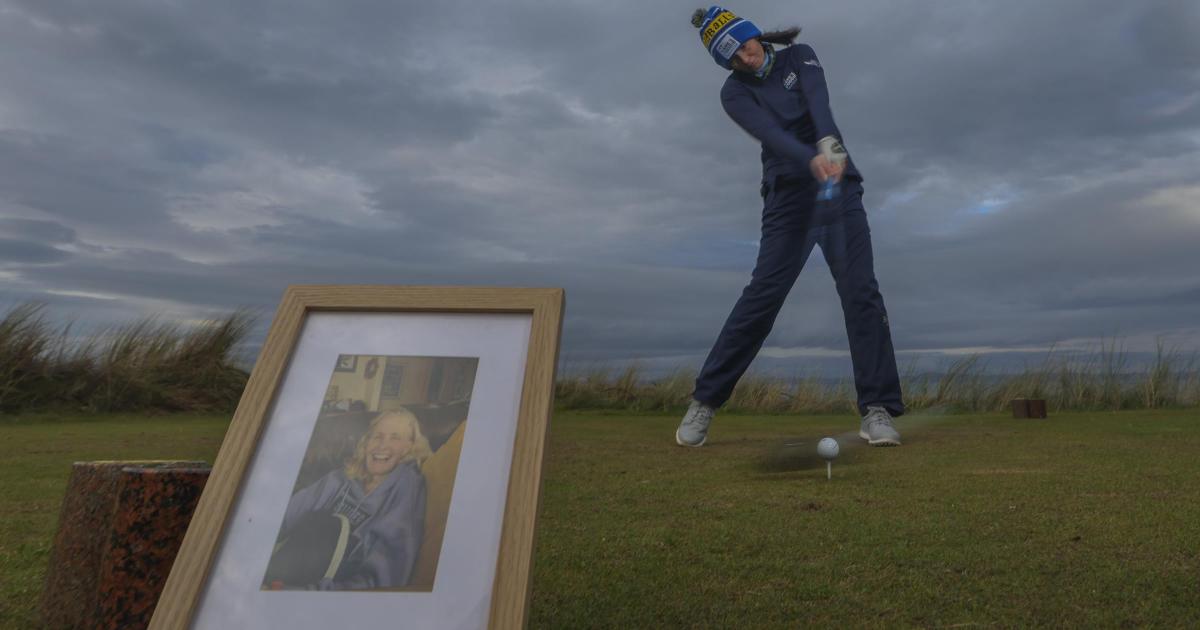
Tara Carrick beside an image of mum Claire, who lost her life to MND last year (Image: Contributed)
Tara Carrick, 30, lost her mum Claire Mactaggart to the terminal illness and is now urging the public to take part in broader efforts to improve care and research for MND.
She has described the final stages of her mother’s illness as “the worst experience of my life”.
Tara said: “You’re no longer just a daughter, or a husband – you’re a carer.
“The way your relationship changes is one of the hardest parts to get your head around.”
Tara, who competes on the LET Access Tour, is now an ambassador for My Name’5 Doddie Foundation, the charity founded by the late Scotland rugby international and MND campaigner Doddie Weir.
She is supporting the organisation’s annual Doddie Aid fundraising challenge, which encourages people to take part in physical activity to raise money for MND research and care.
Tara Carrick, an ambassador for My Name’5 Doddie Foundation, at the Renaissance Club (Image: Name’5 Doddie)
MND is a life-limiting illness that affects the brain and nerves, leading to progressive muscle weakness. The average life expectancy is 18 months from diagnosis and there is currently no cure and very limited treatment.
The first signs of Claire’s illness appeared in January 2024, when she developed slurred speech; Tara initially assumed her mother had had a stroke but she was diagnosed with MND on July 1 that year.
Tara, who turned professional in 2021, was competing in Sweden at the time; her family – dad Stuart and older sister Gina – waited until she returned home to tell her.
Tara said: “That’s what Doddie had. I knew instantly it was a death sentence.
“You never think it will happen to you – and then, boom, life will never be the same again.”
Tara cried in front of her mum only once, early on, and said that Claire’s response changed how they coped.
Tara said: “She told me: ‘I only get upset because you get upset. Life doesn’t end with my diagnosis and let’s not allow it to take more than it already has’
“From then, we were joyful and happy. That’s how mum wanted to live. The switch flicked.”
Tara described her mum as “the truest heart”, someone who “never complained about anything” – even as the illness took hold.
Claire had been a riding instructor before spending 30 years as an additional support needs assistant, working one-to-one with autistic children.
“There’s a tragic irony in it,” Tara said. “She taught people how to speak and communicate – and then she lost her own voice.”
Claire was also central to Tara’s golf career, alongside dad Stuart, a bloodstock agent in the horseracing industry, with both parents taking her to junior competitions and practice, and then travelling to tournaments and supporting her.
Pro golfer Tara Carrick and her mum, Claire, on the European tour (Image: Contributed)
“She came to all my tournaments,” Tara said. “She was always there. She was the chief of snacks, juice – everything.”
After the diagnosis, Tara wanted to stop competing to focus on her mum’s care, but Claire pushed her to keep playing for as long as possible so they could continue sharing trips and time together.
“By me continuing to live my dreams, she could live hers,” Tara said.
“Everybody called her Queen Claire. She felt like a queen, because she was a queen.
“It makes me really happy that she was able to find joy in continuing to travel with me.”
Tara Carrick and her mum, Claire, on Tara’s wedding day (Image: Contributed)
As the disease progressed, Tara said it took “one thing after another” from her mum – speech, swallowing, then the move to soft foods, a feeding tube, the loss of hand movement and mounting exhaustion.
“She was strong, bold, no [nonsense] from anybody,” she said. “And this disease took everything. It makes somebody unrecognisable.”
Tara said that caring for her mother revealed gaps in the health system’s preparedness for MND patients, particularly during medical emergencies.
Describing an experience when her mum developed pneumonia last June, Tara said: “We sat in an ambulance outside for two and a half hours, then 10 hours we were in A&E with somebody who has a terminal disease.
“That’s what makes it so much more traumatic.
“It’s bad enough knowing there’s no cure. Knowing the care, knowledge and understanding of MND isn’t there for everybody makes it worse.
“It isn’t good enough.”
Claire Mactaggart in hospital with her husband Stuart (Image: Name’5 Doddie)
Tara said that while research and the search for treatments remained the ultimate goal, families also needed specialist support “along the road” – including clear pathways and spaces designed for people with MND so they were not repeatedly pushed through crisis care
“A cure has to be the ultimate aim, but it will take time to get there,” she said.
“In the meantime, there are other, equally important things. People with that diagnosis need to know there’s somewhere they can go.”
She praised the Margaret Kerr palliative care ward at Borders General Hospital for the support given during her mother’s final days.
Despite the trauma, Tara said that her mother managed to attend her wedding to her husband Angus on March 29 last year.
“For one day people forgot about MND,” Tara said.
Claire danced all night, even emerging following an outfit change wearing sparkly red trainers with her second dress of the day.
Tara said: “The joy in her face, she was beaming.
“I was the bride, but she stole the show.
“It’s my favourite day ever – such an honour – and I’ll never forget it.”
Tara Carrick and her mum, Claire, on Tara’s wedding day (Image: Name’5 Doddie)
Now, Tara said she was determined to help raise funds for both research and practical support.
“People like my mum can’t die for nothing,” she said.
“There has to be something positive and good from the suffering.
“If that’s raising money and awareness that takes us closer to a cure, or makes some difference, then that must be it.”
Tara is now encouraging people to sign up for Doddie Aid to help raise funds for research and family support.
Anyone can take part, as for five weeks from January 1, participants may choose an activity, such as walking, running, cycling or swimming – log their miles during the challenge period, and raise money to support research and care.
Tara added: “This disease doesn’t just happen to one person, it happens to whole families.
“People often ask me what they can do to help: the first thing is to sign up for Doddie Aid.
“It gives meaning to those we have lost and honours those who have fought this disease, and takes us closer to a future where no family has to go through what we did.”
To take part in Doddie Aid, sign up via myname5doddie.co.uk and search Doddie Aid, or visit doddieaid.com