
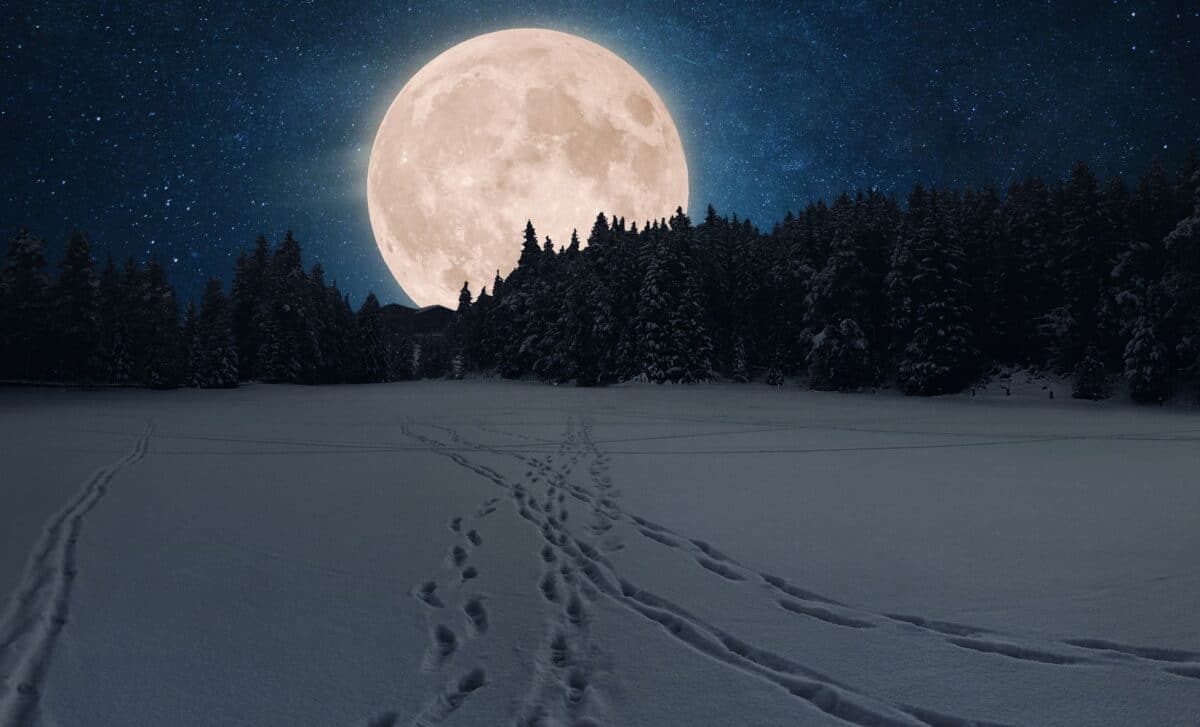
February’s night sky is setting up a quiet surprise. The full Snow Moon will climb at dusk, and it will not be alone. Just beneath its glow, the Beehive Cluster, a tight swarm of stars, will hover in the same patch of sky, close enough to make even casual stargazers pause.
But the real twist comes a little later. On February 2, in parts of North America, Regulus, Leo’s brightest star, may suddenly seem to blink out as it slips behind the nearly full Moon in a rare lunar occultation. According to media reports, this particular Moon and Regulus hide-and-seek will not return until the late 2030s.
A Moonrise Beneath the Beehive Cluster
The full Moon will reach peak phase at 5:09 p.m. EST on February 1. As dusk falls, it will rise just below the Beehive Cluster, one of the closest and most visually impressive open clusters in the night sky. Live Science, the cluster lies between Pollux, in the constellation Gemini, and Regulus, the leading star in Leo.
Also known as Praesepe, the Beehive Cluster contains approximately 1,000 stars packed into a tight formation. Under dark skies, it’s visible to the naked eye and adds depth to an already striking lunar scene
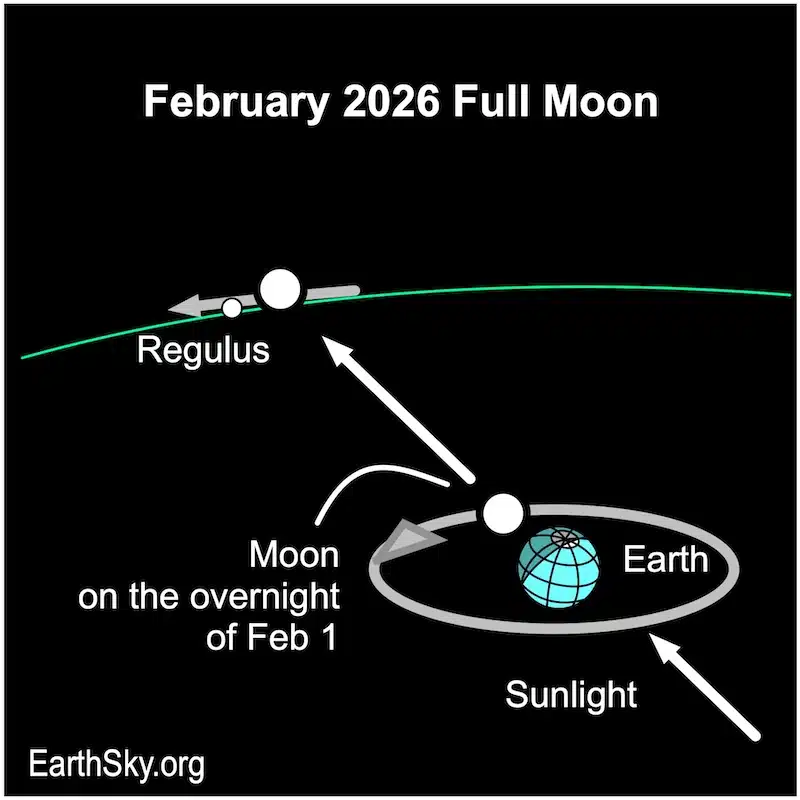 The Snow Moon will align with Regulus for a rare celestial event in February 2026. Credit: Earthsky.org
A Rare Disappearance Of Regulus
On February 2, observers across select regions of North America will have the chance to witness Regulus briefly vanish behind the night orb, a phenomenon known as a lunar occultation. This happens when the Moon’s orbit causes it to pass directly in front of a star from our viewpoint on Earth.
As noted by EarthSky.org, this type of event, especially involving a bright star like Regulus and a nearly full Moon, is rare and won’t occur again with this star until the late 2030s. For those in the viewing zone, the moment when the star disappears and later reappears will offer a subtle but unforgettable show.
How And When To See It
The event will begin rising in the eastern sky just after sunset on February 1, appearing especially round and luminous as it sits low on the horizon. According to EarthSky, the celestial companion will reach full phase at 22:09 UTC (4:09 p.m. CST), aligning closely with sunset for viewers in the central United States.
By midnight, the Earth’s satelitte will be high in the southern sky, then drift westward before sunrise on February 2. It will also appear nearly full the evening before and after its peak.
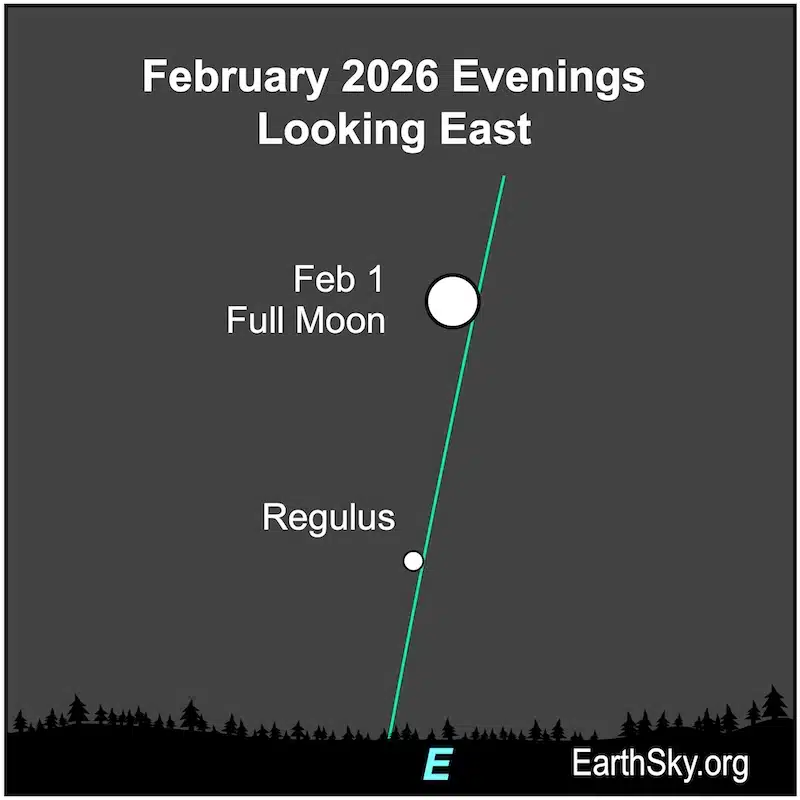 This image shows the position of the full moon just above Regulus during moonrise on February 1, 2026. Credit: Earthsky.org