
The Irish government is “impeding” local councils’ road safety plans, putting cyclists “in danger”, and hampering climate goals, a mayor has claimed, after swingeing cuts were made to active travel grants across Ireland.
In 2022, Ireland’s then-transport and climate minister, Green Party leader Eamon Ryan, launched the ‘Pathfinder’ active travel programme, which aimed to fund and deliver 35 walking, cycling, and public transport projects, ranging from cycle networks to bus electrification, 15-minute neighbourhoods, and workshops, through grants allocated by the National Transport Authority.
According to Ryan, the Pathfinder schemes would all be “innovative”, “ambitious” and “delivered at speed”, demonstrating a “real appetite for change across the country”.
However, the programme has come in for criticism this week, following claims that funding for selected projects had been cut to such an extent that they could not be carried out in full, or even started, potentially leading to lengthy delays.
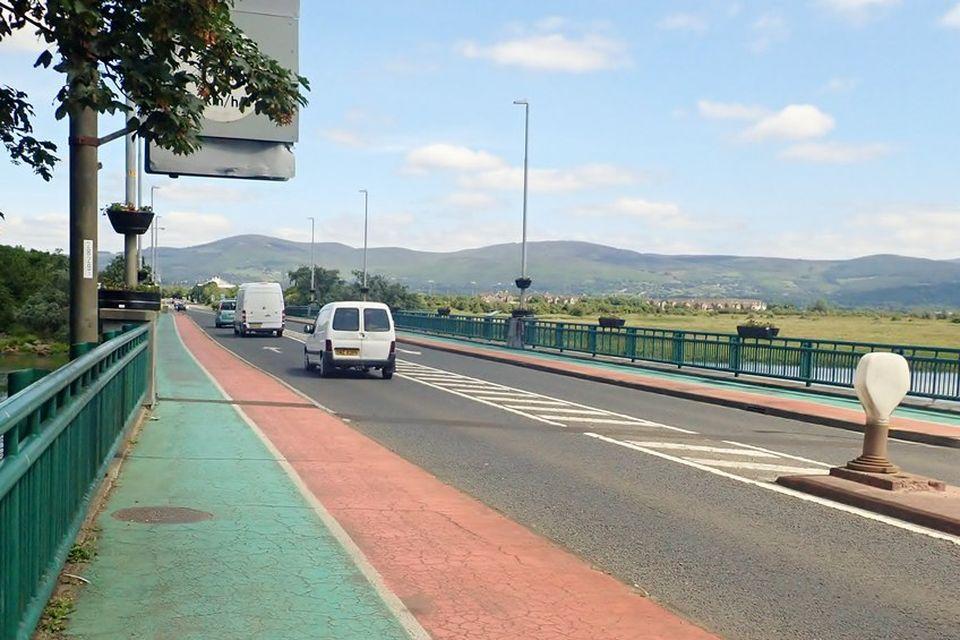 Inner Relief Road, Dundalk active travel plans (credit: Louth County Council)
One such project, on Dundalk’s Inner Relief Road, in Co Louth, received €800,000, far short of the amount required to install safe crossings and pavements on an urban road that was originally “built for speed” and designed to carry large volumes of traffic between Belfast and Dublin, before the advent of the adjacent M1.
“With the opening of the bike station, we see a lot more foot traffic crossing there,” Ciaran Fisher told Louth Country Council this week, asking if there was a timeline in place concerning the installation of a pedestrian crossing on the Inner Relief Road, the Irish Independent reports.
He described the junction as “very perilous to cross, even when the opportunity arises,” and appealed to the council to explore “making this junction safer”.
Meanwhile, another plan to install 2.8km of “high-quality” cycle lanes on the R132 Dublin Road was awarded just €2,500 from the Pathfinders programme.
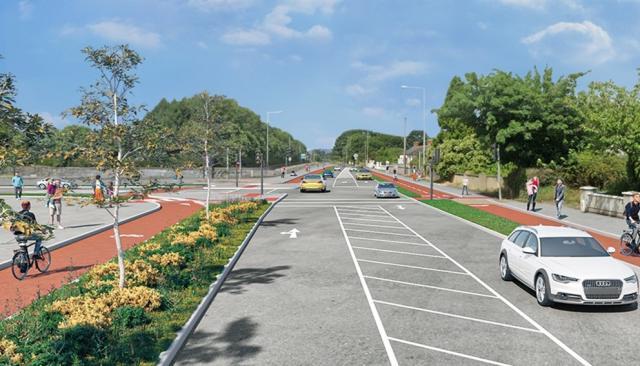 Dundalk active travel scheme plans (credit: Louth County Council)
“What in God’s name are we going to do with €2,500 for that whole stretch of road that has the benefit of planning permission?” asked Marianne Butler, who told the council that the funding cuts were “condemning us to traffic jams, poor safety, and huge driver frustration.”
20 miles further south, Drogheda’s mayor Michelle Hall also criticised the cuts to the town’s proposed active travel projects, arguing that the inability to create a connected cycle network was putting people travelling by bike in danger.
Speaking at a meeting of Louth Country Council, Hall questioned why Drogheda’s pathfinder scheme on the Dublin Road was only awarded €120,000, despite the plans for the project – which she says will cost €11 million in total – already being in place.
“What can we do with that? To me it looks like it is ready to go,” she said, before asserting that the schemes will only be successful if they link up with pre-existing bike lanes.
“Otherwise you are just putting people in danger. In Drogheda you are bringing them out onto the carriageway from the Dublin Road to go up to the train station without protected cycle lanes,” she said.
“This approach is not going to be successful, it is not going to get people out of their cars. I just don’t understand the rationale here, are we meant to reapply again for the rest of the funding needed, asking can we get the €11 million that we need now?”
Hall also asserted that the cuts were “impeding” the council’s road safety plans and preventing Louth from fulfilling both national and local climate action plans.
“Our highest increase in emissions in Ireland over the last decade has been in transport, because we are so car-centric. So, we have to reduce those emissions in order to meet targets set,” she said.
“We know the statistics on pedestrians and cyclists killed. But people want to cycle, even though they know they are taking their lives in their hands.
“I do it myself, I blindly get on the bike every time and just hope I get home safe and alive.”
David Jones, the director of Service at Louth County Council, also told the meeting that the total allocation for active travel projects in Louth had been reduced to €4.5million, and that these cuts had been applied across Ireland.
Jones added that the lower funding award would impact on the local authority’s ability to start work on a number of schemes.
In a statement, local campaign group Drogheda Cycling described the cuts as “disappointing” and called for clarity on how the reduced sums would be spent.
“We are asking the council to clarify how this reduction will impact the development of Active Travel improvements in Drogheda,” the group said.
“Significant funding has already been spent on planning these routes and many are now close to being ready for construction.
“The most cost-effective option would be to fund the construction of these routes immediately rather than continuing to delay them. Further delays will only increase costs due to inflation.”
The news of the ‘Pathfinder’ funding cuts comes in the same week it emerged that the Irish government is considering whether to make cycling without a helmet or hi-vis clothing a criminal offence, after appearing to add cyclists to an ongoing review of safety legislation concerning e-scooter users.
Earlier this month, Taoiseach Micheál Martin and Seán Canney, Ireland’s minister of state for road safety, announced that the government was planning an “aggressive” drive to tighten e-scooter laws, as well as improving enforcement of existing laws concerning speed and underage use, following a steep rise in collisions.
While there are no plans to introducing number plates or licences for e-scooter users, Martin and Canney, along with minister for transport Darragh O’Brien, said they will focus on making helmets and high-visibility clothing compulsory as part of the review.
It was understood initially that this review of safety legislation would only apply to e-scooters. However, last week in the Irish parliament, Canney appeared to indicate that cyclists and e-bike riders were also being considered as part of the plans, under the general umbrella of ‘micromobility’.