
Topline
The full snow moon — the second of 13 full moons in 2026 — will turn full on Sunday, Feb. 1, 2026. Named for the snow on the ground at this time of year in North America, this full moon will rise close to a spectacular star cluster and, one day after it’s full, occult a bright star as seen from North America — a very rare event that won’t be repeated until 2035.
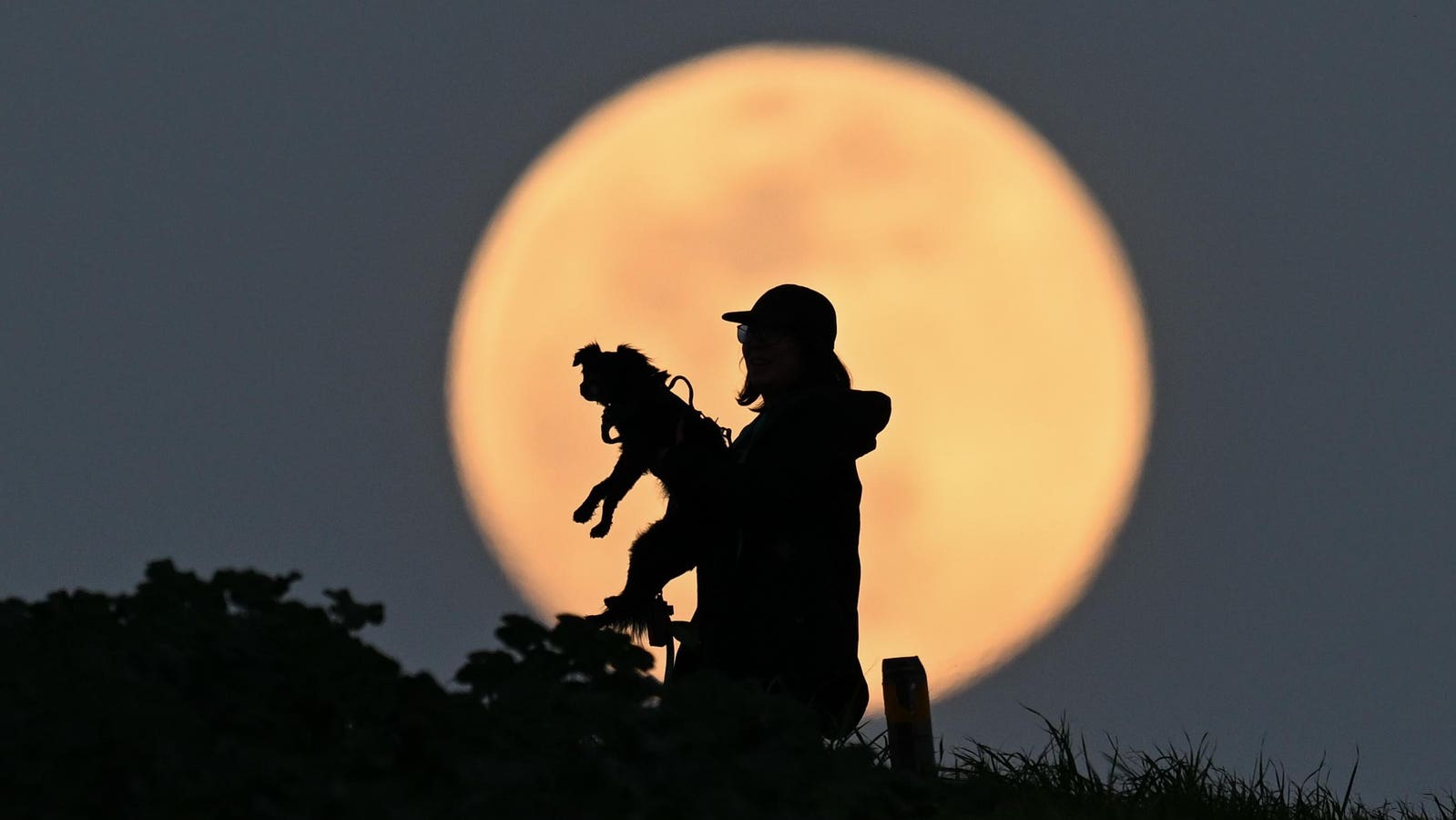
Full Moon named the ”Snow Moon” rises over San Francisco Bay at the Seal Point Park as a woman stands with her dog in San Mateo, California, United States on February 23, 2024. (Photo by Tayfun Coskun/Anadolu via Getty Images)
Anadolu via Getty ImagesKey Facts
The moon will be officially full at 5:09 p.m. EST on Sunday (Feb. 1) and will be best seen appearing in the east at the time of moonrise where you are. The moon will also appear bright and full on Feb. 2.
A full moon always looks its best when it first appears above the eastern horizon during dusk. The sight is at its most dramatic when the moon rises shortly after sunset during “blue hour,” when a full moon rising into fading daylight provides dramatic contrast. This month that happens in western North America.
According to Almanac, Native American names for February’s full moon include Bald Eagle Moon, Bear Moon and Raccoon Moon.
The day after the full moon, on Feb. 2, the moon will occult Regulus, the 21st brightest star in the night sky, as seen from parts of North America.
The new moon following the snow moon will bring an annular “ring of fire” solar eclipse. On Feb. 17, 96% of the sun will be covered by the moon for up to 2 minutes and 20 seconds. It will only be seen from remote regions of Antarctica.
Best Time To See The Full ‘snow Moon’ Rise
To see the full snow moon at its best, find an elevated location, an open field or an east-facing coastline with a clear view of the eastern horizon. To find the best time to see it appear from where you are, consult a moonrise calculator. Here are some sample times :
New York: sunrise at 7:06 a.m. EST, moonset at 6:52 a.m. EST/sunset at 5:23 p.m. EST, moonrise at 5:26 p.m. EST on Sunday, Feb. 1.Los Angeles: sunrise at 6:50 a.m. EST, moonset at 7:08 a.m. EST/sunset at 5:13 p.m. EST, moonrise at 5:04 p.m. EST on Sunday, Feb. 1. When To See The ‘snow Moon’ Occult Regulus
Just a day after the full wolf supermoon, the near-full moon will occult Regulus for about an hour, as seen from the eastern half of North America. According to In-The-Sky.org, between 8:40 and 10:05 p.m. is when it will happen, though specific times differ by location. In New York City, Regulus will disappear behind the bright limb of the near-full moon at 8:51 p.m. and remerge at 9:54 p.m. EST.
The Next Full Moon Is A Total Lunar Eclipse ‘blood Moon’
The snow moon is the second of 13 full moons in 2025. A solar year is 365.24 days, while a lunar year is around 354.37 days, so sometimes there are 13 full moons in one calendar (solar) year. The 13 full moons in 2026 include a “blood moon” total lunar eclipse in March, a “blue moon” in May and supermoons in November and December, the latter on Christmas Eve.
The next full moon — the worm moon — arrives on Mar. 3, the year’s only total lunar “blood moon” eclipse, with totality lasting 58 minutes. The best views will be from western North America, Australia, New Zealand, East Asia and the Pacific. It will be the last total lunar eclipse until 2029.
Further Reading
Here’s The Date For Chinese New Year 2026 — And What Animal You Are